Facts
The applicants, father and son, sought quashing under Section 482 of the Code of Criminal Procedure, 1973 (“CrPC”) of Criminal Case No. 663 of 2012 pending before the Metropolitan Magistrate, Court No. 36, Ahmedabad, arising from proceedings under Section 138 of the Negotiable Instruments Act, 1881 (“NI Act”).
Source reference: p.1, para. 1The applicants alleged that, while arranging funds for the son’s proposed studies in Australia, they obtained approximately ₹6 lakh through the respondent’s wife, agreed to pay interest and charges, and issued blank cheques as security.
Source reference: p.2, para. 2Although the amount was allegedly placed in a fixed deposit and subsequently withdrawn by the respondent’s wife, the applicants claimed that the amount was later returned and that they failed to recover the cheques.
Source reference: p.2, para. 2The respondent’s wife, in whose favour the cheque was issued, died before the statutory legal notice under the NI Act was issued.
Source reference: pp.3–4, paras. 2.1–3Thereafter, the respondent-husband issued the notice and instituted the criminal complaint, claiming entitlement as the deceased’s legal heir under a Will.
Source reference: pp.3–4, paras. 2.1–3It was conceded that no succession certificate or letter of administration had been obtained or placed on record.
Source reference: pp.3–4, paras. 2.1–3Issues
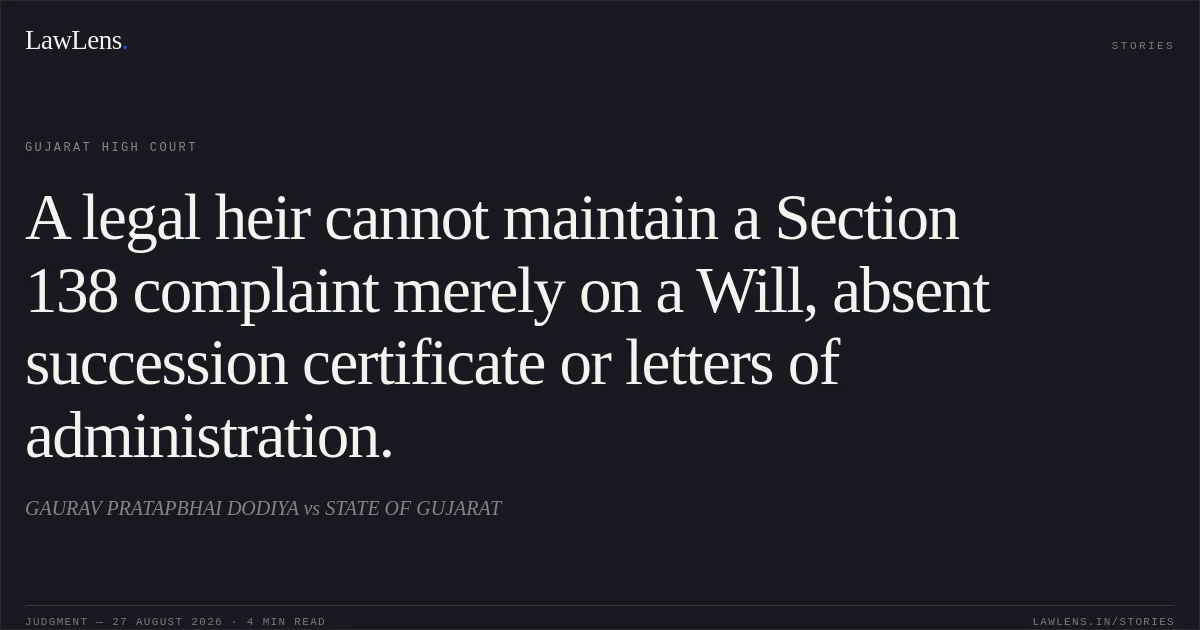
Whether the respondent-husband, claiming rights under a Will as the legal heir of the deceased payee, could institute proceedings under Section 138 of the NI Act without a succession certificate or letter of administration?
Source reference: pp.3–5, paras. 2.1–3.1Whether the criminal complaint and consequential proceedings were liable to be quashed under Section 482 CrPC on the ground that they were barred by law and fell within the categories identified in State of Haryana v. Bhajan Lal?
Source reference: pp.5–7, paras. 4.1–4.3; p.12, para. 6Law Applied
The Court applied Section 482 CrPC, which preserves the High Court’s inherent jurisdiction to prevent abuse of process and secure the ends of justice.
Source reference: pp.5–7, paras. 4.1–4.2It relied on State of Haryana v. Bhajan Lal, AIR 1992 SC 604, particularly the category permitting quashing where an express legal bar prevents institution or continuation of criminal proceedings.
Source reference: pp.5–7, para. 4.1Under Sections 7 and 9 of the NI Act, a “payee” or “holder in due course” must possess the legally recognised status contemplated by the statute; mere possession as an heir or legatee does not automatically make such person a holder in due course.
Source reference: no citationThe Court adopted the principle that a legal heir or legatee of a deceased payee does not acquire the status of a holder in due course merely by inheritance, particularly in the absence of possession for consideration.
Source reference: pp.8–9, paras. 5–5.1The Court distinguished U. Ponnappa Moothan Sons, Palghat v. Catholic Syrian Bank Ltd., (1991) 1 SCC 113, TRL Krosaki Refractories Ltd. v. SMS Asia Pvt. Ltd., (2022) 7 SCC 612, A.C. Narayanan v. State of Maharashtra, (2014) 11 SCC 790, and Yogeshkumar Keshavlal Kamdar v. Jamnadas Bhagwandas Vakharia, 2022 (0) AIJEL-HC 243886, as inapplicable to the facts.
Source reference: pp.10–12, paras. 5.2–5.5Reasoning
The Court found that the cheque was admittedly issued in favour of the respondent’s deceased wife and that she had died before issuance of the statutory notice and filing of the complaint.
Source reference: pp.7–10, paras. 4.3–5.1The respondent was therefore not the original payee.
Source reference: no citationAlthough he claimed entitlement under a Will, the Court held that succession by itself did not confer the statutory status of “holder in due course”; such status requires more than mere possession as an heir or legatee and cannot be established solely through inheritance.
Source reference: pp.8–9, para. 5In the absence of a succession certificate or letter of administration, the respondent could not maintain a complaint under Section 138 of the NI Act in his own capacity.
Source reference: no citationThe Court consequently treated the defect as an express legal bar to continuation of the criminal proceedings, bringing the case within category (6) of Bhajan Lal.
Source reference: p.12, para. 6The respondent’s reliance on authorities concerning presumptions in favour of holders, power-of-attorney complaints, authorization, or substitution of legal heirs after cognizance was rejected because those decisions did not address a complaint initiated after the death of the original payee by a person lacking the requisite statutory status.
Source reference: pp.10–12, paras. 5.2–5.5Holding
The Court held that the respondent-husband, relying only on his status as the deceased payee’s heir and on a Will, could not be treated as a “holder in due course” for purposes of instituting proceedings under Section 138 of the NI Act without the requisite legal authority.
The application was allowed, and Criminal Case No. 663 of 2012 and all consequential proceedings were quashed qua the applicants under Section 482 CrPC; the Rule was made absolute.
Source reference: p.12, para. 7The Court clarified that the quashing would not affect any civil remedy available to the respondent, which could be pursued and decided on its merits in accordance with law.
Source reference: p.13, para. 7.1Acts & Sections Cited
8 provisions across 2 statutes referred to in this judgment. Each provision opens on LawLens.
Code of Criminal Procedure, 19734
Negotiable Instruments Act, 18814
Original Court PDF
GAURAV PRATAPBHAI DODIYAvsSTATE OF GUJARAT
Click to open original judgment
Original judgment, available to read, download and summarize on LawLens.in
![Courts will not interfere with transfers absent mala fides or violation of statutory rules.. M Ramya vs EMPLOYEES STATE INSURANCE CORPORATION (ESIC). CAT - ['Chennai']. LawLens](/stories/thumbnails/courts-will-not-interfere-with-transfers-absent-mala-fides-or-violation-of-statutory-rules-a6845e9ca6f548fca284c51c8351957f.webp)
![Courts cannot direct one-time recruitment age relaxation absent authority in the governing rules or advertisement.. UT OF PUDUCHERRY vs M ANDAL. CAT - ['Chennai']. LawLens](/stories/thumbnails/courts-cannot-direct-one-time-recruitment-age-relaxation-absent-authority-in-the-governing-895d78fde47143e2a8ed0207c4b6a44f.webp)
![A review cannot correct an allegedly erroneous decision absent an error apparent on the record.. Ajit Kumar Jha vs RAILWAY BOARD. CAT - ['Delhi']. LawLens](/stories/thumbnails/a-review-cannot-correct-an-allegedly-erroneous-decision-absent-an-error-apparent-on-the-re-8ac952fd4eba470c92f7da20af72a220.webp)