01Facts
Kumar claimed that he was employed as a lorry driver and was injured when a train struck the lorry he was driving across a level crossing. He sustained fractures to both femurs and sought compensation under the Workmen’s Compensation Act, 1923.
¶ 3–5The Commissioner found a 79% loss of earning capacity and awarded ₹3,82,347 with interest. The insurer appealed, challenging both the assessment of earning capacity and its liability, including on the ground that Kumar did not hold a heavy-goods-vehicle licence at the time of the accident.
¶ 7–802Issues
i.1. Whether the Commissioner was justified in assessing loss of earning capacity at 79% despite medical evidence of 26% whole-body disability
¶ 7ii.2. Whether the insurer could avoid liability under Section 149 of the Motor Vehicles Act, 1988, because the driver allegedly lacked a valid licence and the policy conditions and statutory requirements were breached
¶ 703Law Applied
The appeal was brought under Section 30(1) of the Workmen’s Compensation Act, 1923.
p. 2The Court applied the principle that proceedings under the Workmen’s Compensation Act and the Motor Vehicles Act involve different procedures and methodologies; consequently, statutory defences under the Motor Vehicles Act are not automatically available in a claim under the Workmen’s Compensation Act merely because the policy is a motor-vehicle accident policy.
¶ 12The Court also considered Sections 3, 5 and 149 of the Motor Vehicles Act, which were relied on by the insurer in its licensing and policy-defence arguments.
¶ 7, 12Provisions in the judgment · 3 · Linked ones open on LawLens
Motor Vehicles Act, 1988 Section 149Section 3Section 5
04Reasoning
On the first issue, the Commissioner had considered the medical records and the doctor’s evidence concerning fractures to both femurs, including the evidence that the right femur fracture had become infected and required further treatment. The Court held that the Commissioner had a material basis for finding that the disability affected Kumar’s driving occupation and assessed his loss of earning capacity at 79%; the challenge therefore did not raise a substantial question of law.
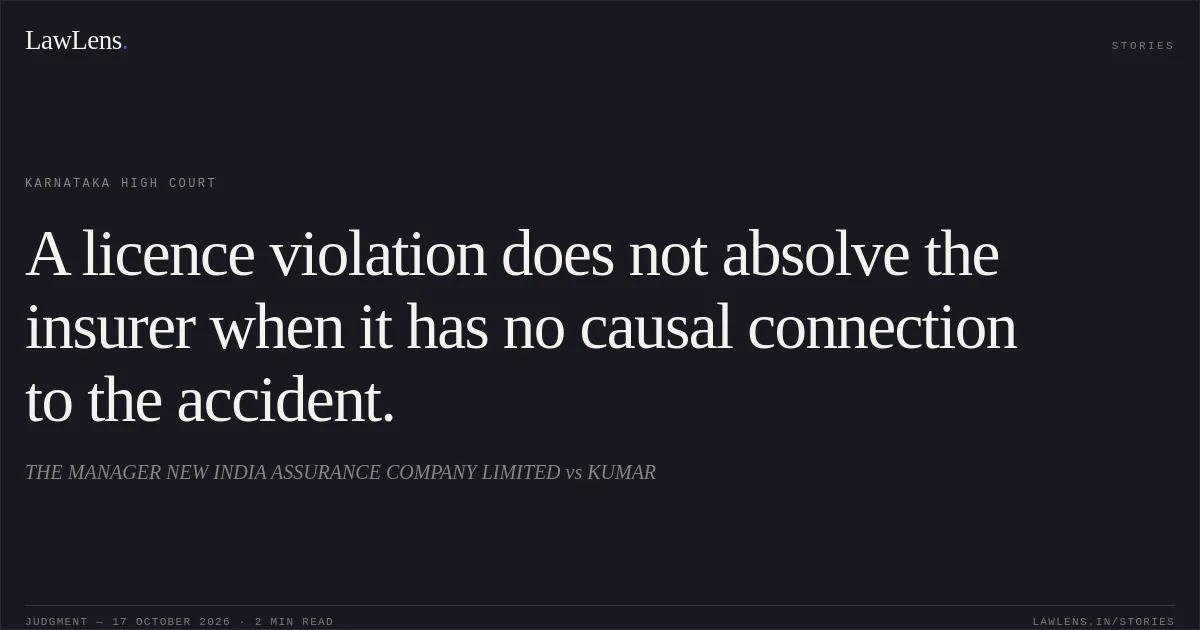
¶ 11On the second issue, although the licence extract showed that Kumar obtained a learner’s licence for a heavy-goods vehicle after the accident, the accident occurred when a train struck the lorry at an unmanned level crossing. In those circumstances, the possession or absence of a driving licence was irrelevant to the cause of the accident, and the insurer’s statutory-defence argument did not raise a substantial question of law.
¶ 12–1305Holding
The Court held that neither proposed issue gave rise to a substantial question of law and dismissed the appeal.
¶ 14Any amount deposited before the Court was ordered to be transmitted to the jurisdictional court for disbursement.
¶ 14Original Court PDF
THE MANAGER NEW INDIA ASSURANCE COMPANY LIMITEDvsKUMAR
Click to open original judgment
Original judgment, available to read, download and summarize on LawLens.in