01Facts
Arunachala Chetty executed a Will dated 10 November 1953 bequeathing his self-acquired properties, including the suit property measuring 2 acres 50 cents in Survey No.368/7, to his wife Unnamalaiammal for her lifetime without power of alienation, with a vested remainder in favour of his son Veerappa for absolute enjoyment.
¶ 3, 15–16In 1975, Unnamalaiammal and Veerappa jointly executed a gift-settlement deed in favour of Ganga, Veerappa’s alleged second wife. Ganga subsequently sold the property to Subburu in 1996.
¶ 3.1, 4–5The plaintiffs, claiming through Veerappa, challenged the settlement and sale deeds and sought declaration of title and permanent injunction, asserting that the settlement was contrary to the Will and that they were in possession.
¶ 3.1The Trial Court upheld the settlement deed and dismissed the suit.
¶ 8The First Appellate Court reversed that decision, holding that the settlement contravened the Will and that Ganga’s marriage with Veerappa was not established.
¶ 9Ganga and Subburu preferred the second appeal.
¶ 102Issues
i.Whether Unnamalaiammal acquired absolute ownership under Section 14(1) of the Hindu Succession Act, 1956, and consequently had authority to execute the settlement deed.
¶ 10(a), 15–16ii.Whether the marriage between Ganga and Veerappa was proved on the evidence, including the marriage invitation, settlement deed, birth certificates and revenue records.
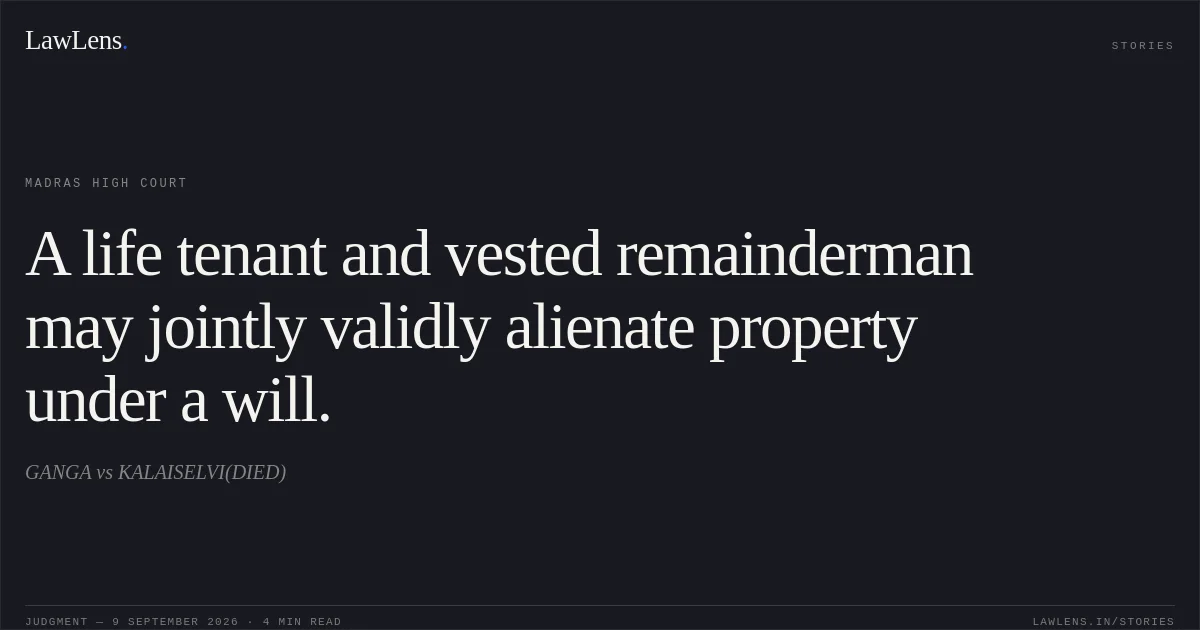
¶ 10(b), 23iii.Whether the settlement deed executed jointly by the life-estate holder and the vested remainderman was valid, and whether the subsequent sale deed in favour of Subburu conveyed valid title.
¶ 21–2503Law Applied
The Court applied Sections 14(1) and 14(2) of the Hindu Succession Act, 1956: a limited estate possessed by a Hindu woman may enlarge into an absolute estate under Section 14(1), but Section 14(2) applies where the limited interest is created for the first time under a testamentary or other instrument and is not intended as maintenance.
¶ 16The Court relied on C.N. Arunachala Mudaliar v. C.A. Muruganatha Mudaliar, AIR 1953 SC 495, for the principle that the nature of property received under a gift or Will depends on the donor’s intention and surrounding circumstances.
¶ 19It also relied on M.P. Peria Karuppan Chettiar v. CIT, (1975) 3 SCC 439, for the principle that property bequeathed absolutely to a son in his individual capacity is his separate property, rather than joint-family property.
¶ 20The Court further applied the doctrine that a life-estate holder and vested remainderman may jointly alienate the property in the absence of competing interests, as well as Section 43 of the Transfer of Property Act, 1882, concerning feeding the grant by estoppel.
¶ 21Under Section 68 of the Indian Evidence Act, 1872, examination of an attesting witness was unnecessary where execution of the settlement deed had been admitted and the document had been acted upon.
¶ 18Provisions in the judgment · 3 · Linked ones open on LawLens
Code of Civil Procedure, 1908 Section 100
Hindu Succession Act, 1956 Section 14
Transfer of Property Act, 1882 Section 43
04Reasoning
The Court found that the suit property was Arunachala Chetty’s self-acquired property and that the Will was valid.
¶ 15Interpreting the Will through the “armchair rule,” it held that the dominant intention was to protect the property during Veerappa’s youth and ultimately vest it absolutely in Veerappa, not to provide Unnamalaiammal with maintenance; separate and abundant maintenance provisions had already been made for her.
¶ 16Accordingly, Section 14(2), rather than Section 14(1), governed Unnamalaiammal’s life interest, and the first substantial question concerning enlargement into absolute ownership did not arise in the manner framed.
¶ 16Nevertheless, the Court held that Veerappa was the vested remainderman and that, together with Unnamalaiammal, he could validly execute the settlement deed.
¶ 20–22Since the property became Veerappa’s separate property upon the termination of the life estate, the settlement was not inconsistent with the testator’s intention and was further supported by the doctrine of feeding the grant by estoppel.
¶ 20–22The Court also held that execution of the settlement deed was admitted by the plaintiffs, the document had been acted upon, and revenue records and other evidence showed Ganga’s possession and enjoyment.
¶ 17–18, 23Ganga’s marriage with Veerappa was held proved through the marriage invitation, recitals in the settlement deed, birth certificates of their children, patta records, cultivation records and tax receipts, although the Court observed that the validity of the marriage was a separate question.
¶ 23As the settlement deed was valid, Ganga was competent to execute the subsequent sale deed in favour of Subburu.
¶ 25The revenue records and the plaintiff’s admission established Subburu’s possession, making the suit as framed unsustainable.
¶ 2505Holding
The Court answered the second substantial question of law in favour of Ganga and held that her marriage with Veerappa was proved.
¶ 23It held that the settlement deed executed by Unnamalaiammal and Veerappa in Ganga’s favour was valid, and that the subsequent sale deed executed by Ganga in favour of Subburu was also valid.
¶ 24–25The second appeal was allowed; the First Appellate Court’s judgment and decree were set aside, and the Trial Court’s dismissal of the suit was restored.
¶ 26–27There was no order as to costs.
¶ 26–27Original Court PDF
GANGAvsKALAISELVI(DIED)
Click to open original judgment
Original judgment, available to read, download and summarize on LawLens.in