Facts
The appellant filed a commercial suit for recovery after pre-institution mediation under Section 12A of the Commercial Courts Act, 2015 ended as a non-starter.
Source reference: p. 1–3The suit, filed on 23 October 2021, claimed an outstanding balance arising from supplies made on credit.
Source reference: p. 1–3The plaint referred to payments made in November 2017 and June and September 2018, a ledger account, and a C-form issued under the Central Sales Tax Act, 1956.
Source reference: p. 1–3The respondents sought rejection of the plaint under Order VII Rule 11 CPC, including on limitation.
Source reference: p. 1–3The Commercial Court rejected the territorial-jurisdiction objection but held the suit time-barred, calculating limitation from the last invoice dated 31 January 2016 and its 15-day payment period.
Source reference: p. 1–3The appellant appealed.
Source reference: p. 1–3Issues
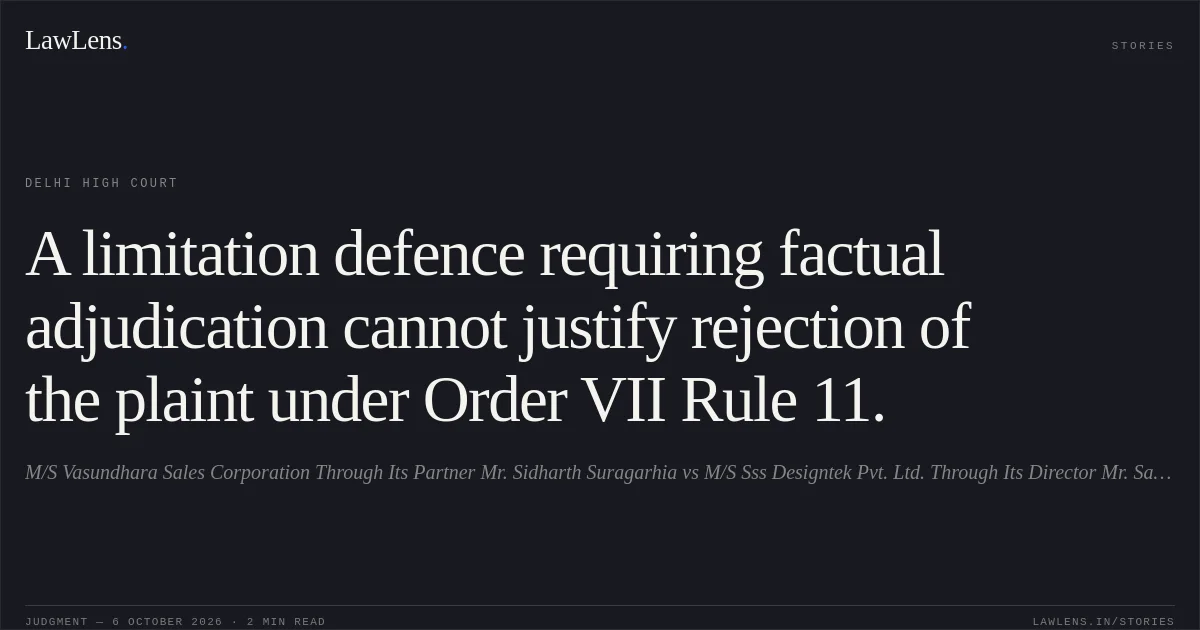
Whether the suit could be rejected as time-barred under Order VII Rule 11 CPC where deciding limitation required examination of the parties’ account, later payments, the C-form, and the COVID-19 limitation-extension orders.
Source reference: p. 2–5Whether the Commercial Court could assess the evidentiary effect of the C-form and the alleged acknowledgment of debt at the threshold stage.
Source reference: p. 5–6Law Applied
Under Order VII Rule 11 CPC, the court must consider the plaint’s averments as a whole, assume them to be true, and ordinarily disregard the defence; rejection is permissible only where the plaint itself establishes a ground under the rule.
Source reference: p. 3–6The judgment relied on P. Kumarakurubaran v. P. Narayanan & Ors., 2025 INSC 598, and Uma Devi & Ors. v. Anand Kumar & Ors., 2025 INSC 434, for the principle that limitation requiring appreciation of evidence is a mixed question of law and fact that cannot ordinarily be decided summarily.
Source reference: p. 3–6It also relied on Shakti Bhog Food Industries Ltd. v. Central Bank of India, (2020) 17 SCC 260, which states that limitation ordinarily presents a mixed question of fact and law.
Source reference: p. 3–6Section 18 of the Limitation Act, 1963 governs the effect of acknowledgment in writing.
Source reference: p. 3–6The Supreme Court’s orders in In Re: Cognizance for Extension of Limitation, Suo Motu Writ Petition (C) No. 3 of 2020, must also be factored into the limitation assessment.
Source reference: p. 3–6Reasoning
The plaint alleged a continuing account, payments after the last invoice, and the issuance of a C-form relating to transactions between the parties.
Source reference: p. 5–6Determining the nature of the account, the effect of the later payments, and whether the C-form could amount to an acknowledgment under Section 18 required consideration of evidence.
Source reference: p. 5–6The Court held that the Commercial Court exceeded the limited scope of Order VII Rule 11 by deciding those matters and by testing whether the pleaded acknowledgment was substantiated.
Source reference: p. 5–6The COVID-19 limitation-extension orders also had to be considered when limitation was determined.
Source reference: p. 5–6These matters were not appropriately resolved at the threshold stage.
Source reference: p. 5–6Holding
The Court allowed the appeal and set aside the Commercial Court’s order rejecting the suit as time-barred.
It did not determine that the claim was within limitation; the relevant issues, including the effect of the payments, C-form, account, and COVID-19 orders, remained for determination in the suit.
Source reference: p. 6Acts & Sections Cited
1 provisions across 1 statute referred to in this judgment. Each provision opens on LawLens.
Limitation Act, 19631
Original Court PDF
M/S Vasundhara Sales Corporation Through Its Partner Mr. Sidharth SuragarhiavsM/S Sss Designtek Pvt. Ltd. Through Its Director Mr. Sachin Handa & Anr.
Click to open original judgment
Original judgment, available to read, download and summarize on LawLens.in