01Facts
The petitioner awarded the respondent contracts for the supply and erection of pre-engineered buildings at its transformer manufacturing unit, initially for ₹12.50 crore and subsequently for additional works, taking the aggregate contract value to approximately ₹13.48 crore.
¶ 4–7The respondent claimed that the work was completed and handed over in January 2012, but the petitioner alleged substantial defects, including water leakages, delays and incomplete works.
¶ 8–12The respondent raised a final invoice for ₹1,23,75,000 on 12 March 2014. The petitioner disputed the respondent’s entitlement and, by letter dated 14 August 2014, alleged delay and defective performance and reserved its right to claim liquidated damages.
¶ 13, 30, 54–57The respondent invoked arbitration on 4 March 2017. An arbitral tribunal awarded the respondent ₹1,23,75,000 with 9% interest and costs.
¶ 14–16The petitioner challenged the award under Section 34 of the Arbitration and Conciliation Act, 1996, alleging limitation, denial of opportunity to present its case, expiry of the tribunal’s mandate, and absence of adequate reasons.
¶ 17–2502Issues
i.Whether the respondent’s claim and invocation of arbitration were barred by limitation, particularly when the work was allegedly completed in January 2012 and arbitration was invoked on 4 March 2017.
¶ 48–54ii.Whether the petitioner could raise the plea of limitation for the first time in proceedings under Section 34 when it had not filed a statement of defence or raised limitation before the arbitral tribunal.
¶ 52–53iii.Whether the petitioner was legally incapacitated or was otherwise unable to present its case within the meaning of Sections 34(2)(a)(i) and 34(2)(a)(iii), read with Section 18 of the Arbitration and Conciliation Act.
¶ 68–75iv.Whether the arbitral tribunal’s mandate had expired before pronouncement of the award, rendering the award invalid.
¶ 83–87v.Whether the award was liable to be set aside as a non-speaking, perverse or patently illegal award under Section 34.
¶ 24, 45–47, 8803Law Applied
Section 34 of the Arbitration and Conciliation Act permits interference with an arbitral award only on the limited statutory grounds specified therein; the court does not sit as an appellate court, reappreciate evidence or substitute a plausible arbitral view with its own.
¶ 46–47A limitation objection is ordinarily a mixed question of law and fact and must be raised before the arbitral tribunal at the first opportunity; failure to do so may amount to waiver and ordinarily precludes its introduction for the first time in Section 34 proceedings, applying International Breweries (P) Ltd. v. Kalpana International Breweries Ltd.
¶ 52–53Section 34(2)(a)(i) concerns legal incapacity affecting a party’s ability to enter into the arbitration agreement, such as minority or mental incapacity, and does not include internal managerial or administrative difficulties, following Delhi Jal Board v. Reliable Diesel Engg. (P) Ltd.
¶ 70–72Section 18 requires equal treatment and a full opportunity to present one’s case; Section 34(2)(a)(iii) applies only where the party was not given proper notice or was otherwise genuinely prevented from presenting its case.
¶ 73–75Under Section 25, the tribunal may proceed where a party fails to file its defence or repeatedly defaults despite notice and opportunity.
¶ 76–80The tribunal’s mandate under Section 29A may be extended by consent or by the competent court, and statutory exclusions recognised by the Supreme Court may also be taken into account.
¶ 83–87Provisions in the judgment · 7 · Linked ones open on LawLens
Arbitration and Conciliation Act, 1996 Section 11Section 18Section 23Section 25Section 34Section 37
Limitation Act, 1963 Section 18
04Reasoning
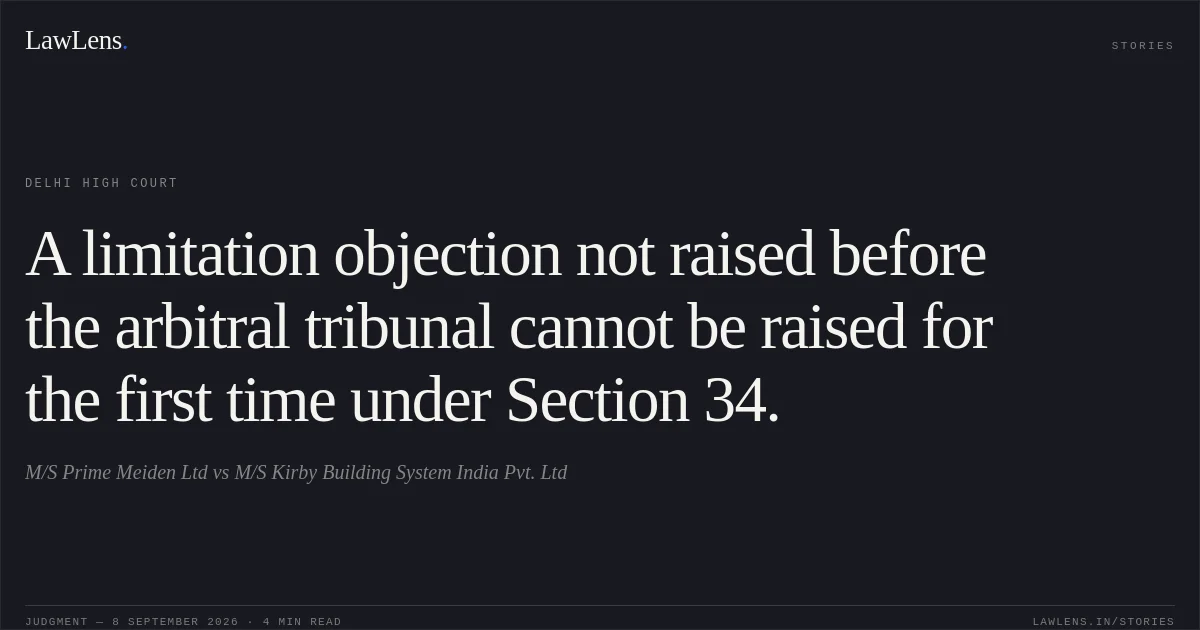
The Court held that the limitation challenge could not be raised for the first time under Section 34 because the petitioner had filed neither a statement of defence nor a limitation objection before the tribunal.
¶ 52–53In any event, the tribunal’s conclusion was considered plausible: the petitioner’s letter dated 14 August 2014 treated the contractual relationship as subsisting by referring to outstanding defects, rectification efforts and continuing disputes regarding the project.
¶ 54–64The tribunal therefore treated that communication as crystallising the dispute and found the 4 March 2017 invocation to be within three years.
¶ 54–64The Court declined to reappreciate the correspondence, minutes of meetings and evidence supporting that conclusion.
¶ 54–64The petitioner was also not legally “incapacitated”; internal management disputes did not affect its legal capacity to arbitrate.
¶ 68–72Nor was it denied a fair opportunity: it received repeated notices, was granted time to file its defence and counterclaim, appeared through different counsel on several occasions, and was warned that the proceedings would continue under Section 25.
¶ 76–82Its failure to file pleadings, pay its share of fees or secure proper authorisation was attributable to its own defaults, not to procedural unfairness by the tribunal.
¶ 76–82On the mandate issue, the Court found that the tribunal’s mandate was extended first with the respondent’s consent, then by the High Court, and was further protected by the Supreme Court’s orders extending or excluding limitation periods during the relevant period.
¶ 83–87The award was therefore not shown to be unreasoned, perverse or patently illegal within the narrow scope of Section 34.
¶ 88–8905Holding
The Delhi High Court dismissed the Section 34 petition, holding that the arbitral award did not suffer from limitation-related error, denial of natural justice, expiry of mandate, perversity or patent illegality.
¶ 88The award of ₹1,23,75,000, together with 9% interest and costs of ₹6,60,500 and ₹3,00,000, was left undisturbed.
¶ 16The petitioner’s bank guarantee furnished for the awarded amount was directed to be released in favour of the respondent within four weeks from pronouncement of the judgment.
¶ 89–90Original Court PDF
M/S Prime Meiden LtdvsM/S Kirby Building System India Pvt. Ltd
Click to open original judgment
Original judgment, available to read, download and summarize on LawLens.in