01Facts
The petitioner-plaintiff instituted a suit seeking declaration of sole ownership over the suit land, a declaration that the order dated 3 June 2000 passed by the Assistant Settlement Officer was null and ineffective against her, and permanent injunction.
¶ 3–4 · pp. 1–3The respondents-defendants disputed the claim and pleaded that the property was joint property, although it had been purchased by their father in the petitioner’s name.
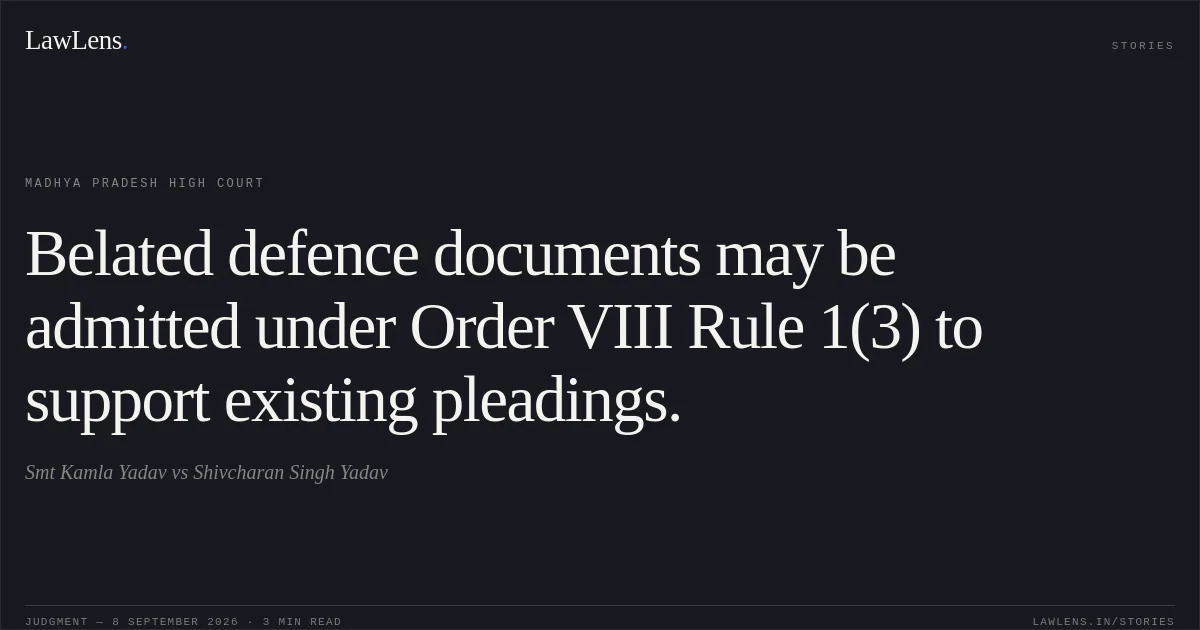
¶ 3–4 · pp. 1–3After closure of the plaintiff’s evidence and recording of her statement, respondents 1–3 applied under Order VIII Rule 1(3) read with Section 151 of the Code of Civil Procedure, 1908, seeking to place on record an agreement dated 24 September 2007.
¶ 3 · p. 1The Trial Court allowed the application by order dated 21 January 2026. The plaintiff challenged that order under Article 227 of the Constitution, contending that the agreement was unsupported by specific pleadings in the written statement and that its admission would cause prejudice.
¶ 2–3 · pp. 1–202Issues
i.1. Whether the Trial Court was justified in permitting the defendants to produce the agreement dated 24 September 2007 under Order VIII Rule 1(3) read with Section 151 CPC after closure of the plaintiff’s evidence?
¶ 2–7 · pp. 1–6ii.2. Whether the agreement could be received in evidence despite the plaintiff’s contention that there were no corresponding pleadings in the defendants’ written statement?
¶ 3–4, 7–8 · pp. 2–6iii.3. Whether the Trial Court’s order disclosed any palpable or jurisdictional error warranting interference under Article 227 of the Constitution?
¶ 9–10 · p. 703Law Applied
Order VIII Rule 1-A(1) CPC requires a defendant to produce and list documents relied upon in support of the defence along with the written statement; under Order VIII Rule 1-A(3), a document not so produced may nevertheless be received with the leave of the Court.
¶ 6 · pp. 4–5The discretion to grant such leave must be exercised judiciously, but courts should adopt a liberal approach where the document is relevant and its admission does not cause serious prejudice, since procedural rules are intended to advance substantial justice: Sugandhi (Dead) by LRs & Anr. v. P. Rajkumar, Civil Appeal No. 3427 of 2020, decided on 13 October 2020.
¶ 6 · pp. 4–5Order VI Rule 2 CPC requires pleading of material facts, not the evidence by which those facts are to be proved; the distinction between pleading and proof was reaffirmed with reliance on Marietta D’Silva v. Rudolf Clothan Lacerda & Others, SLP (C) No. 31012 of 2025, decided on 15 May 2026.
¶ 4, 7–8 · p. 3, 6The High Court’s supervisory jurisdiction under Article 227 is limited and is not to be exercised in the absence of a palpable or jurisdictional error.
¶ 9 · p. 7Provisions in the judgment · 1 · Linked ones open on LawLens
Code of Civil Procedure, 1908 Section 151
04Reasoning
The Court held that the defendants had already pleaded the material factual foundation of their defence: namely, that the suit property was jointly owned by the parties and had remained joint property despite being purchased in the plaintiff’s name.
¶ 4, 7 · p. 3, 6The agreement dated 24 September 2007 was therefore treated as evidence intended to substantiate that existing defence, rather than as an entirely new case requiring additional pleadings.
¶ 7–8 · pp. 6–7Applying Sugandhi, the Court found that Order VIII Rule 1-A(3) gives the Court a further opportunity to permit production of documents omitted at the written-statement stage, particularly where the document is relevant and no serious prejudice is demonstrated.
¶ 6–8 · pp. 4–7The plaintiff’s reliance on K. Gunasekaran v. R. Ranganathan was rejected because, on the facts, the defendants had pleaded the relevant defence. The Trial Court had consequently exercised its discretion properly, and no jurisdictional error or perversity was established.
¶ 3, 8–9 · pp. 2, 6–705Holding
The High Court dismissed the miscellaneous petition and upheld the Trial Court’s order dated 21 January 2026 permitting respondents 1–3 to place the agreement dated 24 September 2007 on record under Order VIII Rule 1(3) read with Section 151 CPC.
¶ 8–10 · p. 7It held that the document was relevant evidence supporting the defendants’ pleaded case of joint ownership, and that its admission did not warrant interference under Article 227 of the Constitution.
¶ 8–10 · p. 7Any pending interlocutory applications were also disposed of.
¶ 10–11 · p. 7Original Court PDF
Smt Kamla YadavvsShivcharan Singh Yadav
Click to open original judgment
Original judgment, available to read, download and summarize on LawLens.in