01Facts
The petitioners—a former Head Constable, Inspector of Police and Sub-Inspector of Police—were proceeded against departmentally for allegedly receiving illegal gratification of ₹1 crore to refrain from arresting Feroz Khan, an accused in a high-value economic offence.
pp. 4–5Charge memos were issued on 15 September 2015.
pp. 4–5Although an FIR had been registered earlier, the Vigilance and Anti-Corruption Department ultimately found insufficient material for criminal prosecution but recommended disciplinary proceedings before the Tribunal for Disciplinary Proceedings (“TDP”).
pp. 4–5The TDP, in TDP Case Nos. 11/2014, 30/2012 and 12/2014, found the charges proved on the basis, inter alia, of the evidence of PW5, the alleged bribe-giver, and PW13, a superior police officer.
pp. 5–6The disciplinary authority imposed the punishment of removal from service on 17 June 2020.
pp. 5–6The statutory appeals were rejected by the Government on 23 November 2021, 7 October 2021 and 1 October 2021, respectively.
pp. 5–6The petitioners invoked Article 226 of the Constitution, alleging bias on the part of the TDP Presiding Officer, denial of adequate opportunity to file written statements and examine defence witnesses, non-compliance with the applicable disciplinary rules, failure to consider the evidence and defence submissions, and absence of reasoned orders by the disciplinary and appellate authorities.
pp. 5–702Issues
i.Whether the departmental enquiry was vitiated by violation of natural justice or the applicable disciplinary rules, particularly on account of alleged bias, denial of opportunity and failure to permit examination of defence witnesses?
pp. 5–7ii.Whether the findings of the TDP and the disciplinary authority were unsupported by evidence or so perverse that they warranted interference under Article 226 of the Constitution?
pp. 8–14 · pp. 21–22iii.Whether the disciplinary and appellate authorities passed non-speaking orders by failing to adequately consider the petitioners’ defence and the requirements of Rule 6 of the Tamil Nadu Police Subordinate Service (Discipline and Appeal) Rules?
pp. 6–7 · pp. 14–20iv.Whether the punishment of removal from service was liable to be interfered with as disproportionate to the misconduct proved?
pp. 9–12 · p. 2303Law Applied
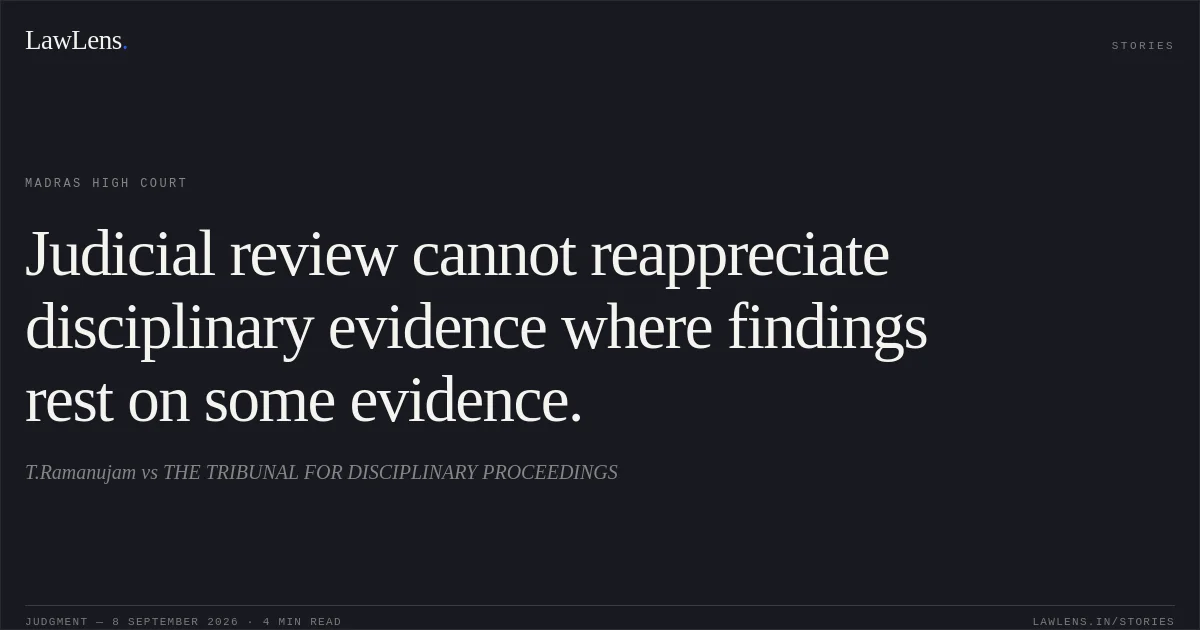
The Court applied the limited scope of judicial review under Article 226: judicial review examines the legality and fairness of the decision-making process, not the correctness of the factual conclusion as an appellate court.
pp. 8–10Under B.C. Chaturvedi v. Union of India, the Court may interfere where natural justice or statutory procedure is violated, the finding is based on no evidence, or no reasonable person could have reached it; ordinarily, it cannot reappreciate evidence or substitute its own penalty.
pp. 8–10The same principles were reaffirmed from Deputy General Manager (Appellate Authority) v. Ajai Kumar Srivastava, including interference in cases of perversity, patent error, mala fides or absence of evidence.
pp. 10–12The Court further applied the rule that departmental guilt is established on the preponderance of probabilities, not proof beyond reasonable doubt, as stated in Union of India v. Sardar Bahadur.
pp. 13–14 · pp. 21–22In relation to disciplinary and appellate orders, the Court relied on Narinder Mohan Arya v. United India Insurance Co. Ltd. and held that the appellate authority must demonstrate application of mind to the procedure, findings and proportionality of penalty under the applicable rules, although it need not answer every defence in elaborate detail.
pp. 17–20It also relied on Airports Authority of India v. Pradip Kumar Banerjee and Boloram Bordoloi v. Lakhimi Gaolia Bank for the principle that a disciplinary authority accepting an enquiry officer’s findings need not provide elaborate additional reasons.
p. 20Provisions in the judgment · 1
Tamil Nadu Civil Service (Discipline and Appeal) Rules Section 17
04Reasoning
The Court found that the TDP’s conclusion was supported by relevant material, particularly PW5’s evidence that ₹1 crore had been paid to secure non-arrest and PW13’s evidence regarding the petitioners’ delay and reluctance in arresting the accused.
pp. 12–14 · pp. 21–22The evidence, together with the surrounding circumstances, furnished at least a probable and reasonable basis for the finding of misconduct; disagreements about the credibility or sufficiency of that evidence merely suggested an alternative view and did not establish perversity.
pp. 12–14 · pp. 21–22Since departmental proceedings apply the preponderance-of-probabilities standard, the absence of proof sufficient for criminal prosecution did not invalidate the disciplinary finding.
pp. 13–14 · pp. 21–22The Court also rejected the objection that the TDP report was unreasoned, observing that its “Epilogue” discussed the material evidence and disclosed application of mind.
pp. 12–14The disciplinary authority’s acceptance of that report did not require a separate elaborate reasoning exercise.
pp. 12–14 · pp. 20–21The appellate orders, though concise, recorded the petitioners’ alleged roles, the gravity of the misconduct and the absence of material warranting interference; they therefore demonstrated sufficient consideration of the appeals under the applicable rules.
pp. 15–20No violation of natural justice, statutory procedure or demonstrable perversity was established.
pp. 21–23Given the allegation of receipt of a ₹1 crore bribe to obstruct the arrest of an accused, the Court found no basis to interfere with the punishment in judicial review.
pp. 12–14 · p. 2305Holding
The Court held that the departmental findings were based on relevant evidence and constituted a reasonable and probable view.
pp. 21–23The TDP proceedings, disciplinary order and appellate decisions were not shown to be contrary to natural justice, unsupported by evidence, perverse, or inadequately reasoned.
pp. 21–23The punishment of removal from service was therefore not liable to interference under Article 226.
pp. 21–23Accordingly, W.P. Nos. 3346, 3351 and 3360 of 2022 were dismissed, without costs, and the connected miscellaneous petitions were closed.
p. 23Original Court PDF
T.RamanujamvsTHE TRIBUNAL FOR DISCIPLINARY PROCEEDINGS
Click to open original judgment
Original judgment, available to read, download and summarize on LawLens.in