01Facts
The appeals concerned land in Survey Nos.621/3 and 628/8 at Thiruvengadampalayam Hamlet, Erode District, recorded in the revenue records as “Government Poromboke—Cart Track.” Certain villagers claimed that the land had been used as a burial and cremation ground, including by members of the Arunthathiyar community, for several decades, while adjoining landowners claimed that it was a public cart track necessary for access to their properties.
¶ 3, 5–7Three writ petitions were filed. One sought to prevent reclassification of the cart track as a burial ground; another sought recognition of portions of the land as a burial and burning ground and action against persons alleged to have disturbed graves; and the third sought enforcement of the statutory burial-ground rules and removal of a body allegedly buried in violation of a status quo order.
¶ 5–7The District Collector’s inspection report stated that the land had been used for burials for more than seventy years, although it had not been formally notified as a burial ground. It also recorded the existence of roads, vacant portions, alleged levelling of graves, and a Town Panchayat resolution seeking measurement and reclassification of the land.
¶ 8–9.3The learned Single Judge held that the land had historically been used as a burial and cremation ground and directed the authorities to fence and maintain it, prevent encroachment and garbage, act upon the Town Panchayat’s reclassification resolution, exclude the land from the “cart track” classification, and initiate action against those responsible for levelling the graves. The other writ petitions were dismissed.
¶ 10–1102Issues
i.1. Whether the existence, extent and legal effect of an alleged customary right to use land classified as a Government cart track as a burial ground could be conclusively determined in writ proceedings under Article 226 on the basis of an administrative inspection report.
¶ 15–19ii.2. Whether the learned Single Judge was justified in directing the revenue authorities to exclude the land from the “Government Poromboke—Cart Track” classification and proceed with its treatment as a burial ground.
¶ 20–21iii.3. Whether the parties’ competing claims concerning burial rights, access and the character of the land should instead be adjudicated by a competent civil court.
¶ 19, 23–2403Law Applied
The Court considered Sections 172 and 173 of the Tamil Nadu Urban Local Bodies Act, 1998, and Rules 388 and 388A of the Tamil Nadu Urban Local Bodies Rules, 2023, which regulate the registration, licensing and use of places for burial or burning.
¶ 10–11It also considered the statutory framework governing Special Grade Town Panchayats and the requirement that burial grounds be dealt with through the competent local and revenue authorities.
¶ 10–11The Court applied the settled principle that writ jurisdiction is ordinarily inappropriate for adjudicating seriously disputed questions of fact requiring oral and documentary evidence, cross-examination and determination of customary rights.
¶ 17–19The Court distinguished the administrative value of an inspection report from the evidentiary adjudication required in a civil suit.
¶ 17–19The Court also noted the constitutional concern regarding dignity in death under Article 21, as relied upon by the Single Judge, but held that such considerations could not justify a final determination of disputed title, custom, land character or access rights in writ proceedings.
¶ 10–11, 17–19Provisions in the judgment · 3
Tamil Nadu Panchayats Act, 1994 Section 172Section 172Section 173
04Reasoning
The Division Bench held that the central controversy was not merely the present physical use of the land but whether a legally enforceable customary right of burial existed, its antiquity and extent, and whether it prevailed against the recorded classification of the land as a public cart track and the adjoining owners’ asserted rights of access. These matters were disputed on the pleadings and depended upon evidence from witnesses, historical documents, resolutions and revenue records.
¶ 15–18The Collector’s report was relevant as evidence of the present condition of the land and the entries in official records, but it could not substitute for a civil trial or conclusively establish a customary right binding the State and third parties.
¶ 18Consequently, the Single Judge erred in moving from an administrative factual report to mandatory directions requiring reclassification of the land. Direction 67(iii), in particular, prejudiced the appellants’ asserted access rights and effectively decided an issue that belonged to the civil court.
¶ 19–21Since the land had already been fenced pursuant to the impugned order, the appellate court considered it appropriate to preserve the existing position temporarily rather than restore the earlier situation that had led to allegations of grave-levelling and further disputes.
¶ 22–2305Holding
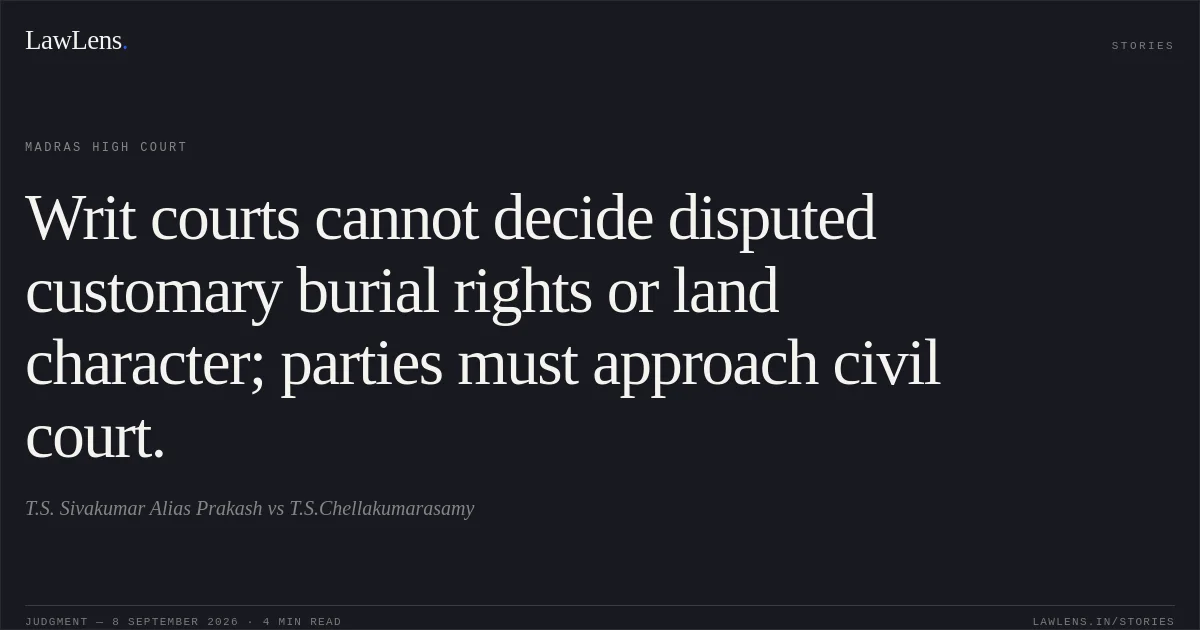
The writ appeals were formally dismissed, but the Division Bench directed that the four operative directions in paragraph 67(i)–(iv) of the Single Judge’s order should not be given further effect.
¶ 24(i)The parties were granted liberty to approach the competent civil court within eight weeks for appropriate relief, including declarations concerning the character of the land and the rights claimed over it.
¶ 24(ii)Until the civil court decides an application for interim relief under Order XXXIX Rules 1 and 2 of the Code of Civil Procedure, the parties must maintain the status quo as it existed on 07.09.2026, including the existing fencing and use of the land.
¶ 24(iii)The civil court was directed to decide any interim application independently and uninfluenced by the observations in either judgment.
¶ 24(iv)The District Collector was permitted to continue the measurement and enquiry pursuant to the Town Panchayat resolution dated 14.10.2025, but any final reclassification must abide by the outcome of the civil proceedings and cannot prejudice any party’s access claim without leave of the civil court.
¶ 24(v)Original Court PDF
T.S. Sivakumar Alias PrakashvsT.S.Chellakumarasamy
Click to open original judgment
Original judgment, available to read, download and summarize on LawLens.in