01Facts
The petitioner, Plaintiff No. 1 in O.S. No. 48/2010, challenged the Trial Court’s order dismissing three applications: to reopen the case and adduce further evidence under Section 151 CPC; to recall P.W.1 under Order XVIII Rule 17 read with Section 151 CPC; and to receive documents under Order VII Rule 14(3) read with Section 151 CPC.
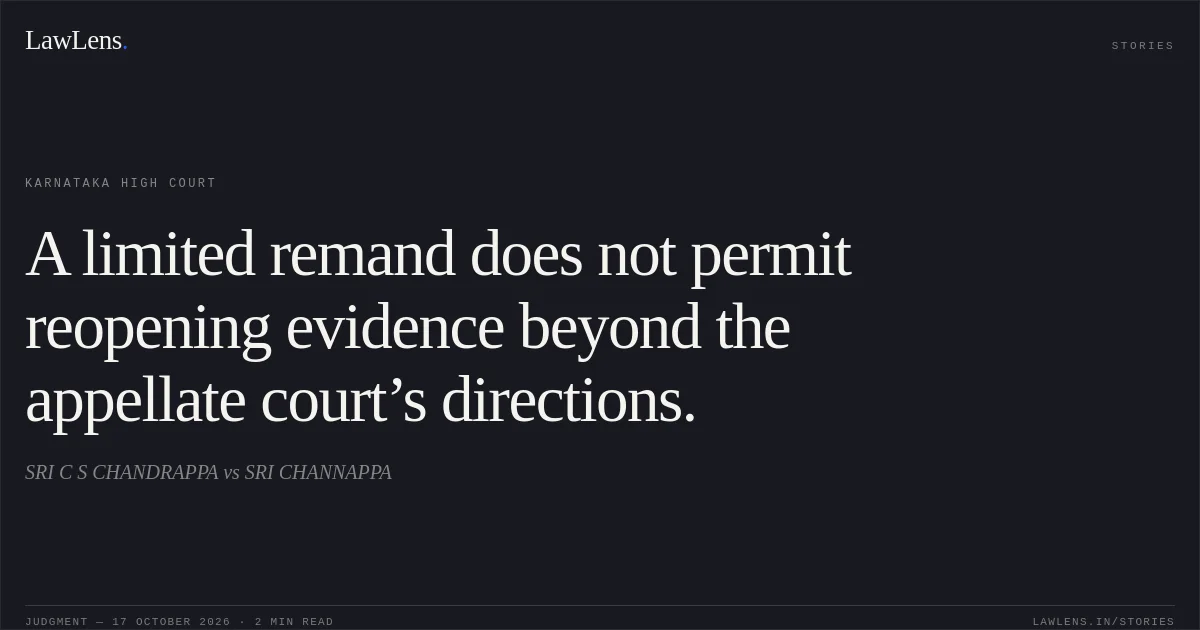
p. 3The suit had previously been decreed, but the Appellate Court set aside the decree and remanded the matter for the specific purpose of allowing Defendant Nos. 1 and 4 to cross-examine P.Ws. 1 and 2 and lead their evidence.
pp. 4–6The petitioner sought to introduce documents concerning certain schedule properties, although the plaint did not plead that those properties were self-acquired.
p. 602Issues
i.1. Whether the Trial Court’s dismissal of the petitioner’s applications to reopen the case, recall P.W.1, and produce additional documents warranted interference under Article 227 of the Constitution.
p. 3, 7ii.2. Whether the petitioner could seek to introduce documents beyond the scope of the limited remand, in the absence of pleadings that the relevant schedule properties were self-acquired.
pp. 5–703Law Applied
Article 227 of the Constitution confers supervisory jurisdiction on the High Court; the Court declined to exercise it to interfere with the impugned order in the circumstances of this case.
p. 7The petitioner’s applications invoked Section 151 CPC, Order XVIII Rule 17 CPC, and Order VII Rule 14(3) CPC.
p. 3The Court treated the Appellate Court’s remand directions as limited to permitting Defendant Nos. 1 and 4 to cross-examine P.Ws. 1 and 2 and lead evidence; it did not identify or rely on any precedent.
pp. 5–6Provisions in the judgment · 4 · Linked ones open on LawLens
Code of Civil Procedure, 1908 Section 151Section 18Section 7Section 96
04Reasoning
The High Court considered both the limited scope of the remand and the absence of pleadings that the relevant properties were self-acquired.
pp. 5–6The documents the petitioner sought to place on record concerned properties for which the plaint contained no such pleading, and the remand was directed to provide specified opportunities to the defendants, not to reopen the suit generally.
pp. 5–6In those circumstances, the Court found no basis to interfere with the Trial Court’s dismissal of the applications under Article 227.
p. 705Holding
The Court dismissed the writ petition and declined to interfere with the Trial Court’s order dismissing the three applications.
p. 7All pending applications were closed.
p. 7Original Court PDF
SRI C S CHANDRAPPAvsSRI CHANNAPPA
Click to open original judgment
Original judgment, available to read, download and summarize on LawLens.in