Facts
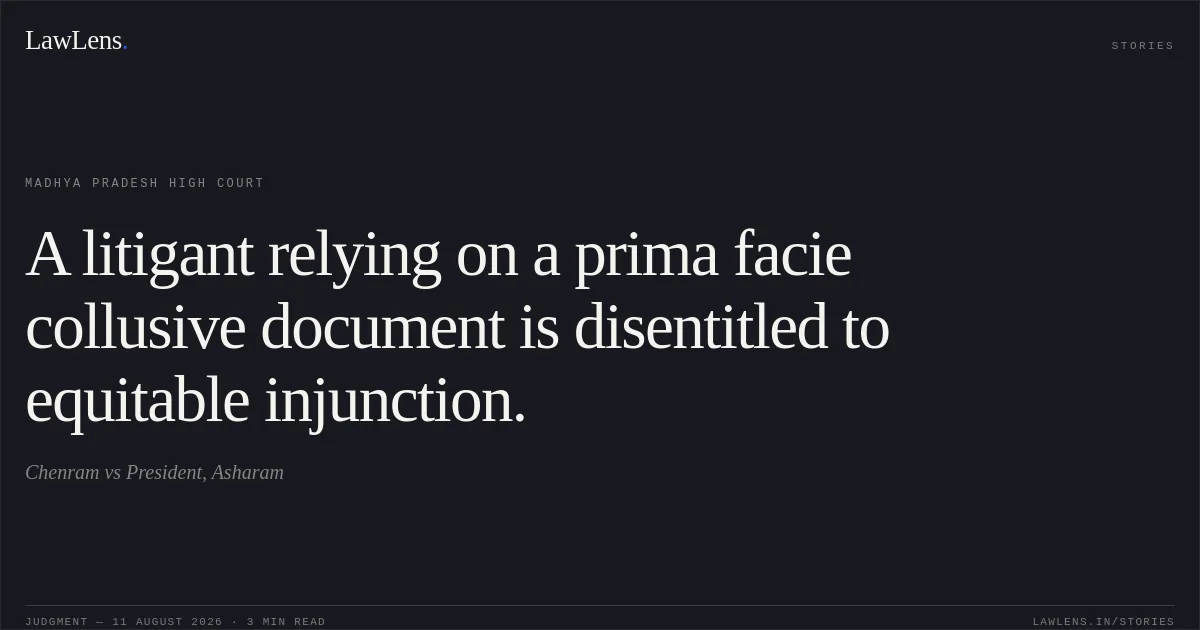
The petitioner-plaintiff sought temporary injunction restraining the respondent Trust from creating third-party rights in respect of ten shops proposed to be constructed on the terrace of the Trust’s building. He relied on receipts and related documents and claimed that Rs. 12,51,000 had been paid to the Trust through banking channels, with a further endorsement allegedly made by the Trust’s Treasurer.
Source reference: p. 2, para. 2; p. 3, para. 4The Trust disputed that the payment created any right in the terrace shops and alleged that the petitioner had colluded with the Trust’s Secretary, Mahendra Jain, to procure the documents without authority. It relied on a resolution dated 6 July 2025 providing that allotment of the terrace shops was to be made through a tender process; the alleged transaction was entered into on the following day without informing the President or Treasurer. The Secretary was subsequently removed on 10 September 2025.
Source reference: p. 3, para. 4The Trial Court rejected the injunction application on 12 November 2025, and the First Appellate Court dismissed the petitioner’s appeal on 19 June 2026. The petitioner challenged both orders under Article 227 of the Constitution.
Source reference: p. 1, para. 1Issues
1. Whether the petitioner established a prima-facie case, balance of convenience, and likelihood of irreparable injury warranting temporary injunction against the Trust.
Source reference: p. 2, paras. 2–5; p. 5, paras. 7–82. Whether the concurrent findings of the Trial Court and First Appellate Court refusing injunction were perverse, illegal, or otherwise liable to interference under Article 227.
Source reference: p. 5, para. 83. Whether the principle in Maharwal Khewaji Trust (Regd.) v. Baldev Dass, AIR 2005 SC 105, required grant of status quo in the circumstances of the case.
Source reference: p. 2, para. 2; p. 7, para. 11Law Applied
The Court exercised limited supervisory jurisdiction under Article 227 of the Constitution and held that concurrent factual findings based on pleadings and documents should not be disturbed unless shown to be perverse or illegal.
Source reference: p. 5, paras. 8–9Temporary injunction is an equitable and discretionary relief, dependent on establishment of a prima-facie case, balance of convenience, and irreparable injury; the conduct of the party seeking equity is also relevant.
Source reference: p. 5, paras. 7–8The Court considered the principle relied upon from Maharwal Khewaji Trust (Regd.) v. Baldev Dass, AIR 2005 SC 105, concerning preservation of the subject property/status quo, but held that the precedent was distinguishable on facts.
Source reference: p. 2, para. 2; p. 7, para. 11Reasoning
Although the record prima facie showed receipt of Rs. 12,51,000 by the Trust, the receipt did not clearly establish that the amount was paid towards allotment of the ten terrace shops; it referred generally to membership, donation, or related payments.
Source reference: p. 3, paras. 20–22, 25The alleged endorsement fixing the price of the shops was also unsupported by the signature of the authorised office-bearer, and no concluded agreement or allotment document was produced.
Source reference: p. 3, paras. 20–23These circumstances had to be assessed alongside the Trust’s resolution requiring allotment through tender and the allegation that the Secretary entered into the transaction unilaterally and in collusion with the petitioner.
Source reference: p. 3, para. 24; p. 5, paras. 6–8The Court held that, even assuming the petitioner’s assertions to be correct, the prima-facie case and the balance of convenience favoured the Trust, particularly because the petitioner’s conduct appeared to involve creation of documents to secure an equitable advantage. The alleged fraud and authority of the Secretary were matters requiring proof at trial and did not justify interim protection in favour of the petitioner.
Source reference: p. 5, paras. 7–9Consequently, the concurrent findings were neither perverse nor illegal, and Maharwal Khewaji Trust did not assist the petitioner because of the materially different factual setting.
Source reference: p. 7, para. 11Holding
The High Court dismissed the petition and declined to interfere with the orders dated 12 November 2025 and 19 June 2026 refusing temporary injunction.
It held that the petitioner failed to establish entitlement to interim injunction or status quo, while the Trust’s case was prima facie stronger.
Source reference: p. 8, para. 13In view of the petitioner’s conduct and the Court’s prima-facie assessment that the proceedings involved an attempt to abuse the process by creating documents in collusion with the former Secretary, exemplary costs of Rs. 1,00,000 were imposed, payable within seven days to the M.P. Legal Aid Services Authority, Indore, with proof of payment to be filed in the Registry.
Source reference: p. 6, paras. 8–10The observations were expressly confined to the interlocutory stage and were not to prejudice the parties at trial.
Source reference: p. 7, para. 12Original Court PDF
ChenramvsPresident, Asharam
Click to open original judgment
Original judgment, available to read, download and summarize on LawLens.in