Facts
The respondent filed O.S. No. 81/2013 against the petitioner and others for a declaration of possession and correction of survey numbers regarding Schedule ‘A’ (Sy.No. 86/18) and Schedule ‘B’ (Sy.No. 84/3) properties.
Source reference: p. 2, para. 2(a)On 23.11.2013, the matter was advanced and referred to a Lok Adalat, where a compromise was recorded allotting Sy.No. 84/3 to the petitioner and Sy.No. 86/18 to the respondent.
Source reference: p. 3-4, 9However, the respondent failed to disclose that he had already sold Sy.No. 84/3 to one G.B. Jayaramu via a registered sale deed in 1992.
Source reference: p. 4, para. 2(e)The petitioner discovered the compromise decree only after being served in a subsequent injunction suit (O.S. No. 299/2021).
Source reference: p. 19, para. 10The petitioner challenged the Lok Adalat award under Article 227 of the Constitution, alleging fraud and concealment.
Source reference: p. 2Issues
1. Whether a Lok Adalat award obtained through active concealment of material facts (fraud) is legally valid.
Source reference: p. 14-152. Whether a writ petition under Article 226/227 is the appropriate remedy to challenge a Lok Adalat award as opposed to a recall application or a fresh suit.
Source reference: p. 22, para. 12Law Applied
Section 17 of the Indian Contract Act, 1872, which defines fraud as the active concealment of a fact by one having knowledge of it.
Source reference: p. 13-14The doctrine "fraud vitiates all judicial acts" as established in Papayya Shastry v. Government of Andhra Pradesh, holding that a decree obtained by fraud is a nullity.
Source reference: p. 15, para. 9Section 21(2) of the Legal Services Authorities Act, 1987, alongside the precedents of State of Punjab v. Jalour Singh and Bhargavi Constructions v. Kothakapu Muthyam Reddy, which mandate that a Lok Adalat award can only be challenged via writ jurisdiction under Article 226 or 227 and not via appeal or separate suit.
Source reference: p. 19-22Reasoning
The Court found that the respondent committed "active concealment" under Section 17 of the Contract Act by inducing the petitioner to accept a property (Sy.No. 84/3) that he had already alienated in 1992 and which was subject to multiple litigations.
Source reference: p. 10-11, 14The Court rejected the respondent's argument regarding the bar on suits under Order XXIII Rule 3A CPC, distinguishing between a compromise decree passed by a Civil Court and an award by a Lok Adalat; the latter is only challengeable via writ petition.
Source reference: p. 24-25The Court reasoned that since the respondent tricked the petitioner into a settlement regarding non-existent title, the "finality of litigation" could not protect a fraudulent act.
Source reference: p. 16It further held that delay (laches) does not bar relief when the underlying decree is void ab initio due to fraud.
Source reference: p. 19, para. 10Holding
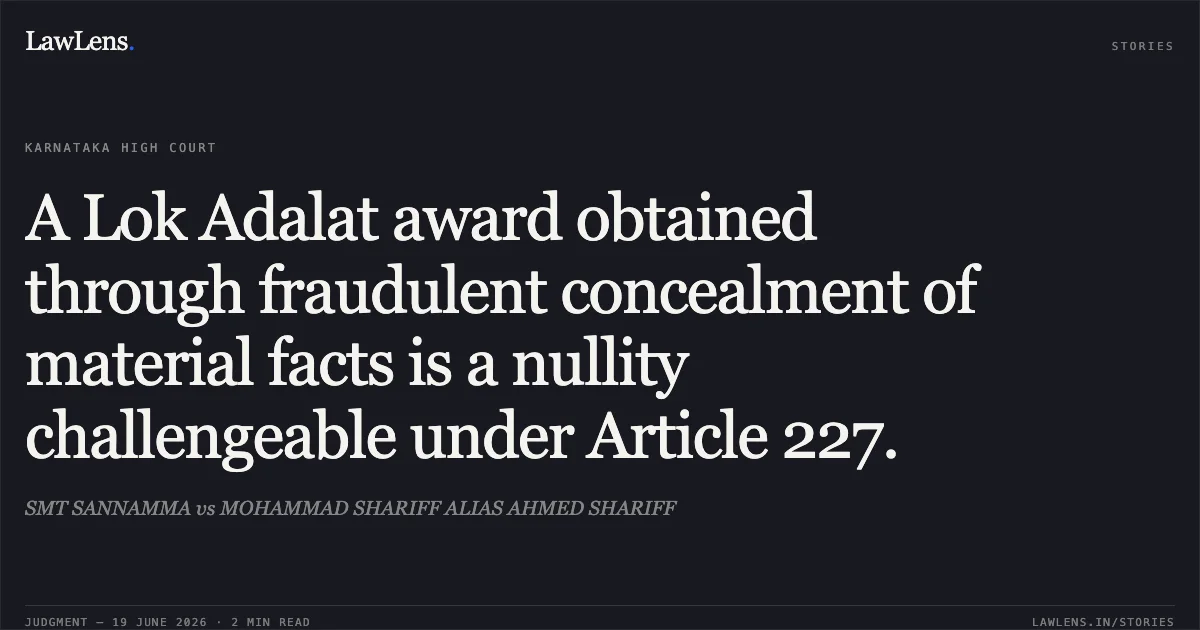
The Court answered that a Lok Adalat award obtained by fraud is a nullity and that a writ petition is the proper remedy for such a challenge.
The Court allowed the petition and quashed the Lok Adalat award/decree dated 23.11.2013 passed in O.S. No. 81/2013.
Source reference: p. 26Acts & Sections Cited
4 provisions across 2 statutes referred to in this judgment. Each provision opens on LawLens.
Indian Contract Act, 18722
Legal Services Authorities Act, 19872
Original Court PDF
SMT SANNAMMAvsMOHAMMAD SHARIFF ALIAS AHMED SHARIFF
Click to open original judgment
Original judgment, available to read, download and summarize on LawLens.in