Facts
State Bank of India (“SBI”) awarded the respondent a contract for constructing 76 flats at Sector-62, Noida, for ₹19,81,39,324, with completion scheduled by 15 January 2015.
Source reference: p.1–2The respondent completed the work on 23 January 2016. SBI granted three extensions: the first two with price variation adjustment (“PVA”) and the third, up to 28 January 2016, without PVA.
Source reference: p.2After disputes arose concerning delay, payment of PVA, delayed payments, and release of security deposit, the respondent invoked arbitration and raised fourteen claims aggregating to ₹4,92,35,263.
Source reference: p.2–3The arbitrator awarded ₹1,42,95,725, including amounts under claims 1, 3, 7 and 10.
Source reference: p.3–4SBI challenged the award under Section 34 of the Arbitration and Conciliation Act, 1996, with the challenge confined principally to those claims and the consequential interest.
Source reference: p.4Issues
1. Whether the award of ₹30,27,231 towards overhead expenditure under claim no. 1 was sustainable in the absence of evidence proving the actual loss suffered, merely because the Emden formula was applied?
Source reference: p.10–16; paras 8–152. Whether the award of PVA under claim no. 3 for the third extension was sustainable when that extension was granted without PVA and the contractual clause restricted PVA to the contract period and authorised extensions?
Source reference: p.5–6, 16–18; paras 16–213. Whether interest awarded under claim no. 7 for delayed payment of running bills and the final bill was legally sustainable under clause 37 of the GCC?
Source reference: p.18–20; paras 22–254. Whether interest awarded under claim no. 10 for delayed release of the security deposit was barred by clause 6.2 of the GCC, which provided that no interest would be paid on the security deposit?
Source reference: p.6, 20–22; paras 26–295. Whether the court could set aside only the severable invalid portions of the arbitral award under Section 34?
Source reference: p.22–23; paras 30–32Law Applied
The court applied Sections 34 and 31(3) of the Arbitration and Conciliation Act, 1996, holding that an arbitral award may be interfered with where it suffers from patent illegality, perversity, or lack of intelligible and adequate reasons, but a plausible factual or legal view of the arbitrator is ordinarily not disturbed.
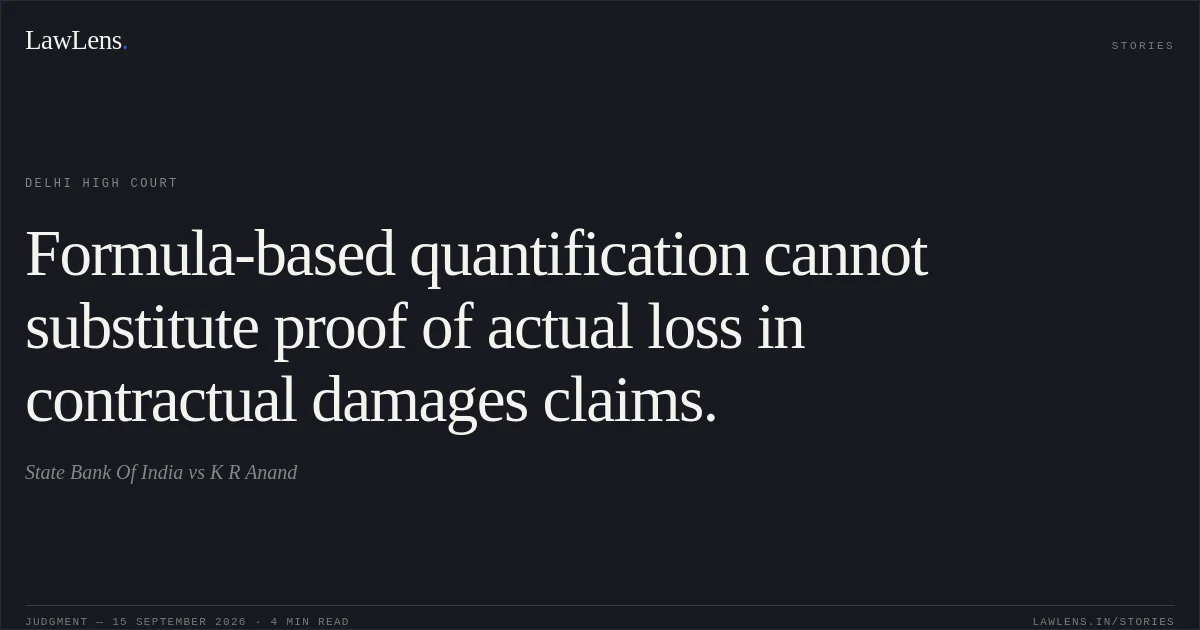
Source reference: p.14–16, 18–20Under Section 73 of the Indian Contract Act, 1872, a party claiming damages must establish breach and actual loss, unless the loss is difficult or impossible to prove; a formula such as the Emden formula assists in quantification but cannot itself prove loss, as recognised in Kailash Nath Associates v. DDA , State of Rajasthan v. Ferro Concrete Construction (P) Ltd. , and Unibros v. All India Radio .
Source reference: p.12–15Section 31(3) requires a reasoned award, as explained in Dyna Technologies Pvt. Ltd. v. Crompton Greaves Ltd.
Source reference: p.15–16Contractual provisions governing PVA and payment timelines must be given effect, including clause 44.3 restricting PVA and clause 37 prescribing payment within fourteen working days.
Source reference: p.9–10Under Section 31(7), the arbitrator’s power to award interest may be excluded by an express contractual bar, but such a plea must be raised before the arbitral tribunal; a plea raised for the first time under Section 34 may be treated as waived under Union of India v. Susaka Private Limited .
Source reference: p.20–22Finally, relying on Gayatri Balasamy v. ISG Novasoft Technologies Ltd. , the court held that severable invalid portions of an award may be set aside without disturbing valid and independent portions.
Source reference: p.22–23Reasoning
For claim no. 1, although the arbitrator attributed 175 days of delay to SBI and applied the Emden formula at 7.5% of the tender prime cost, the respondent did not produce evidence establishing the actual overhead loss suffered during the prolongation period.
Source reference: p.10–12The formula could quantify a proved loss but could not substitute for proof of loss; the absence of adequate reasons for adopting the formula rendered the award contrary to Sections 31(3) and 73 and patently illegal.
Source reference: p.13–16For claim no. 3, the arbitrator relied on an alleged admission by the architect, but the architect’s letter expressly recommended the third extension without monetary benefit or PVA, and the cross-examination answer did not amount to an admission of entitlement to PVA.
Source reference: p.16–18The award also failed to identify the period of delay attributable to SBI and therefore lacked a rational basis for awarding PVA for the third extension.
Source reference: p.18–21However, the separately calculated PVA amount relating to the first two extensions was not challenged and was severable.
Source reference: p.21In contrast, claim no. 7 was upheld because clause 37 required payment within fourteen working days of the architect’s certificate, applied to running as well as final bills, and the delay in payment was undisputed.
Source reference: p.18–20Claim no. 10 was also upheld because SBI had not pleaded clause 6.2 before the arbitrator and, in any event, that clause concerned security retained in accordance with the contractual release mechanism; it did not justify delayed release beyond the stipulated period.
Source reference: p.20–22Holding
The petition under Section 34 was partly allowed.
The court set aside the award of claim no. 1 for overhead expenditure and the portion of claim no. 3 awarding PVA for the third extension.
Source reference: p.23–24The PVA awarded for the first two extensions remained undisturbed, as did the awards under claims no. 7 and 10 for delayed payment of bills and delayed release of the security deposit, respectively.
Source reference: p.21, 23–24The court consequently upheld the severable valid portions of the award and disposed of the pending application.
Source reference: p.23–24Acts & Sections Cited
6 provisions across 2 statutes referred to in this judgment. Each provision opens on LawLens.
Arbitration and Conciliation Act, 19963
Indian Contract Act, 18723
Original Court PDF
State Bank Of IndiavsK R Anand
Click to open original judgment
Original judgment, available to read, download and summarize on LawLens.in
![RBE No. 41/2013 cannot retrospectively withdraw grade-pay benefits validly granted under earlier instructions.. MOHAMMAD ANWAR KHAN vs M/o Defence. CAT - ['Allahabad']. LawLens](/stories/thumbnails/rbe-no-41-2013-cannot-retrospectively-withdraw-grade-pay-benefits-validly-granted-under-ea-d825d8900cf0403f90d903a2a4e3d6a6.webp)