Facts
The plaintiff instituted a suit on 15 October 2018 for recovery of more than ₹30 lakhs.
Source reference: no citationOn 16 October 2024, neither the plaintiff nor anyone on his behalf appeared when the suit was called, and the suit was dismissed for want of prosecution.
Source reference: para. 2The plaintiff filed an application under Order 9 Rule 9 of the Code of Civil Procedure, 1908 (“CPC”) on 4 November 2024, within the prescribed limitation period, seeking restoration of the suit.
Source reference: paras. 3, 5The Trial Court rejected the application, principally relying on the delay in adducing evidence, the availability of other counsel, and the non-examination of the doctor who issued the medical certificate.
Source reference: para. 7The Principal District Judge, Khandwa, in appeal, set aside the Trial Court’s order and restored the suit by order dated 2 July 2026.
Source reference: paras. 1, 3The defendant challenged that order under Article 227 of the Constitution of India.
Source reference: no citationIssues
Whether the plaintiff had shown sufficient cause for his non-appearance on 16 October 2024 so as to warrant restoration of the suit under Order 9 Rule 9 CPC?
Source reference: paras. 3, 5–8Whether the Appellate Court committed illegality or material irregularity in allowing the plaintiff’s restoration application and restoring the suit?
Source reference: paras. 1, 9–10Whether the plaintiff’s previous conduct in taking time to adduce evidence justified rejection of the restoration application despite its being filed within limitation?
Source reference: paras. 7–8Law Applied
The Court applied Order 9 Rule 9 CPC, under which a suit dismissed for the plaintiff’s default or non-appearance may be restored upon the plaintiff showing sufficient cause for the absence.
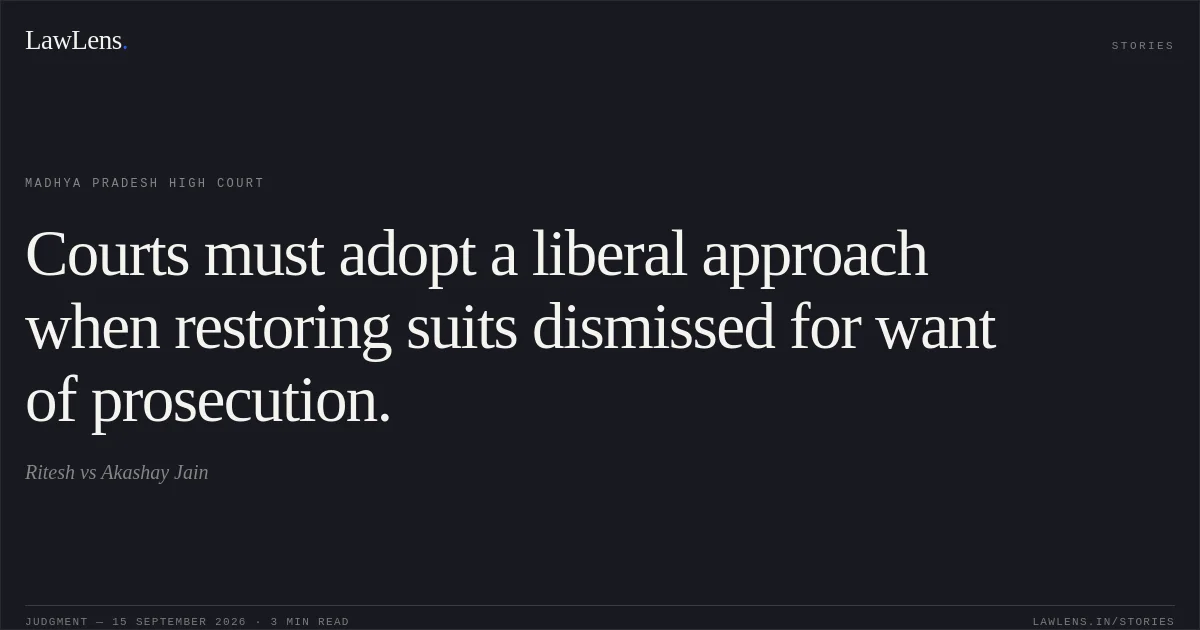
Source reference: no citationThe Court reiterated the principle that restoration applications should ordinarily be considered liberally to advance substantial justice, particularly where the application is filed within limitation.
Source reference: para. 8The Court also applied the supervisory jurisdiction under Article 227 of the Constitution of India, under which interference is warranted where the subordinate court has acted without jurisdiction or with illegality or material irregularity, but not merely because another view is possible.
Source reference: paras. 1, 9Reasoning
The High Court held that the plaintiff had regularly appeared in the proceedings and that his counsel had also generally been participating in the matter.
Source reference: para. 8The plaintiff’s explanation for his absence on the specific date was supported by a medical prescription, which had not been effectively rebutted by the defendant.
Source reference: para. 8The Court held that the relevant inquiry under Order 9 Rule 9 CPC was the reason for non-appearance on the date of dismissal; the plaintiff’s earlier conduct in seeking time for evidence could not, by itself, determine the restoration application.
Source reference: paras. 7–8Since the application was filed within limitation and the plaintiff had shown sufficient cause, the Appellate Court acted within its jurisdiction in restoring the suit.
Source reference: para. 9The defendant would suffer no prejudice because he retained a full opportunity to contest the suit on merits.
Source reference: para. 9Holding
The High Court answered the issues in favour of the plaintiff.
It held that sufficient cause had been shown for the plaintiff’s non-appearance and that the Appellate Court had committed no illegality or material irregularity in allowing restoration under Order 9 Rule 9 CPC.
Source reference: paras. 8–10The order dated 2 July 2026 passed by the Principal District Judge, Khandwa, restoring the suit was affirmed, and the defendant’s petition under Article 227 was dismissed.
Source reference: para. 10Original Court PDF
RiteshvsAkashay Jain
Click to open original judgment
Original judgment, available to read, download and summarize on LawLens.in