Facts
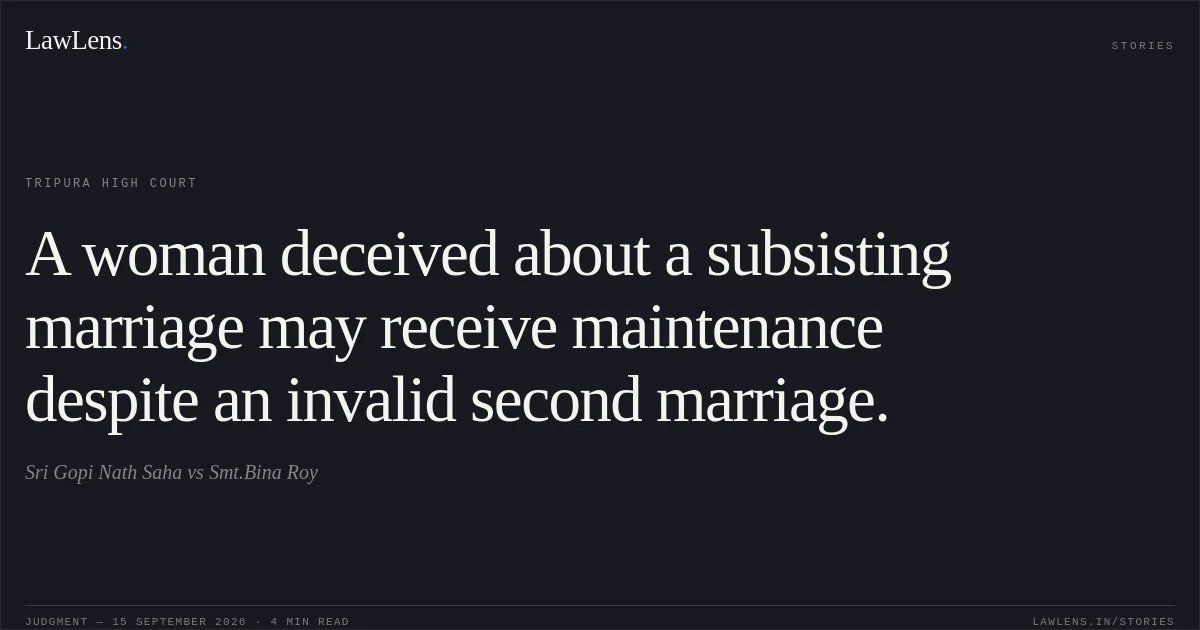
The respondent-wife had worked at the petitioner’s garment shop from approximately 2008–2010. She alleged that the petitioner represented that he had divorced his first wife and, relying on that representation, she married him on 20 November 2012 at Kalighat Temple, Kolkata, after which they lived together as husband and wife. She further alleged that the petitioner introduced her socially as his wife, supported her and her son, and later deserted her in 2022.
Source reference: pp.18–21, paras.26–31The petitioner denied the marriage and cohabitation. He asserted that his marriage with Shipra Saha continued until her death on 9 January 2020 and that the respondent had merely been his employee and had received financial assistance from his family.
Source reference: pp.20–22, paras.32–35The respondent instituted proceedings for maintenance under Section 125 of the Code of Criminal Procedure, 1973, and sought interim maintenance. The Family Court, Agartala, awarded her interim maintenance of ₹15,000 per month by order dated 24 July 2025 in Crl. Misc. (Int.) No. 231 of 2024.
Source reference: pp.1–3, paras.1–3; p.22, para.36The petitioner challenged that order by filing the present revision petition under Sections 438 and 442 of the BNSS, 2023.
Source reference: p.1, para.1Issues
Whether a criminal revision petition was maintainable against an order granting interim maintenance by the Family Court under Section 125 CrPC, notwithstanding the restriction under Section 19(4) of the Family Courts Act, 1984?
Source reference: pp.7–9, paras.15–17Whether interim maintenance could be granted where the claimant’s status as the legally wedded wife was disputed and the alleged marriage was said to have occurred during the subsistence of the petitioner’s earlier marriage?
Source reference: pp.3–7, paras.4–14; pp.22–25, paras.38–45Whether, at the interim stage, the petitioner could rely upon the alleged invalidity of the second marriage when the respondent claimed that he had concealed or misrepresented the subsistence of his first marriage?
Source reference: pp.11–15, paras.21–22; pp.24–25, paras.42–45Law Applied
The Court considered Section 125 CrPC, which provides a summary remedy of maintenance to a wife unable to maintain herself, and the corresponding revisional provisions under the BNSS and the Family Courts Act.
Source reference: pp.1–3, paras.1–3It considered Yamunabai Anantrao Adhav v. Anantrao Shivram Adhav, (1988) 1 SCC 530, and Savitaben Somabhai Bhatiya v. State of Gujarat, (2005) 3 SCC 636, which generally hold that “wife” under Section 125 CrPC means a legally wedded wife and that a woman whose marriage is void because the man had a living spouse ordinarily cannot claim maintenance.
Source reference: pp.5–7, paras.10–13However, the Court applied the qualification recognised in Badshah v. Urmila Badshah Godse, (2014) 1 SCC 188, namely that where a man deceives a woman by concealing his existing marriage or falsely representing himself as free to marry, he cannot take advantage of his own wrong; for the purpose of Section 125 CrPC, such a woman may be treated as a wife entitled to maintenance.
Source reference: pp.11–15, paras.21–22; pp.24–25, paras.42–45The Court also relied on Nityagopal Sukladas v. Anjali Nag Nath @ Sukladas, Crl. Rev. P. Nos. 53 and 69 of 2007, holding that long cohabitation and conduct consistent with a marital relationship may justify treating a woman as a wife for maintenance purposes at the interim stage.
Source reference: pp.15–18, para.23It further considered Akanksha Arora v. Tanay Maben, 2024 SCC OnLine SC 3688, and the principle that an appropriate criminal revision may be entertained against an interim-maintenance order.
Source reference: pp.8–9, para.16Reasoning
The High Court held that the respondent’s marital status remained a matter for final adjudication by the Family Court and that the revision court was not required to conclusively determine the validity of the alleged marriage at the interlocutory stage.
Source reference: p.22, paras.37–41The petitioner admitted that the respondent had worked in his shop, that they had travelled together, that the photographs relied upon by the respondent were genuine, and that he had spent approximately ₹20 lakh on the education of her son.
Source reference: p.22, paras.38–40These circumstances, coupled with the respondent’s assertion that the petitioner had represented himself as divorced and had lived with her as husband and wife, furnished a prima facie basis for granting interim maintenance.
Source reference: pp.24–25, paras.42–45Although the petitioner relied on the general rule in Yamunabai and Savitaben that a second wife of a man having a living spouse is not entitled to maintenance, the Court distinguished those authorities on the basis of Badshah.
Source reference: pp.11–15, paras.21–22; pp.24–25, paras.42–45It reasoned that, if the petitioner had concealed his existing marriage or falsely represented that it had ended, he could not use that deception to defeat the respondent’s claim for maintenance.
Source reference: pp.11–15, paras.21–22; pp.24–25, paras.42–45The Court therefore found no error in the Family Court’s interim determination, while expressly refraining from deciding the parties’ ultimate marital status or the merits of the main maintenance proceeding.
Source reference: p.25, para.45Holding
The High Court dismissed the revision petition as devoid of merit and upheld the Family Court’s order awarding the respondent interim maintenance of ₹15,000 per month until disposal of the main maintenance proceeding.
It directed the Family Court to dispose of the main proceeding at the earliest, after giving both parties adequate opportunity to adduce evidence, and clarified that the observations in the revision order would not prejudice the final adjudication.
Source reference: p.25, para.46Pending applications were also disposed of, and the judgment was directed to be communicated to the Trial Court and circulated to the Family Courts in the State.
Source reference: p.26Acts & Sections Cited
7 provisions across 4 statutes referred to in this judgment. Each provision opens on LawLens.
Bharatiya Nagarik Suraksha Sanhita, 20232
Code of Criminal Procedure, 19733
Family Courts Act, 19841
Hindu Marriage Act, 19551
Original Court PDF
Sri Gopi Nath SahavsSmt.Bina Roy
Click to open original judgment
Original judgment, available to read, download and summarize on LawLens.in