Facts
The petitioner, the sole accused, invoked Section 528 of the Bharatiya Nagarik Suraksha Sanhita, 2023 (“BNSS”) seeking quashing of Crime No. 498 of 2026 registered at Karimnagar II Town Police Station for offences under Section 78(2) of the Bharatiya Nyaya Sanhita, 2023 (“BNS”) and Sections 3(1)(r), 3(1)(s), and 3(2)(v-a) of the Scheduled Castes and Scheduled Tribes (Prevention of Atrocities) Amendment Act, 2015.
Source reference: para. 1He contended that he had been falsely implicated, had not abused the second respondent by referring to her caste, and that the alleged words were not uttered within public view.
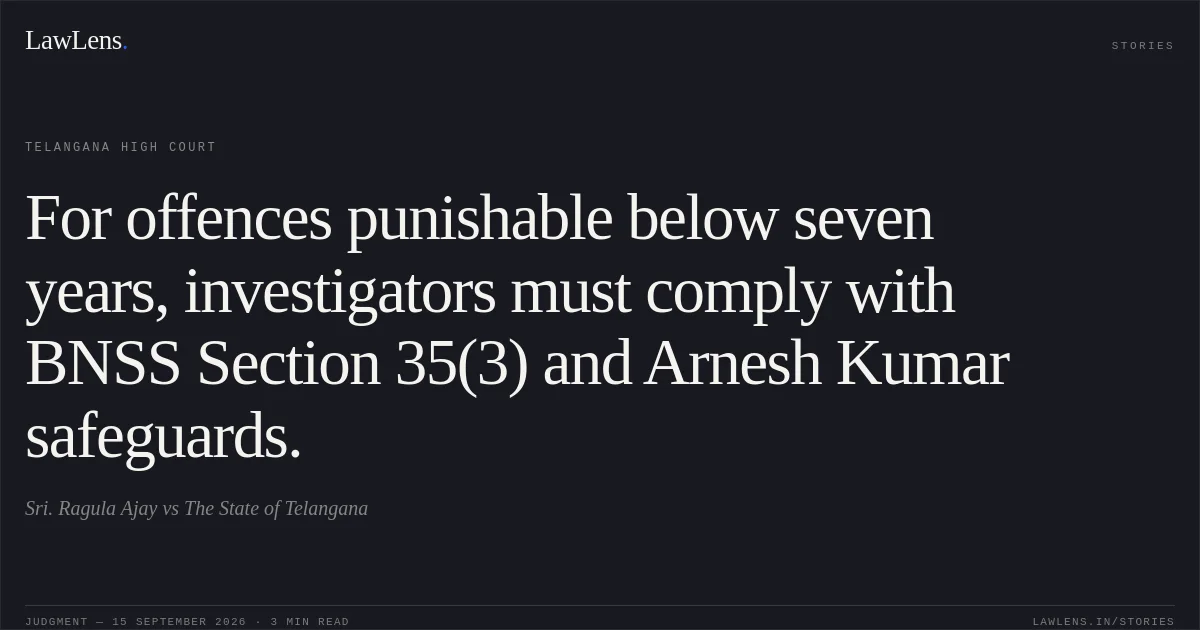
Source reference: para. 4.1He also alleged that the Investigating Officer had failed to follow Section 35(3) of the BNSS and the principles in Arnesh Kumar v. State of Bihar, (2014) 8 SCC 273, since the offences were punishable with imprisonment of less than seven years.
Source reference: para. 4.2The prosecution opposed quashing, stating that the complaint contained specific allegations and that their truth or otherwise would emerge during investigation; it undertook to follow the statutory procedure and the Arnesh Kumar guidelines.
Source reference: paras. 5.1–5.2The second respondent, despite service of notice, did not appear.
Source reference: para. 2Issues
1. Whether the proceedings in Crime No. 498 of 2026 were liable to be quashed under Section 528 of the BNSS on the ground that the ingredients of the offences under Section 78(2) of the BNS and the SC/ST (Prevention of Atrocities) Act were not made out.
Source reference: paras. 4.1, 5.1–5.22. Whether, during investigation of offences punishable with imprisonment of less than seven years, the Investigating Officer was required to follow Section 35(3) of the BNSS and the safeguards laid down in Arnesh Kumar v. State of Bihar.
Source reference: paras. 4.2, 5.2, 7–83. Whether the petitioner was entitled to appropriate directions protecting him from non-compliance with the procedure governing investigation, while requiring him to cooperate with the investigation.
Source reference: paras. 7–8Law Applied
The Court applied Section 528 of the BNSS, which preserves the High Court’s inherent jurisdiction to prevent abuse of process and secure the ends of justice.
Source reference: para. 1It also applied Section 35(3) of the BNSS, requiring compliance with the statutory procedure applicable where arrest is not automatically warranted in offences punishable with imprisonment of less than seven years.
Source reference: paras. 4.2, 5.2The Court relied on Arnesh Kumar v. State of Bihar, (2014) 8 SCC 273, which requires investigating officers and courts to follow safeguards against unnecessary arrest and to apply the prescribed procedure in offences carrying punishment of less than seven years.
Source reference: paras. 4.2, 5.2, 8At the investigation stage, disputed factual allegations, including whether caste-based abuse occurred and whether it was uttered within public view, are ordinarily to be assessed through investigation rather than conclusively determined in a quashing petition.
Source reference: paras. 5.1–5.2Reasoning
The Court did not undertake a final determination of the truth of the allegations or conclusively rule on whether the ingredients of the alleged offences were established.
Source reference: paras. 5.1–5.2It noted that the complaint contained specific allegations and that the investigation was still in progress; consequently, the factual disputes raised by the petitioner did not justify quashing the crime at that stage.
Source reference: paras. 5.1–5.2However, because the alleged offences carried punishment of less than seven years, and because the prosecution itself acknowledged that the Investigating Officer would follow Section 35(3) of the BNSS and the Arnesh Kumar safeguards, the Court considered it appropriate to issue procedural directions rather than permit unregulated investigation.
Source reference: paras. 7–8The petitioner’s undertaking to cooperate with the investigation supported this limited relief.
Source reference: para. 6Holding
The Court declined to quash Crime No. 498 of 2026 at the investigation stage and disposed of the criminal petition with directions.
The petitioner was directed to appear before the Investigating Officer on or before 26 September 2026.
Source reference: para. 8Upon his appearance, the Investigating Officer was directed to scrupulously follow Section 35(3) of the BNSS and the guidelines in Arnesh Kumar; the petitioner was required to cooperate with the investigation.
Source reference: para. 8The petitioner was also permitted to raise all available objections before the Investigating Officer and submit documents in his custody.
Source reference: para. 8Pending miscellaneous applications were closed.
Source reference: para. 9Acts & Sections Cited
3 provisions across 2 statutes referred to in this judgment. Each provision opens on LawLens.
Bharatiya Nagarik Suraksha Sanhita, 20232
Bharatiya Nyaya Sanhita, 20231
Original Court PDF
Sri. Ragula AjayvsThe State of Telangana
Click to open original judgment
Original judgment, available to read, download and summarize on LawLens.in