Facts
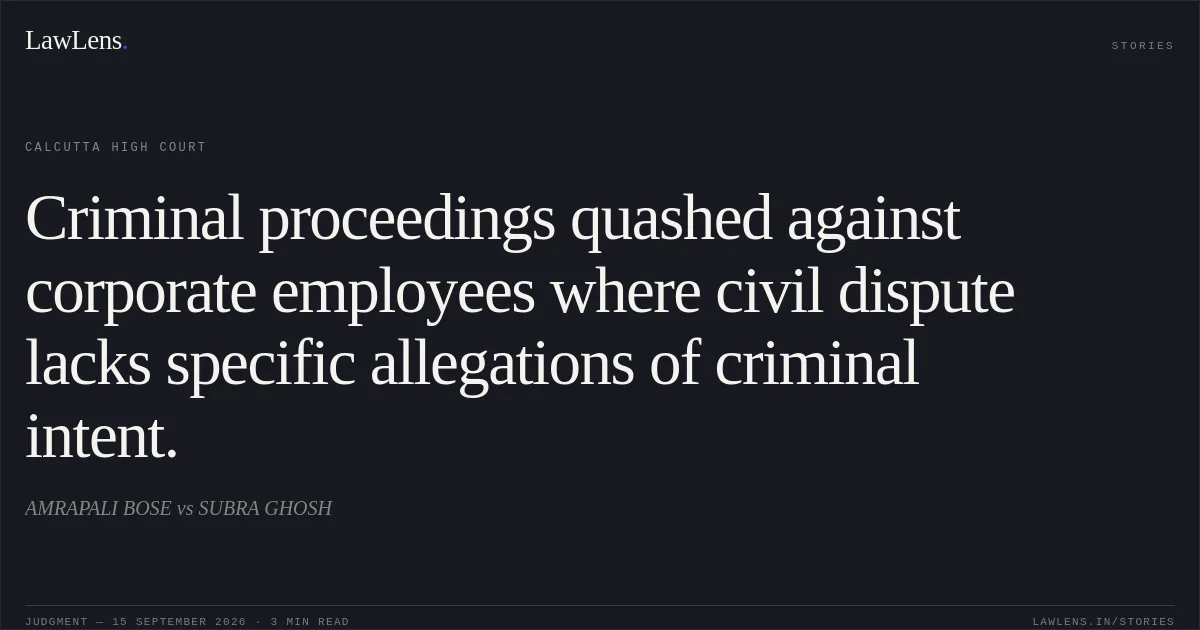
The petitioners sought quashing of Complaint Case No. C-1610 of 2018, pending before the Judicial Magistrate, 7th Court, Alipore, under Sections 406, 415, 418, 420, 506 and 120B of the Indian Penal Code, 1860.
Source reference: para. 1The dispute arose from the complainant’s purchase of a flat from Amrapali Hirise Private Limited. The complainant had previously initiated proceedings before the Consumer Forum in 2017 concerning the same transaction, in which the present petitioners were not named.
Source reference: paras. 2–3The petitioners, shown as accused nos. 3 and 5, were respectively alleged to be a director and an employee of the company. The specific allegation against them was that they had attended a meeting with the complainant at a restaurant on 16 June 2017 and represented that her deposit would be returned within three months.
Source reference: paras. 3–5The complaint further alleged that accused nos. 1, 2 and 6 to 11 had entered into the agreement for sale dated 10 July 2013. The Court noted that the petitioners were not parties to that agreement.
Source reference: para. 6Issues
Whether the allegations in the complaint, taken at face value, disclose the ingredients of offences under Sections 406, 415, 418, 420, 506 and 120B IPC against the petitioners?
Source reference: paras. 10–12Whether continuation of the criminal proceeding, arising substantially out of a flat-purchase and refund dispute, would amount to an abuse of the process of law warranting exercise of the High Court’s inherent jurisdiction under Section 482 CrPC?
Source reference: paras. 9–12Whether the petitioners could be subjected to criminal prosecution when they were not parties to the agreement for sale and the principal allegations were directed against another accused?
Source reference: paras. 3–6, 11–12Law Applied
The Court applied the principles governing cheating under Sections 415 and 420 IPC, namely, deception, fraudulent or dishonest inducement, delivery or retention of property, and resulting or likely damage; dishonest intention must exist at the inception of the transaction, and a mere breach of contract does not constitute cheating.
Source reference: para. 7Section 406 IPC requires entrustment of property and a fiduciary relationship; a normal sale or exchange of consideration does not amount to entrustment. Criminal intimidation under Sections 503 and 506 IPC requires a threat intended to cause alarm or compel the complainant to act or refrain from acting.
Source reference: para. 7The Court further relied on Section 482 CrPC and the principles in State of Haryana v. Bhajan Lal, 1992 Supp (1) SCC 335, under which proceedings may be quashed where the allegations do not constitute an offence, the supporting material is insufficient, or the proceeding is manifestly attended by mala fides or instituted for an ulterior purpose.
Source reference: para. 9The Court also relied on Ramesh Chandra Gupta v. State of Uttar Pradesh, 2022 LiveLaw (SC) 993, and Vineet Kumar v. State of Uttar Pradesh, (2017) 13 SCC 369, which recognise the High Court’s duty to prevent abuse of process and secure the ends of justice.
Source reference: para. 9Reasoning
The Court found that the dispute was essentially civil in nature and related to the purchase of a flat and alleged non-refund of money.
Source reference: paras. 2, 11The petitioners were not parties to the agreement for sale and the principal allegations were directed against Malay Bose and other parties connected with the transaction.
Source reference: paras. 4, 6Their alleged presence at a restaurant and representation that the money would be returned within three months did not establish deception or dishonest intention at the inception of the agreement, as required for cheating under Sections 415 and 420 IPC.
Source reference: paras. 5–7, 12Nor did the allegations disclose entrustment for the purposes of Section 406 IPC or any specific threat intended to cause alarm under Section 506 IPC.
Source reference: para. 7Applying categories 1, 3 and 7 of Bhajan Lal, the Court held that the complaint did not prima facie disclose the essential ingredients of the alleged offences against the petitioners and that continuation of the prosecution would constitute an abuse of process.
Source reference: paras. 10–12Holding
The High Court allowed CRR 4125 of 2024 and CRR 4126 of 2024.
Complaint Case No. C-1610 of 2018 under Sections 406, 415, 418, 420, 506 and 120B IPC was quashed in respect of the petitioners, Amrapali Bose and Dipanjan Ray @ Dipayan Roy.
Source reference: para. 14All connected applications were disposed of, any interim order was vacated, and the judgment was directed to be communicated to the Trial Court for necessary compliance.
Source reference: paras. 15–18Acts & Sections Cited
9 provisions across 2 statutes referred to in this judgment. Each provision opens on LawLens.
Indian Penal Code, 18606
Code of Criminal Procedure, 19733
Original Court PDF
AMRAPALI BOSEvsSUBRA GHOSH
Click to open original judgment
Original judgment, available to read, download and summarize on LawLens.in