Facts
The petitioner, a Wushu Sanda athlete competing in the Men’s 70 kg category, had represented India at the 19th Asian Games in 2023 and had undergone bilateral ACL surgeries in 2023 and 2025.
Source reference: pp. 2–3He did not participate in certain qualifying international events, including the 2nd Wushu Sanda Asian Cup, 2025 and the 17th World Wushu Championships, 2025, due to injury and rehabilitation.
Source reference: pp. 2–3For selection to the 20th Asian Games, 2026, the Wushu Association of India conducted open and final selection trials.
Source reference: pp. 3–6The petitioner secured Rank No. 1 in his category and was thereafter included in national coaching camps conducted under the aegis of the Sports Authority of India.
Source reference: pp. 3–6The Federation also recommended his participation.
Source reference: pp. 3–6However, when the Ministry of Youth Affairs and Sports issued the final Indian contingent list on 22 August 2026, the petitioner’s name was omitted, and no athlete was nominated in the Men’s Sanda 70 kg category despite an available participation slot.
Source reference: p. 5The petitioner therefore filed a writ petition under Article 226 seeking a direction to forward his name to the Indian Olympic Association or, alternatively, to invoke and consider the relaxation clause under Clause 5 of the Ministry’s Selection Criteria dated 24 September 2025.
Source reference: pp. 1–2, 6–7Issues
1. Whether the petitioner, who did not satisfy the benchmark prescribed under the Ministry’s Selection Criteria, could claim a right to relaxation under Clause 5 of that policy?
Source reference: para. 8; p. 82. Whether the Ministry was required to invoke or consider Clause 5 on the basis of the Federation’s recommendation and the petitioner’s Rank No. 1 position in the domestic selection trials?
Source reference: paras. 10–12; pp. 9–103. Whether the Court could direct the Ministry to nominate the petitioner or interfere with the expert policy governing selection for the Asian Games?
Source reference: paras. 15–18; pp. 11–13Law Applied
The Court applied the Ministry’s Selection Criteria dated 24 September 2025, particularly Clause 4.1(II)(b), read with Clause 10, which required a top-six finish in an equivalent international competition meeting the prescribed participation criteria for non-measurable individual sports.
Source reference: para. 9; p. 9Clause 5 was interpreted as an enabling and discretionary relaxation provision, requiring the concurrent opinion of experts of the specific discipline and the Sports Authority of India, supported by justifiable reasons; it provided only for consideration by the Ministry and did not confer an enforceable right to relaxation.
Source reference: paras. 10–12; pp. 9–10Relying on Yoga Federation of India v. Union of India, 2026:DHC:5515, the Court held that conditions governing relaxation are safeguards against arbitrary exercise of power.
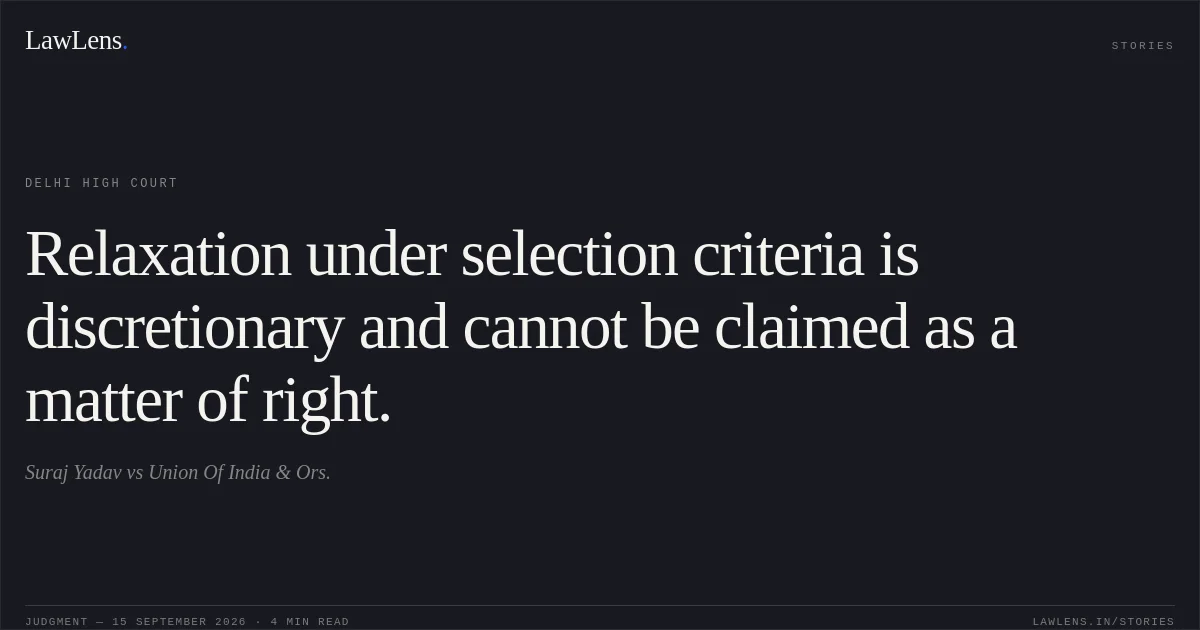
Source reference: para. 13; pp. 10–11Relying on State of U.P. v. Vikash Kumar Singh, (2022) 1 SCC 347, it held that relaxation is discretionary and cannot be claimed as a matter of right.
Source reference: para. 14; p. 11The Court also relied on Sanjana v. Union of India, 2026:DHC:7666, for the principle that an available or vacant participation slot does not create an automatic right to nomination or relaxation.
Source reference: para. 16; p. 12The Court also relied on Directorate of Film Festivals v. Gaurav Ashwin Jain, (2007) 4 SCC 737, and Yamini Mourya v. Indian Olympic Association, 2023 SCC OnLine Del 6213, to hold that a writ court cannot act as an appellate authority over a reasonable, good-faith selection policy formulated by experts.
Source reference: para. 17; pp. 12–13Reasoning
The petitioner admittedly failed to satisfy the qualifying benchmark under Clause 4 because he had not participated in the relevant Asian Cup or World Championships, while the competitions on which he relied were invitational events and did not meet the policy’s prescribed participation requirements.
Source reference: para. 9; p. 9Although he had secured Rank No. 1 in the domestic trials and had received a recommendation from the Federation, Clause 5 required the opinion of both the discipline’s experts and SAI.
Source reference: para. 12; p. 10The Federation’s letter addressed to SAI was not an SAI recommendation, and the Ministry stated that it had received no recommendation from SAI.
Source reference: para. 12; p. 10Further, Clause 5 contemplated consideration by the Ministry rather than mandatory grant of relaxation.
Source reference: paras. 10–12; pp. 9–10The petitioner’s injuries, return to competition, domestic trial performance, continued camp participation, and international record could not enlarge or override the uniformly applicable selection criteria.
Source reference: paras. 15 and 18; pp. 11, 13The Court therefore found no arbitrariness, irrationality, mala fides, or grounds for judicial substitution of its view for that of the competent sporting authorities.
Source reference: paras. 17–18; pp. 12–13Holding
The Court held that the petitioner had no enforceable right to compel the Ministry to invoke or grant relaxation under Clause 5, nor could his Rank No. 1 position in the domestic trials or the availability of a participation slot require his nomination.
Since the cumulative preconditions for Clause 5 were absent and no arbitrariness or mala fides was established, the Court declined to direct the forwarding of the petitioner’s name to the Indian Olympic Association or to order reconsideration.
Source reference: paras. 18–19; p. 13The writ petition and pending applications were dismissed.
Source reference: paras. 18–19; p. 13Acts & Sections Cited
6 provisions across 1 statute referred to in this judgment. Linked provisions open on LawLens.
Ministry6
Original Court PDF
Suraj YadavvsUnion Of India & Ors.
Click to open original judgment
Original judgment, available to read, download and summarize on LawLens.in