Facts
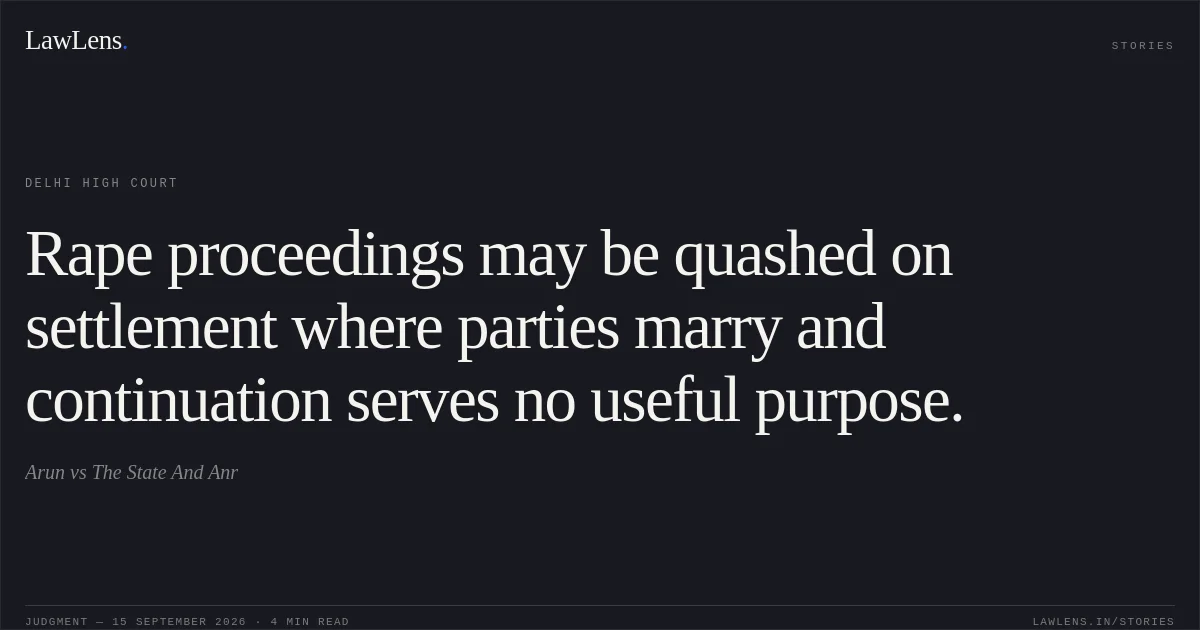
The petitioner sought quashing of FIR No. 44/2026, registered at Police Station Janak Puri for an offence under Section 376 IPC, along with all consequential proceedings, on the basis of a settlement with Respondent No. 2.
Source reference: paras. 1–2The complainant alleged that she had entered into a romantic and physical relationship with the petitioner after he assured her that he loved her and would marry her, but subsequently refused to marry her.
Source reference: para. 2After investigation, a charge-sheet was filed and Section 69 of the Bharatiya Nyaya Sanhita, 2023 was also invoked; charges were reportedly framed under Sections 376 IPC and 69 BNS.
Source reference: paras. 3–4The parties executed a Compromise-cum-Settlement Deed dated 11 June 2026 and stated that they had married on 24 March 2026.
Source reference: paras. 6–7The Investigating Officer verified the marriage certificate and contacted the parties’ parents, who confirmed the marriage and stated that they had no objection to it.
Source reference: paras. 8–10Respondent No. 2 appeared before the Court, stated that the FIR had been lodged due to a misunderstanding, affirmed that the marriage was voluntary and free from coercion, and expressed that she was living happily with the petitioner and had no objection to quashing of the FIR.
Source reference: paras. 11–12Issues
Whether the High Court could exercise its inherent jurisdiction under Section 528 of the Bharatiya Nagarik Suraksha Sanhita, 2023 to quash proceedings arising from an FIR alleging rape under Section 376 IPC, notwithstanding the non-compoundable and serious nature of the offence, on the basis of a subsequent settlement and marriage between the parties.
Source reference: paras. 15–19Whether, in the facts of the case, continuation of the criminal proceedings would serve any useful or meaningful purpose when the parties had settled their disputes and were living together peacefully as spouses.
Source reference: paras. 12–13, 17–18Law Applied
The Court exercised its inherent powers under Section 528 of the Bharatiya Nagarik Suraksha Sanhita, 2023 to secure the ends of justice.
Source reference: para. 19It relied on Gian Singh v. State of Punjab & Anr., (2012) 10 SCC 303, and Narinder Singh & Ors. v. State of Punjab & Anr., (2014) 6 SCC 466, for the principle that criminal proceedings involving non-compoundable offences may be quashed where the Court is satisfied that continuation would serve no meaningful purpose and the likelihood of conviction is remote or bleak.
Source reference: paras. 15, 18The Court also relied on Madhukar & Anr. v. State of Maharashtra, 2025 SCC OnLine SC 1415, which recognised that although offences under Section 376 IPC are grave and ordinarily should not be quashed merely on settlement, the inherent power of the Court must be exercised flexibly with reference to the facts of each case, particularly where continuation of proceedings would cause continuing distress without a productive outcome.
Source reference: paras. 16–17The Court further referred to decisions of the Delhi High Court in Abu Bakar v. State NCT of Delhi & Anr., W.P. (CRL.) 782/2024, decided on 12 March 2024, Parmanand Mishra & Anr. v. State NCT of Delhi & Anr., CRL.M.C. 3076/2021, decided on 5 August 2022, and Rocky Massey v. State (NCT of Delhi) & Anr., CRL.M.C. 8305/2025, decided on 21 November 2025, concerning quashing after settlement and marriage between the parties.
Source reference: para. 14Reasoning
The Court found that the settlement was voluntary and genuine: the parties had married, the marriage had been verified by the Investigating Officer, their families had no objection, and Respondent No. 2 personally confirmed that she was living happily with the petitioner and had not been coerced or pressured.
Source reference: paras. 9–12Applying the principles in Narinder Singh, Gian Singh, and Madhukar, the Court concluded that the complainant no longer had any grievance, the parties were leading a peaceful matrimonial life, and continuation of the prosecution would cast a shadow over their marriage and serve no useful purpose.
Source reference: paras. 13, 17–18Although the allegation under Section 376 IPC was grave and ordinarily discouraged from being quashed on the basis of compromise, the Court considered the particular factual circumstances and the complainant’s consistent position before concluding that the continuation of proceedings was unlikely to produce a meaningful or productive outcome.
Source reference: paras. 16–18Holding
The Court answered the issues in favour of the petitioner and exercised its inherent jurisdiction under Section 528 BNSS, 2023.
FIR No. 44/2026 dated 19 February 2026, registered at Police Station Janak Puri for the offence under Section 376 IPC, together with all consequential proceedings, was quashed on the basis of the parties’ settlement and marriage.
Source reference: paras. 19–20The parties were directed to submit the Compromise-cum-Settlement Deed dated 11 June 2026 and the original affidavits before the learned Trial Court within four weeks.
Source reference: para. 20The petition was accordingly disposed of.
Source reference: para. 21Acts & Sections Cited
4 provisions across 4 statutes referred to in this judgment. Each provision opens on LawLens.
Indian Penal Code, 18601
Bharatiya Nyaya Sanhita, 20231
Code of Criminal Procedure, 19731
Bharatiya Nagarik Suraksha Sanhita, 20231
Original Court PDF
ArunvsThe State And Anr
Click to open original judgment
Original judgment, available to read, download and summarize on LawLens.in