Facts
The batch comprised approximately 271 civil appeals and special leave petitions filed by the Union of India against orders of the Armed Forces Tribunal and various High Courts granting disability element of service pension to ex-servicemen.
Source reference: paras. 2–5, 14–15.6; pp. 30–32, 52–58In each case, the Release Medical Board had initially classified the disability as neither attributable to nor aggravated by military service (“NANA”), and departmental appeals were rejected; the Tribunal or High Court thereafter granted relief by applying the beneficial principles associated with the Entitlement Rules for Casualty Pensionary Awards, 1982 and Dharamvir Singh v. Union of India.
Source reference: paras. 2–5, 14–15.6; pp. 30–32, 52–58The controversy principally concerned entitlement to the disability element upon normal retirement, completion of tenure or completion of service, rather than only premature medical invalidation.
Source reference: paras. 4, 7.2–9; pp. 31, 34–38The Union argued that the Entitlement Rules, 2008 had removed the earlier presumption of attributability and introduced a stricter causal-connection requirement, whereas the ex-servicemen contended that the 2008 Rules substantially preserved the beneficial 1982 framework.
Source reference: paras. 13.2–13.9, 18–19.6; pp. 42–70Issues
Whether the Entitlement Rules for Casualty Pensionary Awards, 2008 were validly promulgated and possessed binding legal force so as to supersede or modify the Entitlement Rules, 1982.
Source reference: paras. 20–28; pp. 70–82Whether the Entitlement Rules, 2008 made a substantial change to the 1982 scheme concerning presumption at entry, causal connection, burden of proof, aggravation and diseases of unknown cause.
Source reference: paras. 29–31.1; pp. 82–90Whether Dharamvir Singh v. Union of India, (2013) 7 SCC 316, could be mechanically applied to claims governed by the 2008 Rules, particularly where the Medical Board had recorded a NANA finding.
Source reference: paras. 15–17.3; pp. 52–65Whether the opinion of a duly constituted Medical Board could be displaced by a court or Tribunal merely because another view was possible, and what effect the fifteen-year limitation in Rule 7 of the 2008 Rules had on the burden of proof.
Source reference: paras. 18.4, 31.1, 33–35, 39(ii)–(iii); pp. 66–70, 90–93Law Applied
The Court applied Regulations 48, 53, 173 and 179 of the Pension Regulations for the Army, 1961, under which disability pension or the disability element is payable where the disability is attributable to or aggravated by military service and satisfies the applicable disability threshold, including in cases of normal retirement or completion of tenure.
Source reference: paras. 7.3, 9–10; pp. 35–38It examined the Entitlement Rules, 1982, especially Rules 4, 5, 6, 8, 9, 14, 20 and 23, which provide for invalidation or deemed invalidation, presumptions regarding soundness at entry and service-related deterioration, causal connection, a claimant-protective burden of proof, benefit of reasonable doubt and rules governing aggravation and medical assessment.
Source reference: paras. 11–11.6; pp. 38–42It also considered the corresponding provisions of the Entitlement Rules, 2008—particularly Rules 4–7, 10 and 11—which require causal connection but ordinarily place the burden on the establishment, preserve the benefit of reasonable doubt and shift the burden to the claimant where the claim is made more than fifteen years after discharge, retirement, invalidment or release.
Source reference: paras. 13.3–13.7, 29–30.7; pp. 44–48, 82–89The Court relied on Dharamvir Singh, Rajbir Singh, Angad Singh Titaria, Manjeet Singh and Rajumon T.M. for the requirement that an unreasoned or procedurally defective Medical Board opinion cannot by itself defeat a claim, while also recognising Narsingh Yadav and Laxmanram Poonia as authority against mechanically presuming that every disability manifesting during service is service-related.
Source reference: paras. 15–16.4; pp. 52–61Regulation 423(a) of the Regulations for Medical Services of the Armed Forces, 2010 requires consideration of direct and circumstantial evidence, treats peace and field service alike for purposes of causal connection, and extends the benefit of reasonable doubt to the service member.
Source reference: paras. 13.8, 19.5; pp. 47–48, 69–70Reasoning
The Court found that the Union had not satisfactorily demonstrated the source, procedure or competent authority by which the Entitlement Rules, 2008 had been formally brought into force, noting the uncertainty recorded in the Raksha Mantri Committee Report and the absence of a clear, authoritative promulgation.
Source reference: paras. 20–28; pp. 70–82However, it did not finally invalidate the 2008 Rules. On a comparative reading, the Court held that, even assuming their legal effect, the 2008 Rules substantially retained the beneficial structure of the 1982 Rules: the establishment continued to bear the primary burden in ordinary cases; aggravation remained service-related where onset was hastened or the condition worsened because of service; unknown causes could still support attributability where the entitlement presumption was unrebutted; and reasonable doubt continued to benefit the claimant.
Source reference: paras. 29–30.7; pp. 82–89The principal qualification was Rule 7: in claims brought after fifteen years, the burden shifts to the ex-serviceman because relevant service records may have been destroyed.
Source reference: paras. 33–35; pp. 90–91Accordingly, Dharamvir Singh remained relevant to the claimant-protective principles, but could not be applied as an automatic or irrebuttable presumption that every disability first appearing during service was attributable to service.
Source reference: paras. 16.1–16.4, 18.4, 31.1, 39(ii); pp. 59–61, 66–67, 89–93The Medical Board’s opinion was entitled to substantial weight, but a court or Tribunal could intervene where it was unreasoned, ignored relevant material or disclosed procedural error; ordinarily, the proper course in such a case was reconsideration by an appropriate medical authority rather than substitution of judicial medical opinion.
Source reference: paras. 16.1–16.4, 18.4, 31.1, 39(ii); pp. 59–61, 66–67, 89–93Applying these principles, the Court found no sufficient ground to interfere with the challenged orders, particularly since many appeals were delayed and several materially similar matters had already been dismissed.
Source reference: paras. 32, 38–39; pp. 90–93Holding
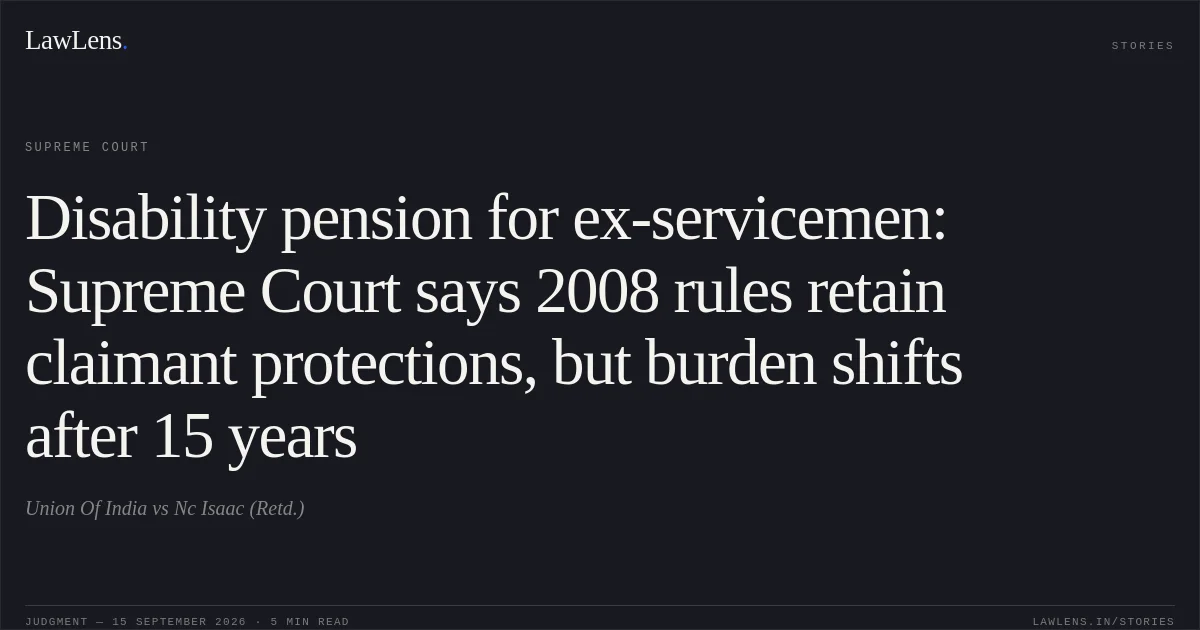
The Court held that the Entitlement Rules, 2008, assuming their legal efficacy, substantially reproduce the 1982 scheme, subject principally to Rule 7’s fifteen-year exception shifting the burden of proof to the claimant in belated claims.
It clarified that Medical Board opinions must receive due weight and cannot be substituted merely because another view is possible, but must be scrutinised for reasons, relevant considerations and procedural legality.
Source reference: para. 39(ii); p. 92All appeals and special leave petitions were dismissed on the grounds of delay as well as merits; pending matters were directed to be examined in accordance with the clarified principles, and there was no order as to costs.
Source reference: paras. 39–41; pp. 92–93Acts & Sections Cited
1 provisions across 1 statute referred to in this judgment. Each provision opens on LawLens.
Army Act, 19501
Original Court PDF
Union Of IndiavsNc Isaac (Retd.)
Click to open original judgment
Original judgment, available to read, download and summarize on LawLens.in