Facts
The minor daughter of the second respondent underwent ear surgery at Prasad ENT Hospital, developed complications, was referred to Sugam Hospital and then Rajiv Gandhi Government General Hospital, and died on 17 February 2023.
Source reference: p.3–4The post-mortem attributed death to the combined effect of sepsis and occlusive coronary artery disease.
Source reference: p.3–4Police initially registered Crime No.122 of 2023 under Section 174 Cr.P.C. and, relying on a Medical Expert Committee opinion that there was no medical negligence, filed a closure report.
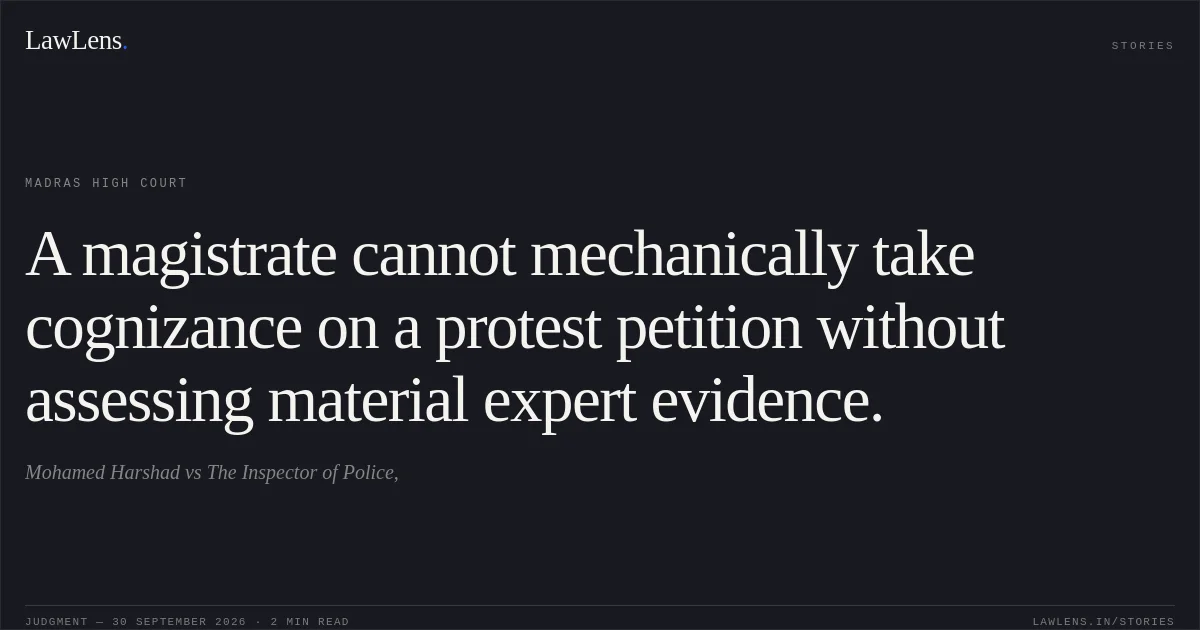
Source reference: p.3–5, 9–10The second respondent filed a protest petition, which the Magistrate treated as a private complaint and took cognizance against eight accused, including the petitioner, A4, for offences including conspiracy and other IPC offences.
Source reference: p.2–3The petitioner sought quashing under Section 528 of the BNSS.
Source reference: p.1Issues
1. Whether the Magistrate’s order taking cognizance on the protest petition, and issuing summons in C.C.No.333 of 2025, was liable to be quashed.
Source reference: p.10–112. Whether the proceedings could be quashed for all accused, including those who had not themselves petitioned for quashing.
Source reference: p.10–11Law Applied
The petition was brought under Section 528 of the Bharatiya Nagarik Suraksha Sanhita, 2023, invoking the High Court’s inherent jurisdiction to seek quashing.
Source reference: p.1The FIR had originally been registered under Section 174 of the Code of Criminal Procedure, 1973.
Source reference: p.3The Court considered the alleged IPC offences, the post-mortem report and the Medical Expert Committee’s opinion; it found that the materials did not disclose medical negligence or the essential ingredients of conspiracy, common intention, or the other alleged offences.
Source reference: p.2, 4–5The judgment cites no precedent or specific statutory test governing review of cognizance on a protest petition.
Source reference: p.10–11Reasoning
The Court relied on the post-mortem report and the Medical Expert Committee’s conclusion that the treatment records disclosed no medical negligence, and found no material showing a meeting of minds or concerted action among the accused.
Source reference: p.4–5It further held that the Magistrate had taken cognizance without examining witnesses or adequately considering the expert opinion, and had relied on the complainant’s objections concerning delayed service of the closure report and the alleged alteration or inadequacy of the expert opinion.
Source reference: p.10In the Court’s view, the resulting order was mechanical and infirm.
Source reference: p.10–11Holding
The High Court allowed the petition and quashed the proceedings in C.C.No.333 of 2025.
Although only the petitioner had sought quashing, the Court extended the relief to all accused in order to meet the ends of justice.
Source reference: p.11Connected miscellaneous petitions were closed.
Source reference: p.11Acts & Sections Cited
14 provisions across 3 statutes referred to in this judgment. Each provision opens on LawLens.
Bharatiya Nagarik Suraksha Sanhita, 20231
Indian Penal Code, 1860
Code of Criminal Procedure, 19731
Original Court PDF
Mohamed HarshadvsThe Inspector of Police,
Click to open original judgment
Original judgment, available to read, download and summarize on LawLens.in