Facts
Respondent No. 2 alleged that the petitioners formed an unlawful assembly and attempted to enter his institution’s office on 13 March 2025, followed by an altercation and physical assault.
Source reference: p. 3–4He claimed that the police and Deputy Superintendent of Police did not act on his complaint, and therefore filed a private complaint under Section 223 of the Bharatiya Nagarik Suraksha Sanhita, 2023 (BNSS), supported by an affidavit.
Source reference: p. 3–4The Magistrate referred the complaint to the police for registration and investigation, leading to Crime No. 186/2026 under Sections 331(5), 324(4), 352, 115 and 190 of the Bharatiya Nyaya Sanhita, 2023 (BNS).
Source reference: p. 3–4The petitioners, who were named as accused, sought to quash the complaint and challenged the registration of the FIR, arguing that the Magistrate had acted mechanically and failed to consider an earlier complaint by Petitioner No. 1, registered as Crime No. 62/2025.
Source reference: p. 4–5Issues
1. Whether the Magistrate’s referral of the private complaint to the police for registration and investigation, under Section 223 BNSS, warranted interference under Article 226 of the Constitution.
Source reference: p. 5–72. Whether the existence of the earlier complaint registered as Crime No. 62/2025 rendered the registration of the present case unlawful or otherwise justified quashing it.
Source reference: p. 5, 7Law Applied
The Court considered Section 223 BNSS, under which the complainant had approached the Magistrate by private complaint, and Article 226 of the Constitution, under which the petitioners sought writ relief.
Source reference: p. 3–4It also noted the BNS provisions under which the police had registered the case.
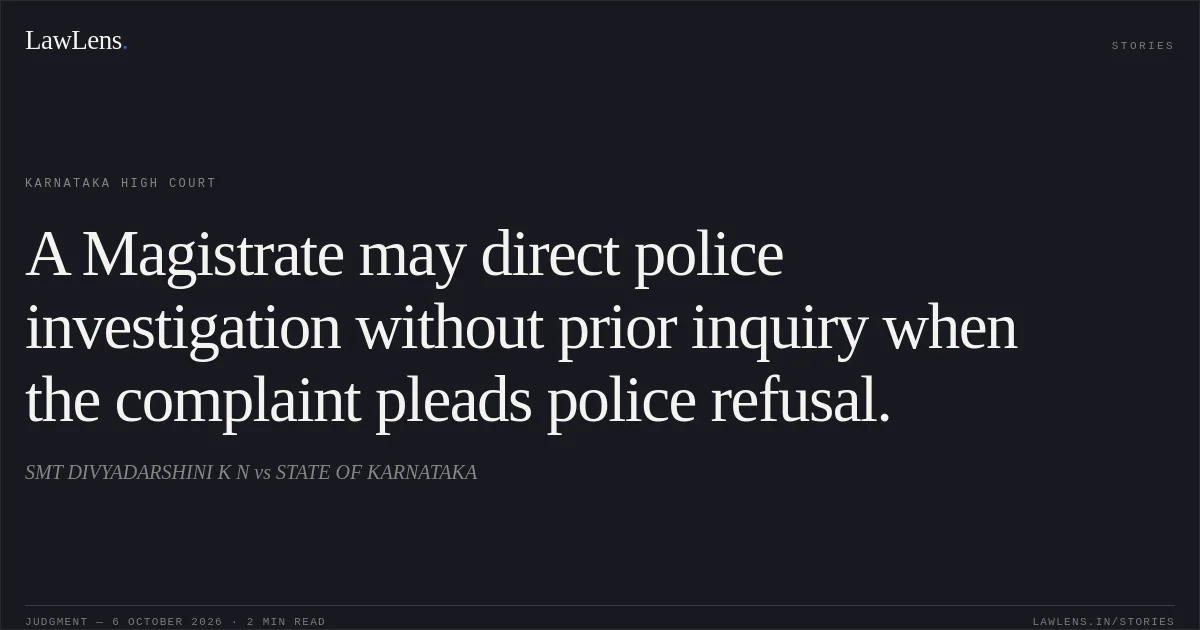
Source reference: p. 3–4The Court’s stated principle was that, where a complaint specifically alleges prior unsuccessful attempts to obtain police action and is supported by an affidavit, the Magistrate’s referral of the matter to the police for registration and investigation is not, on that basis, shown to be illegal or perverse.
Source reference: p. 6–7An earlier complaint by an accused is a relevant matter for the police to consider during investigation, but does not by itself establish that the present FIR must be quashed.
Source reference: p. 6–7Reasoning
The Court found that the private complaint was supported by an affidavit and specifically recorded that the complainant had approached both the police station and the Deputy Superintendent of Police without obtaining action.
Source reference: p. 6–7In those circumstances, it held that the Magistrate’s decision to refer the matter to the police could not be faulted merely because the Magistrate did not first make a further inquiry into the complaint’s contents.
Source reference: p. 6The earlier case initiated by Petitioner No. 1 did not establish illegality in the present referral; instead, the police were required to investigate both matters and submit appropriate reports in accordance with law.
Source reference: p. 7The challenge was therefore premature, as the petitioners had not shown that the referral suffered from illegality or perversity warranting writ interference.
Source reference: p. 7Holding
The Court dismissed the writ petition and declined to quash the private complaint or interfere with the registration of Crime No. 186/2026.
It left the police to investigate the present case and the earlier Crime No. 62/2025 and to file appropriate reports in accordance with law.
Source reference: p. 7Acts & Sections Cited
9 provisions across 2 statutes referred to in this judgment. Each provision opens on LawLens.
Bharatiya Nyaya Sanhita, 20238
Bharatiya Nagarik Suraksha Sanhita, 20231
Original Court PDF
SMT DIVYADARSHINI K NvsSTATE OF KARNATAKA
Click to open original judgment
Original judgment, available to read, download and summarize on LawLens.in