Facts
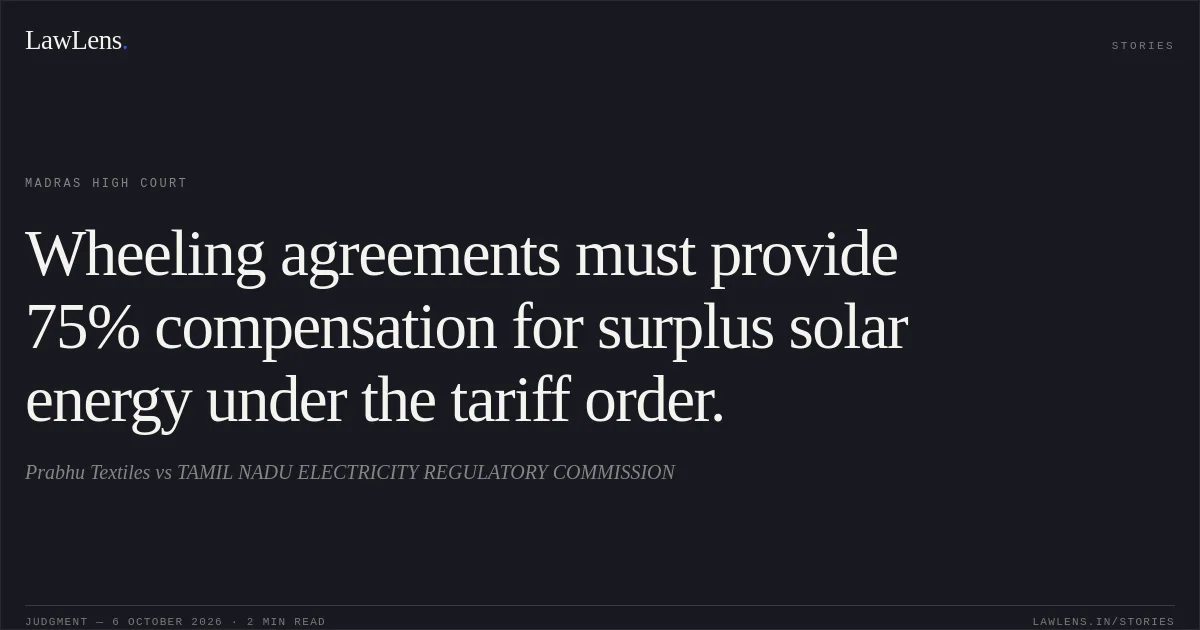
The petitioners sought revision of clauses in their Energy Wheeling Agreements which, they contended, were inconsistent with paragraph 5.5.8 of the Tamil Nadu Electricity Regulatory Commission’s Solar Tariff Order No. 9 of 2020.
Source reference: p. 3–6They sought payment for unutilised surplus solar energy at 75% of the competitively discovered tariff, stated to be ₹3.04 per unit.
Source reference: p. 3–6The Court was referred to earlier writ orders directing revision of similar agreement clauses in light of the Commission’s order in M.P. No. 47 of 2021, dated 11 May 2023.
Source reference: p. 7–10The respondents submitted that an appeal against the Commission’s order was pending before APTEL.
Source reference: p. 10–11Issues
1. Whether the respondents should be directed to revise the petitioners’ Energy Wheeling Agreement clauses to conform to paragraph 5.5.8 of Solar Tariff Order No. 9 of 2020 and settle amounts payable for surplus energy.
Source reference: p. 3–6, 10–112. Whether compliance with those directions should await the outcome of the appeal pending before APTEL.
Source reference: p. 10–11Law Applied
Article 226 of the Constitution empowers the High Court to issue appropriate writs, including mandamus.
Source reference: no citationParagraph 5.5.8 of Solar Tariff Order No. 9 of 2020, as considered by the Commission in M.P. No. 47 of 2021, provides for payment for energy supplied over and above the sanctioned limit at 75% of the tariff fixed by the Commission or, where no tariff is fixed, at 75% of the tariff discovered through competitive bidding; the Commission also found the inconsistent agreement clause contrary to the tariff order and Regulation 7 of the Power Procurement from New and Renewable Sources of Energy Regulations, 2008.
Source reference: p. 8–9The Court followed its earlier orders in W.P. No. 31457 of 2025 and W.P. No. 49777 of 2025, which had directed amendment of similar agreements.
Source reference: p. 7–10Reasoning
The Court treated the issue as covered by its earlier decisions, which had relied on the Commission’s finding that inconsistent agreement terms could not displace the applicable tariff order.
Source reference: p. 7–10Applying that approach, it directed the respondents to revise the relevant clauses in the petitioners’ agreements and to settle any amount payable after modification.
Source reference: p. 11Although an appeal was pending before APTEL, the Court held that the respondents need not defer compliance; they could proceed in accordance with law after APTEL decides the matter.
Source reference: p. 10–11Holding
The writ petitions were disposed of with a direction to respondents 2 to 4 to revise the relevant agreement clauses by incorporating paragraph 5.5.8 of the tariff order within six weeks from uploading of the web copy.
Any amount found payable is to be settled within eight weeks thereafter.
Source reference: p. 11Compliance is not to await APTEL’s decision, but the authorities may act in accordance with law once that decision is made.
Source reference: p. 11No costs were ordered.
Source reference: p. 11Acts & Sections Cited
6 provisions across 5 statutes referred to in this judgment. Linked provisions open on LawLens.
Solar Tariff Order No. 9 of 2020 dated 16.10.2020 (Order No.9/20, passed in T.A.No.9 of 2020)1
Energy Wheeling Agreement dated 25.02.2026 (SPG No.069514430159)1
Energy Wheeling Agreement dated 13.03.20261
Energy Wheeling Agreement dated 31.03.20222
Energy Wheeling Agreement dated 03.03.20211
Original Court PDF
Prabhu TextilesvsTAMIL NADU ELECTRICITY REGULATORY COMMISSION
Click to open original judgment
Original judgment, available to read, download and summarize on LawLens.in