Facts
Respondent No. 2 filed a private complaint alleging offences under Sections 448, 323, 343, 347, 356 and 506B read with Section 34 of the IPC. The complaint was referred to the police for investigation, and the police registered an FIR and filed a ‘B’ Final Report.
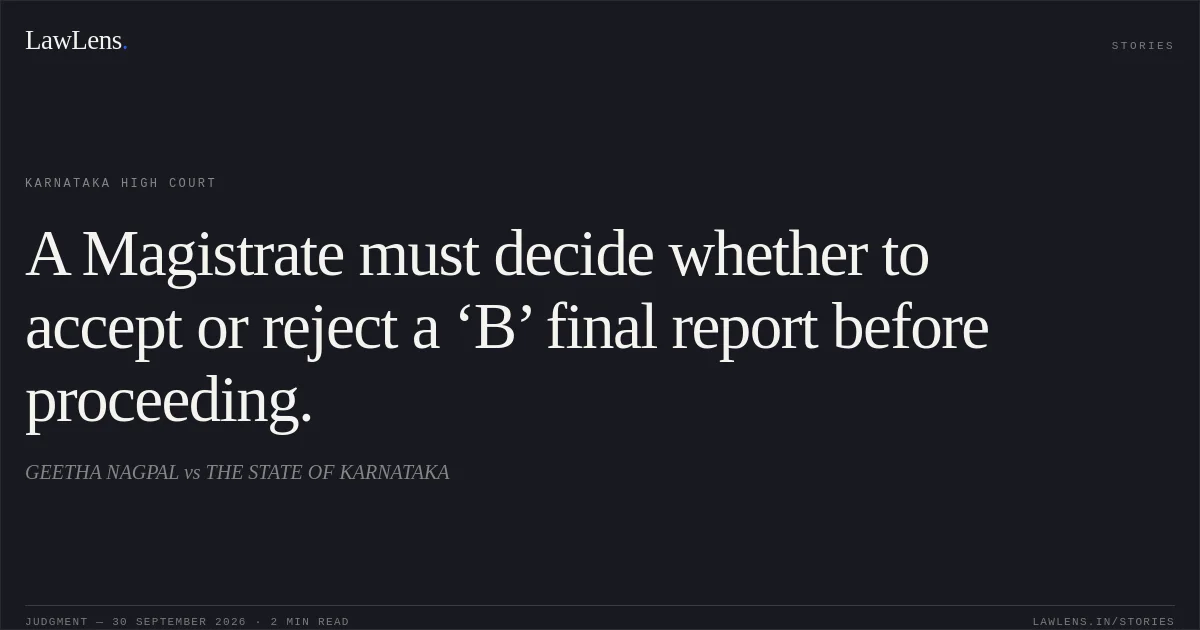
Source reference: p. 5, paras. 4–5After the complainant filed a protest petition, the Magistrate recorded the complainant’s sworn statement and registered a criminal case without first accepting or rejecting the ‘B’ Final Report.
Source reference: p. 5, para. 6During the petition, the third petitioner died, and the petition was dismissed as abated insofar as he was concerned.
Source reference: p. 3, para. 1Issues
1. Whether the Magistrate could proceed to record the complainant’s sworn statement and register the criminal case without first deciding whether to accept or reject the police ‘B’ Final Report.
Source reference: pp. 5–6, paras. 6–72. Whether the Magistrate’s failure to decide the ‘B’ Final Report warranted interference under Article 227 of the Constitution and Section 482 of the CrPC.
Source reference: pp. 6–7, paras. 10–11Law Applied
The Court invoked Article 227 of the Constitution and the inherent jurisdiction under Section 482 of the CrPC to address the Magistrate’s procedural error.
Source reference: pp. 6–7, para. 10Where police have filed a ‘B’ Final Report, the Magistrate must pass an order accepting or rejecting that report before proceeding further with the criminal case; proceeding without such a decision is illegal and may warrant supervisory or inherent-court intervention.
Source reference: pp. 6–7, paras. 10–11Reasoning
The police had completed their investigation and filed a ‘B’ Final Report, but the Magistrate proceeded on the complainant’s protest petition without first ruling on that report.
Source reference: p. 5, paras. 5–6The Court treated this omission as a crucial procedural lapse that rendered the subsequent proceedings illegal, regardless of the merits of the allegations. It therefore found intervention under Article 227 and Section 482 warranted.
Source reference: pp. 6–7, para. 10Holding
The petition was allowed as to the surviving petitioners, and the petition was dismissed as abated insofar as the deceased third petitioner was concerned.
The Magistrate’s order and the resulting registration of the criminal case were set aside. The matter was remitted to the Magistrate for fresh disposal after affording the parties an opportunity to be heard and passing appropriate orders in accordance with law.
Source reference: p. 7, para. 11Acts & Sections Cited
10 provisions across 2 statutes referred to in this judgment. Each provision opens on LawLens.
Code of Criminal Procedure, 19732
Indian Penal Code, 18608
Original Court PDF
GEETHA NAGPALvsTHE STATE OF KARNATAKA
Click to open original judgment
Original judgment, available to read, download and summarize on LawLens.in