Facts
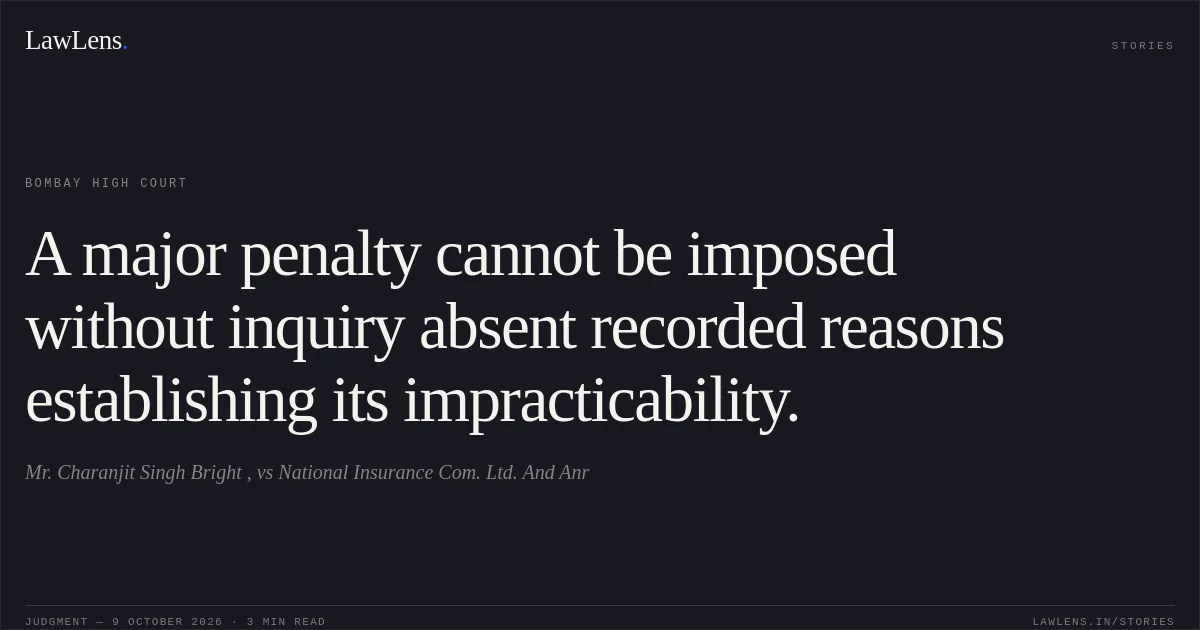
The petitioner, an employee of National Insurance Company Ltd., was removed from service by order dated 8 April 2013 after prolonged absence. The company imposed the penalty without notice or a hearing, relying on Rule 30(ii) and (iv) of the General Insurance (Conduct, Discipline and Appeal) Rules, 1975.
Source reference: paras. 12–20, 42–45, pp. 6–8, 20–21The petitioner challenged the removal and the appellate order dated 5 June 2017, contending that his absence was due to serious illness and that the company had not established abandonment of service. He also sought back wages and retirement benefits. The Court confined its consideration to the 2013 removal and 2017 appellate orders; it did not consider the challenges to the 2009 orders because they were raised belatedly.
Source reference: paras. 12–20, 42–45, pp. 6–8, 20–21Issues
1. Whether the respondents could impose removal without a regular inquiry by invoking Rule 30(ii), absent recorded reasons establishing that an inquiry was not reasonably practicable.
Source reference: paras. 43–52, pp. 20–292. Whether the petitioner’s prolonged absence amounted to abandonment of his post under Rule 30(iv), in light of his medical condition and communications with the respondents.
Source reference: paras. 53–55, pp. 29–313. Whether the writ petition was maintainable and, if so, what relief the petitioner was entitled to.
Source reference: paras. 58–61, pp. 32–34Law Applied
Rules 23 and 25 of the 1975 Rules provide for penalties, including removal, and the inquiry procedure ordinarily required before a major penalty is imposed; Rule 30 permits departure from that procedure in specified circumstances. Under Rule 30(ii), dispensing with an inquiry requires the competent authority to record in writing, on objective material, why it is not reasonably practicable to hold one.
Source reference: paras. 45–51, pp. 21–29The principles in Union of India v. Tulsiram Patel, (1985) 3 SCC 398, Jaswant Singh v. State of Punjab, (1991) 1 SCC 362, Chief Security Officer v. Singasan Rabi Das, (1991) 1 SCC 729, and Manohar Lal v. Commissioner of Police, 2026 SCC OnLine SC 363, establish that this exceptional power is judicially reviewable and cannot rest on the authority’s ipse dixit.
Source reference: paras. 45–51, pp. 21–29Rule 30(iv) and its Explanation address abandonment, but, applying Noble Paints Pvt. Ltd. v. Ashok Tukaram Shinde, LAWS(BOM) 2003-9-66, abandonment turns on intention assessed from the surrounding circumstances and is not presumed from absence alone.
Source reference: para. 54, p. 30The Court also held that a writ petition may lie against Respondent No. 1, which it found to be “State” under Article 12, where the challenge concerns wrongful removal and the appeal has been exhausted.
Source reference: para. 58, p. 32Reasoning
The removal order disclosed no reasons for dispensing with an inquiry under Rule 30(ii), and the appellate order did not cure that defect; it relied only on the petitioner’s non-attendance at an earlier inquiry. The Court therefore found the Rule’s mandatory precondition unsatisfied.
Source reference: paras. 46, 52, pp. 22–23, 29–32As to Rule 30(iv), the petitioner’s medical records, requests for transfer and leave, communications with the employer, and application under the Voluntary Separation Scheme were inconsistent with an intention to sever the employment relationship. The respondents’ own deputation of a retired ACP to verify the petitioner’s illness, and their withholding of the resulting report, further informed the Court’s assessment. The Court accordingly found that abandonment had not been established and that neither Rule 30(ii) nor Rule 30(iv) justified dispensing with the prescribed inquiry.
Source reference: paras. 46, 52–56, pp. 22–23, 29–32It rejected the maintainability objection because Respondent No. 1 was “State” and the petitioner challenged wrongful removal after exhausting the appeal; loan defaults did not bar relief, as the respondents had separate recovery proceedings.
Source reference: paras. 58–60, pp. 32–33The Court declined back wages for periods when the petitioner was on leave or not working.
Source reference: para. 61, p. 33Holding
The Court allowed the petition in part, quashing the removal order dated 8 April 2013 and appellate order dated 5 June 2017.
It directed payment of back wages, if any, only for periods when the petitioner was actually working and not on leave, and ordered release of retirement benefits, including pension, and provident fund dues, with simple interest at 9% per annum from the date of superannuation until payment. The Rule was made absolute in those terms, with no order as to costs.
Source reference: pp. 33–35Acts & Sections Cited
2 provisions across 1 statute referred to in this judgment. Linked provisions open on LawLens.
the 1978 Act (alias, unresolved)2
Original Court PDF
Mr. Charanjit Singh Bright ,vsNational Insurance Com. Ltd. And Anr
Click to open original judgment
Original judgment, available to read, download and summarize on LawLens.in