Facts
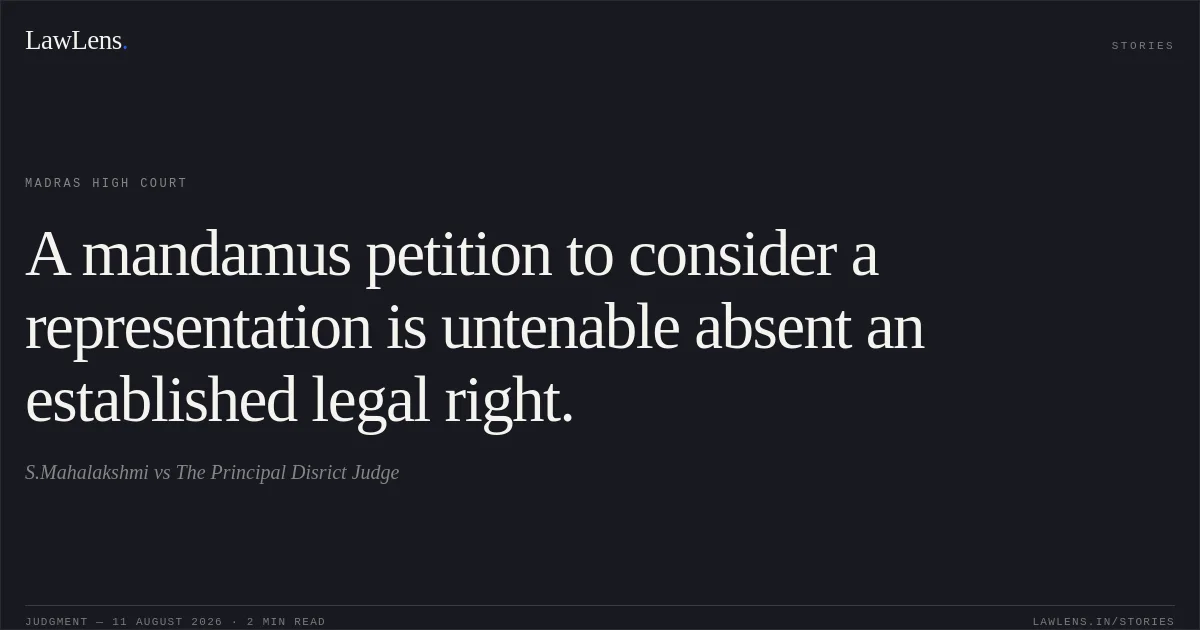
The seven petitioners approached the Madras High Court under Article 226 of the Constitution seeking a writ of mandamus directing the Principal District Judge, Dharmapuri, to consider their representations requesting appointment by transfer of service to the post of Typist under Rule 3(g), read with G.O.Ms.No.43, Personnel and Administrative Reforms (Per.B) Department, dated 15 February 1994.
Source reference: p.2The petitioners sought directions for consideration and disposal of their representations within a time frame fixed by the Court.
Source reference: p.2The respondents were the Principal District Judge, Dharmapuri District Judiciary, and the Registrar General of the Madras High Court.
Source reference: p.1–2Issues
Whether the petitioners could maintain a writ petition under Article 226 merely seeking consideration of their representations for appointment by transfer, without establishing an enforceable legal right to such appointment.
Source reference: p.3–4Whether the mere submission of representations or applications created any right to appointment by transfer or required the respondents to consider and act upon them.
Source reference: p.3–4Law Applied
Appointments and promotions must be made strictly in accordance with the applicable Service Rules.
Source reference: p.3A mere representation or application does not confer a right to appointment or promotion, nor does it by itself provide a basis for invoking the writ jurisdiction under Article 226 of the Constitution.
Source reference: p.3A selection process must first be initiated by the employer for appointment by transfer or promotion; only thereafter may eligible employees submit applications in accordance with the governing rules.
Source reference: p.3The Court also treated Rule 3(g), read with G.O.Ms.No.43 dated 15 February 1994, as subject to the requirement that any appointment by transfer must conform to the applicable service framework.
Source reference: p.2–3Reasoning
The Court held that the petitioners had relied only on the submission of representations seeking appointment by transfer and had not established any corresponding statutory or enforceable right to such appointment.
Source reference: p.3–4Since no selection or recruitment process had been shown to have been initiated by the employer, the petitioners could not require the respondents to consider their individual representations as a matter of right.
Source reference: p.3The Court further reasoned that directing consideration of a representation, in the absence of an established legal right, would serve no useful purpose and that the mere procedural act of submitting an application could not confer entitlement to appointment.
Source reference: p.3–4Accordingly, the writ petition was found to be misconceived.
Source reference: p.4Holding
The Court answered the issues against the petitioners and dismissed the writ petition, holding that the petitioners had neither established a right to appointment by transfer nor a valid cause of action for seeking a mandamus to consider their representations.
No costs were awarded.
Source reference: p.4The connected miscellaneous petition seeking permission to file a single writ petition was ordered on payment of separate court fees.
Source reference: p.4Original Court PDF
S.MahalakshmivsThe Principal Disrict Judge
Click to open original judgment
Original judgment, available to read, download and summarize on LawLens.in