Facts
The State appealed the acquittal of Rahul by the 5th Additional District and Sessions Judge (Special Court), Kalaburagi, on charges under Sections 376(2)(n), 406 and 417 of the Indian Penal Code (IPC).
Source reference: p. 3, p. 10–11The prosecution alleged that the complainant and Rahul were in a relationship and that he repeatedly had sexual intercourse with her on a promise of marriage, which he later refused to honour.
Source reference: p. 4–5At trial, the prosecution examined 15 witnesses and produced 32 documents; the complainant testified, while the lodge and medical evidence did not independently establish the alleged offences.
Source reference: p. 6, p. 13–16The trial court acquitted Rahul, finding the charges unproved beyond reasonable doubt.
Source reference: p. 9–10Issues
1. Whether the State established that the trial court’s judgment and order of acquittal was arbitrary or erroneous
Source reference: para. 162. What order should follow
Source reference: para. 16Law Applied
Under Sections 376(2)(n), 406 and 417 IPC, the prosecution had to prove the charged offences beyond reasonable doubt.
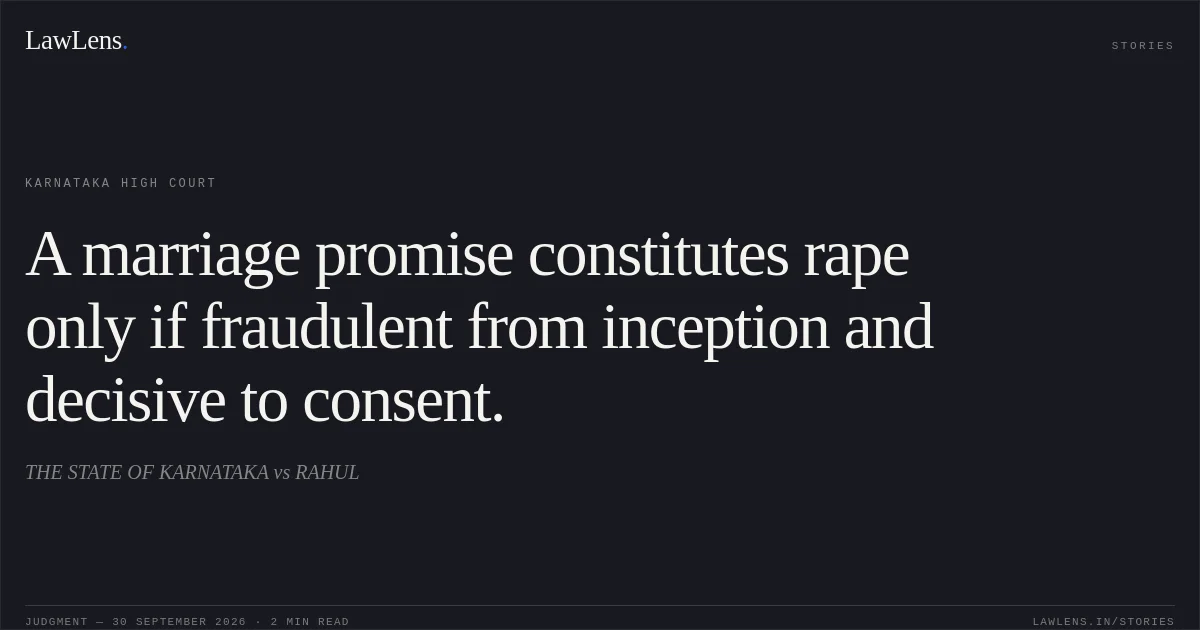
Source reference: no citationA sexual relationship following a promise to marry does not, by itself, constitute rape: the promise must have been false from the outset, made without an intention to fulfil it, and have directly induced consent to sexual relations (Nitin B. Nikhare v. State of Maharashtra and Jaspal Singh Kaural v. State of NCT of Delhi).
Source reference: para. 33, para. 35Cheating under Sections 415 and 417 IPC requires fraudulent or dishonest inducement (Tilak Raj v. State of Himachal Pradesh).
Source reference: para. 38–39On an appeal against acquittal, the appellate court may reappraise the evidence but should not interfere where the trial court’s view is a reasonable or possible one; where two views are possible, the view favourable to the accused is ordinarily adopted (H.D. Sundara v. State of Karnataka; Chandrappa v. State of Karnataka).
Source reference: para. 40, para. 43Reasoning
The High Court considered the complainant’s testimony alongside her statements to the police and Magistrate, the evidence of her parents and lodge witnesses, and the medical evidence.
Source reference: para. 18–29It noted that the complainant’s Section 164 statement did not disclose the alleged relationship and repeated physical relationship from 2019 to 2022, and that the evidence did not establish that Rahul’s promise to marry was dishonest from the outset or that he had made the necessary inducement.
Source reference: para. 31–36The Court also found insufficient evidence of breach of trust under Section 406 IPC and of the inducement required for cheating under Section 417 IPC.
Source reference: para. 37–39Applying the principles governing appeals against acquittal, it held that the trial court’s view was not erroneous or unreasonable.
Source reference: para. 40–48Holding
The Court answered the first issue in the negative and dismissed the State’s appeal.
It confirmed the trial court’s judgment acquitting Rahul of offences under Sections 376(2)(n), 406 and 417 IPC.
Source reference: para. 50Acts & Sections Cited
14 provisions across 3 statutes referred to in this judgment. Each provision opens on LawLens.
Bharatiya Nagarik Suraksha Sanhita, 20231
Indian Penal Code, 18606
Code of Criminal Procedure, 19737
Original Court PDF
THE STATE OF KARNATAKAvsRAHUL
Click to open original judgment
Original judgment, available to read, download and summarize on LawLens.in