01Facts
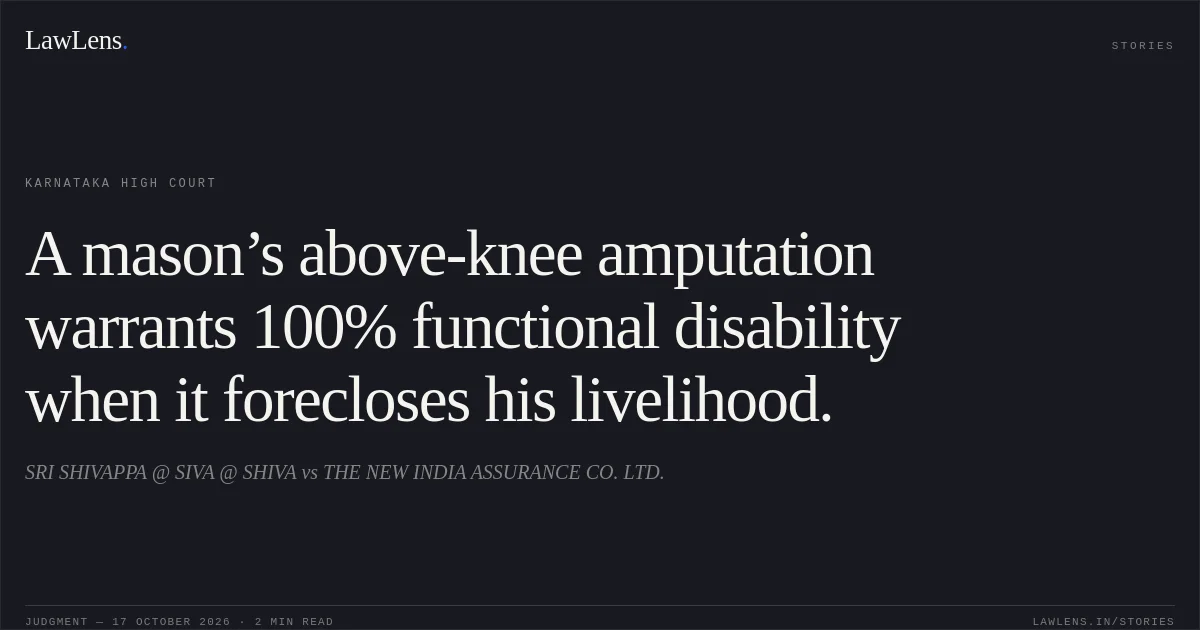
The claimant, a 36-year-old mason, sustained serious injuries in a road accident on 12 February 2018, resulting in amputation of his right leg above the knee and permanent disability to his right arm.
pp. 3–5 · ¶ 1, 3–5The MACT assessed his monthly income at ₹11,000, treated his disability as 50%, and awarded total compensation of ₹18,74,969 with interest at 7.5% per annum.
pp. 3–5 · ¶ 1, 3–5The claimant appealed seeking enhancement, including reassessment of income and functional disability, future prospects, and future medical expenses for a prosthetic limb
pp. 3–5, 19–20 · ¶ 1, 3–5, 12.102Issues
i.Whether the claimant’s functional disability and consequent loss of future earning capacity should be assessed at 100%, having regard to his amputation and occupation as a mason.
pp. 12–19 · ¶ 9–12ii.Whether the claimant’s income, future prospects, and compensation for attendant care and future medical expenses required enhancement.
pp. 5, 19–20 · ¶ 4–5, 12.103Law Applied
Under Section 173(1) of the Motor Vehicles Act, an appeal lies to the High Court against a MACT award.
p. 1Applying Raj Kumar v. Ajay Kumar, the percentage of physical disability cannot automatically be equated with loss of earning capacity; the tribunal must assess the effect of the disability on the claimant’s occupation and earning capacity.
pp. 12–16 · ¶ 9The Court also applied M. Paramesh v. VRL Logistics Ltd., which held that amputation may amount to 100% functional disability where it prevents an injured person from continuing the physical occupation that was his source of livelihood; that decision also recognised the need to account for future prosthesis-related expenses.
pp. 16–18 · ¶ 10Provisions in the judgment · 1 · Linked ones open on LawLens
Motor Vehicles Act, 1988 Section 173
04Reasoning
The Court considered the claimant’s amputation above the knee, his 49% disability in the right arm, and evidence that he required assistance with daily activities and could not return to masonry.
pp. 8–18 · ¶ 7–12Applying Raj Kumar and M. Paramesh, it found that the claimant’s functional loss of earning capacity was 100%, notwithstanding the Tribunal’s lower disability assessment.
pp. 8–18 · ¶ 7–12It adopted monthly income of ₹12,500 for the year of the accident, added 40% for future prospects, and applied a multiplier of 15, calculating future loss of earning capacity at ₹31,50,000.
pp. 19–20 · ¶ 12.1It also enhanced compensation for attendant, food and conveyance expenses, laid-up-period loss of income, and future medical expenses, including the prosthesis.
pp. 19–20 · ¶ 12.105Holding
The appeal was allowed in part.
pp. 20–22 · ¶ 13–14The Court enhanced total compensation from ₹18,74,969 to ₹42,88,969, with interest at 7.5% per annum, and directed the insurer to deposit the enhanced amount with applicable interest within eight weeks of receiving the judgment.
pp. 20–22 · ¶ 13–14The remaining parts of the Tribunal’s award were left undisturbed, and no order as to costs was made.
pp. 20–22 · ¶ 13–14Original Court PDF
SRI SHIVAPPA @ SIVA @ SHIVAvsTHE NEW INDIA ASSURANCE CO. LTD.
Click to open original judgment
Original judgment, available to read, download and summarize on LawLens.in