Facts
Birju Yadav alleged in a fardbeyan recorded at Sadar Hospital on 18 January 2019 that the appellant and three others assaulted him with weapons.
Source reference: paras. 3–6, 9–12He died the following day.
Source reference: paras. 3–6, 9–12The appellant was charged and convicted by the Additional Sessions Judge-III, Lakhisarai under Sections 341/34, 324/34, 326/34 and 302/34 IPC and sentenced, inter alia, to life imprisonment
Source reference: paras. 3–6, 9–12On appeal, the High Court considered challenges to the reliability of the fardbeyan as a dying declaration and to the remaining prosecution evidence
Source reference: paras. 13–18Issues
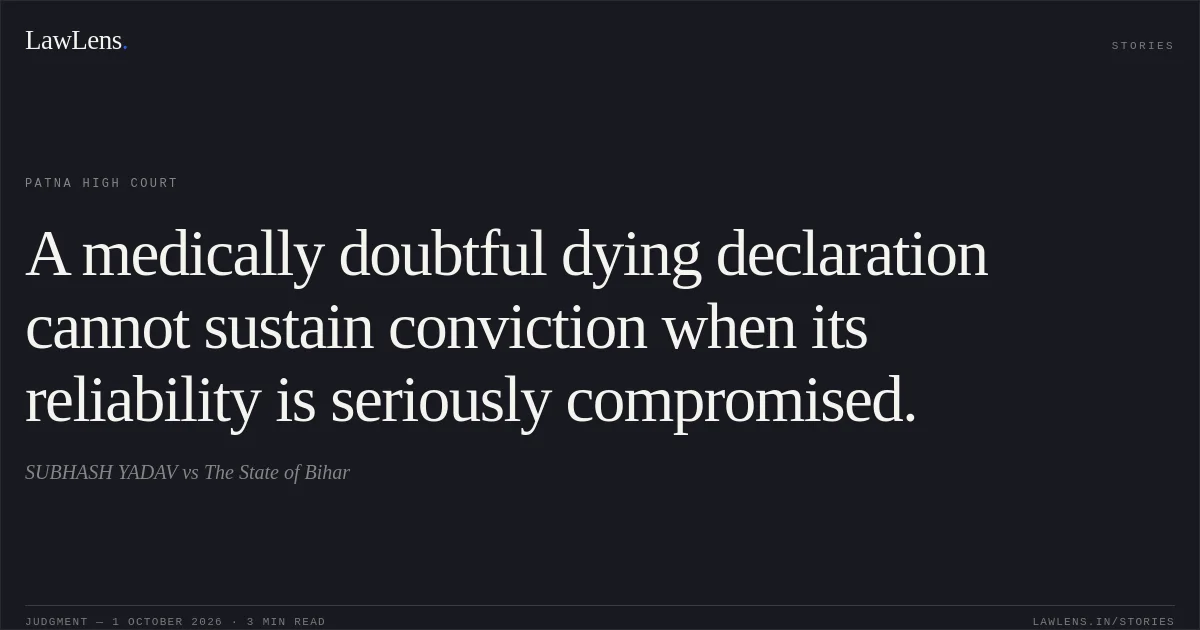
Whether the deceased’s fardbeyan could safely be relied upon as a dying declaration despite the absence of medical confirmation of fitness and the circumstances surrounding its recording.
Source reference: paras. 19–27Whether the remaining evidence established the appellant’s guilt beyond reasonable doubt, including in light of the alleged suppression of an earlier statement, non-production of the recorded videographic statement, and the failure to put the dying declaration to the appellant under Section 313 CrPC.
Source reference: paras. 19, 26–33Law Applied
The Court considered the charged offences under Sections 341, 324, 326 and 302 IPC, read with Section 34, and treated the deceased’s statement as a purported dying declaration.
Source reference: paras. 20, 24, 26It relied on *Surjit Singh v. State of Punjab*, (2024) 2 SCC 411, concerning the scrutiny required where a dying declaration’s maker’s fitness is in doubt; *Suresh Sahu v. State of Bihar (Now Jharkhand)*, 2025 SCC OnLine SC 2637, on assessing the deceased’s capacity to speak in light of injuries and the absence of treatment records; and *Tomaso Bruno v. State of Uttar Pradesh*, (2015) 7 SCC 178, on drawing an adverse inference under Section 114, Illustration (g), of the Evidence Act when material evidence in the prosecution’s possession is withheld.
Source reference: paras. 20, 24, 26The Court also relied on *Munna Shukla v. State of Bihar*, 2020 SCC OnLine Pat 1980, and *Aejaz Ahmad Sheikh v. State of Uttar Pradesh*, 2025 SCC OnLine SC 913, regarding the significance of putting incriminating evidence to an accused under Section 313 CrPC.
Source reference: paras. 28–30Reasoning
The Court found that the formal FIR was registered at 4:30 p.m., fifty minutes before the deceased’s fardbeyan was recorded at 5:20 p.m.; PW-1 had stated that he gave a statement at 4:30 p.m., but that earlier version was not made the basis of the FIR.
Source reference: para. 19The recording officer admitted that the treating doctor had not permitted the statement to be recorded, and the prosecution produced neither medical records establishing the deceased’s fitness nor the videographic statement that the investigating officer said had been made.
Source reference: paras. 20–27Given the nature and number of the deceased’s injuries, the Court doubted that he could have made the detailed statement attributed to him.
Source reference: paras. 22–25It further noted that the alleged dying declaration was not put to the appellant under Section 313 CrPC, that the stated motive differed between accounts, and that the claimed eyewitnesses’ presence was not established in the relevant statements.
Source reference: paras. 28–32Taken together, these deficiencies undermined the prosecution case beyond reasonable doubt.
Source reference: para. 33Holding
The High Court held that the trial court had erred in relying on the fardbeyan as a dying declaration and that the prosecution had not proved the appellant’s guilt beyond reasonable doubt.
It set aside the conviction and sentence, acquitted the appellant on all charges by giving him the benefit of doubt, and directed his release forthwith unless required in another case.
Source reference: paras. 34–35Acts & Sections Cited
10 provisions across 2 statutes referred to in this judgment. Each provision opens on LawLens.
Indian Penal Code, 18608
Code of Criminal Procedure, 19732
Original Court PDF
SUBHASH YADAVvsThe State of Bihar
Click to open original judgment
Original judgment, available to read, download and summarize on LawLens.in