Facts
The petitioners instituted a suit for partition and permanent injunction concerning Plot No. 167, asserting that the property continued to remain joint.
Source reference: no citationDefendant No. 2 relied upon a document dated 24.04.2003, stating that a Panchayat-mediated family settlement had already apportioned Plot Nos. 163 and 167 among the family members and that the parties had thereafter enjoyed their respective shares separately.
Source reference: para. 2The petitioners challenged the document as forged, unregistered, and insufficiently stamped, and sought its exclusion from evidence under Sections 17 and 49 of the Registration Act, 1908, read with Section 35 of the Indian Stamp Act, 1899.
Source reference: para. 2.1The Additional District Judge No. 2, Hanumangarh rejected the application, holding that the document was merely a memorandum recording an already concluded family arrangement.
Source reference: no citationThe petitioners invoked the supervisory jurisdiction of the High Court under Articles 226 and 227 of the Constitution.
Source reference: para. 1Issues
1. Whether the document dated 24.04.2003 was an operative instrument creating, declaring, or extinguishing rights in immovable property and was therefore compulsorily registrable under Section 17 of the Registration Act, 1908.
Source reference: paras. 3, 6–72. Whether the document was insufficiently stamped and inadmissible under Section 35 of the Indian Stamp Act, 1899, read with Section 49 of the Registration Act, 1908.
Source reference: paras. 1, 33. Whether the Trial Court’s order permitting the document to be relied upon disclosed any jurisdictional error, patent illegality, perversity, or material irregularity warranting interference under Article 227 of the Constitution.
Source reference: para. 7.3Law Applied
Section 17 of the Registration Act, 1908 requires registration of instruments that create, declare, assign, limit, or extinguish rights in immovable property.
Source reference: no citationSection 49 restricts the effect and admissibility of an unregistered document that is compulsorily registrable.
Source reference: no citationSection 35 of the Indian Stamp Act, 1899 bars admission in evidence of an instrument chargeable with duty unless it is duly stamped, subject to statutory procedure.
Source reference: no citationHowever, the legal character of a document is determined by its substance and the intention manifested by the parties, not by its nomenclature.
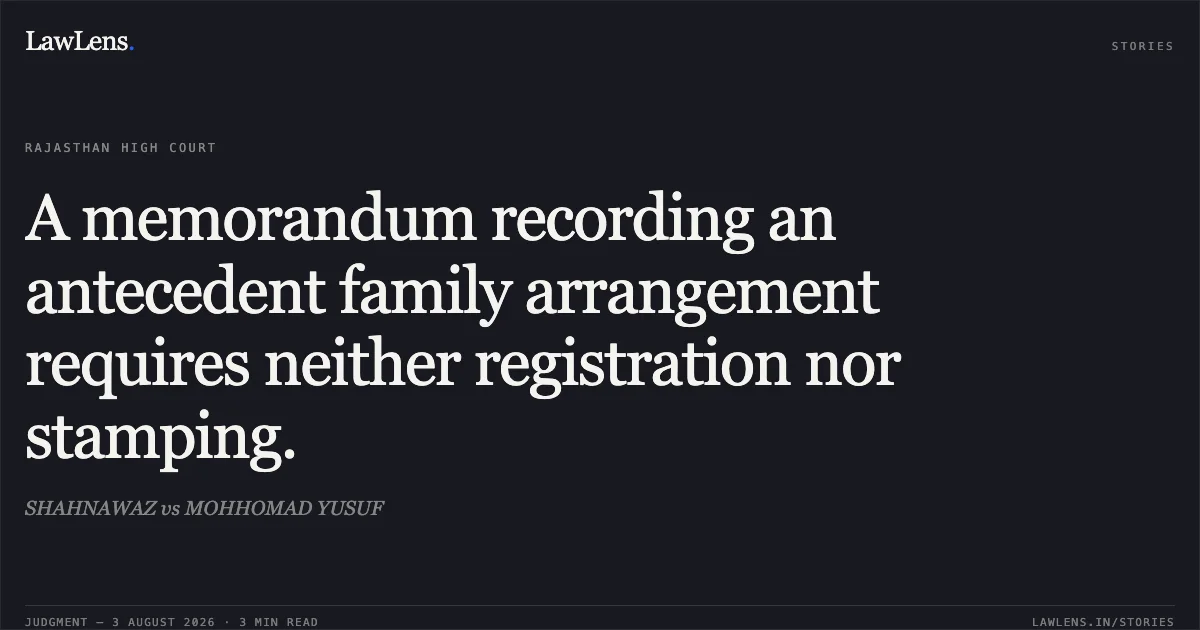
Source reference: para. 6A family arrangement concluded orally or otherwise antecedently, followed by a writing that merely records or acknowledges the completed arrangement, is a memorandum of an accomplished transaction and does not itself require compulsory registration under Section 17.
Source reference: para. 7.1The evidentiary worth, genuineness, and proof of such a document remain matters for trial.
Source reference: para. 7.1Reasoning
The High Court found that the document, on a prima facie reading, did not create, declare, or extinguish rights in presenti.
Source reference: para. 7Its recitals indicated that the family arrangement had previously been reached through Panchayat intervention and had been acted upon by the parties; the document merely recorded that antecedent arrangement.
Source reference: para. 7Accordingly, it was treated as a memorandum rather than the operative instrument effecting partition, and the objections based on compulsory registration and stamping were not accepted at the interlocutory stage.
Source reference: para. 7.1Whether the alleged arrangement had actually been concluded, whether the document genuinely recorded it, and what evidentiary weight it deserved were left for determination after appreciation of the evidence at trial.
Source reference: para. 7.2Since the Trial Court’s view was neither perverse nor manifestly erroneous and involved no jurisdictional error or material irregularity, interference under Article 227 was unwarranted.
Source reference: para. 7.3Holding
The Court held that the document dated 24.04.2003 could prima facie be treated as a memorandum evidencing a pre-existing family arrangement, rather than an instrument requiring compulsory registration and stamping.
It found no patent illegality or jurisdictional error in the Trial Court’s order dated 21.04.2026 rejecting the petitioners’ admissibility objection.
Source reference: para. 8The writ petition was dismissed, and the stay application and all pending applications were also disposed of.
Source reference: para. 8Acts & Sections Cited
3 provisions across 2 statutes referred to in this judgment. Each provision opens on LawLens.
Registration Act, 19082
Indian Stamp Act, 18991
Original Court PDF
SHAHNAWAZvsMOHHOMAD YUSUF
Click to open original judgment
Original judgment, available to read, download and summarize on LawLens.in