Facts
The respondent, a clerk of Syndicate Bank who was occasionally entrusted with cashier duties, received a cheque for ₹25,000 on 11 December 1989. He was required to adjust ₹5,000 towards an account and disburse the remaining ₹20,000 to an Assistant Manager, but allegedly left the branch without making the payment or accounting for the money.
Source reference: para. 2After the Bank’s complaint to the police, the respondent was traced on 13 December 1989. He executed a written acknowledgment and undertook to remit the amount; the entire ₹20,000 was subsequently deposited.
Source reference: para. 3The respondent was suspended and charge-sheeted for gross misconduct under Clause 19.5(j) of the Bipartite Settlement.
Source reference: para. 4A departmental enquiry was conducted in which he was represented by a defence representative, cross-examined the Bank’s witnesses and led defence evidence. The Enquiry Officer found the charge proved, following which the Disciplinary Authority dismissed him on 15 April 1993; the departmental appeal was dismissed on 16 July 1993.
Source reference: paras. 5–6The Central Government Industrial Tribunal held that the enquiry was fair and the misconduct was proved, but nevertheless set aside the dismissal on the ground that the Bank had violated Clauses 19.3 and 19.4 of the Bipartite Settlement by not paying three months’ pay and allowances in lieu of notice after allegedly taking steps to prosecute the respondent. It directed reinstatement with continuity of service and consequential benefits, without back wages.
Source reference: paras. 7–8, 30–31The Bank challenged the Award under Articles 226 and 227 of the Constitution.
Source reference: para. 9Issues
1. Whether the mere lodging of a police complaint amounted to the Bank having taken “steps to prosecute” the respondent within the meaning of Clauses 19.3 and 19.4 of the Bipartite Settlement, thereby requiring payment of three months’ pay and allowances in lieu of notice.
Source reference: paras. 24, 47–582. Whether the departmental enquiry and findings of misconduct were vitiated by vagueness of charges, procedural unfairness, coercion, lack of evidence or delay.
Source reference: paras. 32–453. Whether the punishment of dismissal was disproportionate to the proved misconduct and liable to interference in judicial review.
Source reference: paras. 59–644. Whether the respondent was entitled to any further payment under Section 17-B of the Industrial Disputes Act, 1947, or to retirement benefits and interest.
Source reference: para. 68Law Applied
The Court applied the limited scope of judicial review under Articles 226 and 227, under which the High Court does not act as an appellate court or reappreciate evidence unless the Tribunal’s findings are perverse, based on no evidence or suffer from manifest illegality, relying on Syed Yakoob v. K.S. Radhakrishnan and Indian Overseas Bank v. I.O.B. Staff Canteen Workers’ Union.
Source reference: paras. 26–28It applied Canara Bank v. V.K. Awasthy for the rule that a procedural irregularity vitiates disciplinary proceedings only when actual prejudice or failure of justice is established.
Source reference: para. 37Clauses 19.2–19.4 of the Bipartite Settlement govern cases where the management elects to invoke criminal prosecution, whereas Clauses 19.5 and 19.6 define misconduct and Clauses 19.11 and 19.12 govern departmental action.
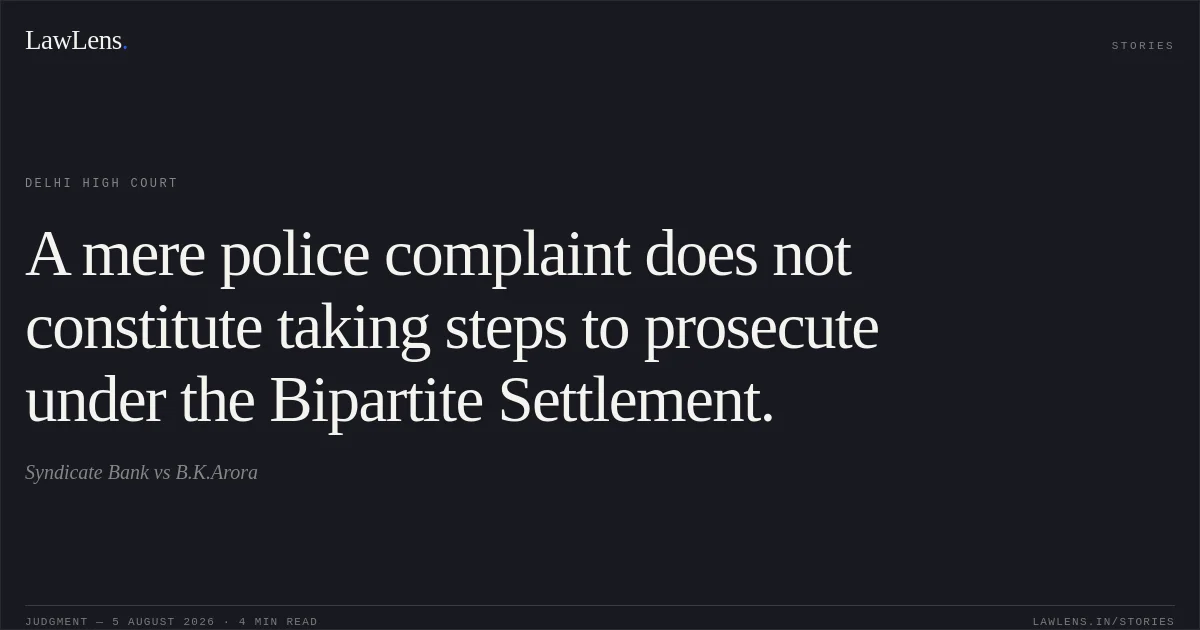
Source reference: paras. 46–48The expression “takes steps to prosecute” requires a conscious and unequivocal invocation and pursuit of the criminal process; a mere police complaint for tracing an employee or recovering property is insufficient.
Source reference: paras. 49–51Punishment may be reviewed only where it is so disproportionate to the proved misconduct as to shock the conscience of the Court. In cases involving financial dishonesty by bank employees, integrity and loss of confidence are particularly material, and subsequent restitution does not erase the misconduct, relying on Deputy General Manager v. Ajai Kumar Srivastava, State Bank of India v. T.J. Paul, KSRTC (NWKRTC) v. A.T. Mane, Janatha Bazar v. Secretary, and Syndicate Bank v. Venkatesh Gururao Kurati.
Source reference: paras. 60–63Section 17-B does not authorise payment beyond the wages directed by the governing court orders.
Source reference: para. 68Reasoning
The Tribunal itself had found that the enquiry was fair, that the respondent had received the relevant documents and adequate opportunity to defend himself, and that the charge was proved.
Source reference: paras. 30, 35–36The High Court found no prejudice arising from the alleged delay and held that the respondent’s inconsistent defences, written acknowledgment, repayment of the money and alteration of the cash scroll provided relevant material supporting the finding of misconduct.
Source reference: paras. 38–45On the interpretation of the Bipartite Settlement, the Bank’s complaint was made only after attempts to trace the respondent had failed and was followed by recovery of the money; no FIR, police report, charge-sheet, cognizance order or other material showed that criminal prosecution had been instituted or pursued.
Source reference: paras. 53–57The Bank subsequently proceeded exclusively under Clause 19.5(j), further demonstrating that it had chosen departmental action rather than criminal prosecution.
Source reference: para. 56Accordingly, Clauses 19.3 and 19.4 were not attracted, and the Tribunal erred in treating the absence of three months’ pay in lieu of notice as fatal to the dismissal.
Source reference: paras. 58, 65–66Given the respondent’s breach of financial trust while handling Bank funds, the dismissal was not shockingly disproportionate; repayment after detection did not restore the Bank’s lost confidence.
Source reference: paras. 61–64Holding
The High Court allowed the writ petition and set aside the CGIT Award dated 7 May 2004.
It held that the domestic enquiry was fair, the finding of gross misconduct under Clause 19.5(j) was supported by evidence, and the punishment of dismissal was not disproportionate.
Source reference: paras. 66–67The dismissal order dated 15 April 1993, affirmed by the appellate order dated 16 July 1993, was restored; the respondent was held not entitled to reinstatement, continuity of service, back wages or consequential service benefits.
Source reference: paras. 66–67The respondent’s application seeking further Section 17-B payments, retirement benefits and interest was dismissed, although amounts already paid under Section 17-B were protected from recovery.
Source reference: para. 68No order as to costs was made.
Source reference: para. 69Original Court PDF
Syndicate BankvsB.K.Arora
Click to open original judgment
Original judgment, available to read, download and summarize on LawLens.in