Facts
The Petitioner, M/S Lanco-Rani (JV), entered into a contract with the National Highways Authority of India (“NHAI”) dated 30 August 2001 for four-laning a section of NH-31 in Bihar.
Source reference: p.1Disputes arising from the contract were referred to arbitration, and the arbitral tribunal was constituted before 23 October 2015.
Source reference: p.3The tribunal delivered a majority award dated 7 June 2008.
Source reference: para.3In its petition under Section 34 of the Arbitration and Conciliation Act, 1996, the Petitioner confined its challenge to alleged bias on the part of the tribunal.
Source reference: para.3The Petitioner subsequently filed I.A. No. 20791/2017, seeking permission to raise the bias contention as an additional ground.
Source reference: para.4It alleged that Dr. C.S. Suryawanshi, NHAI’s nominee arbitrator, was employed by Consulting Engineering Services (India) Pvt. Ltd. (“CES”), which had an ongoing professional and commercial relationship with NHAI and had acted as consultant or engineer on other highway projects.
Source reference: paras.5–8The Petitioner contended that it was unaware of this relationship when the arbitrator was appointed and that the alleged non-disclosure created a justifiable apprehension of bias.
Source reference: paras.6–10Issues
Whether the Petitioner established a justifiable apprehension of bias or partiality sufficient to invalidate the majority arbitral award under Section 34 of the Arbitration and Conciliation Act, 1996?
Source reference: para.10Whether the arbitrator’s association with CES, and CES’s professional relationship with NHAI in other projects, constituted a disqualifying circumstance requiring disclosure or attracting the statutory grounds of ineligibility?
Source reference: paras.7, 15–16, 22Whether the amended provisions of Sections 12 and 13, including the Seventh Schedule, applied to the arbitral proceedings?
Source reference: paras.11–12, 22Law Applied
Since the arbitration was invoked and the tribunal constituted before 23 October 2015, the unamended Sections 12 and 13 of the Arbitration and Conciliation Act, 1996, applied.
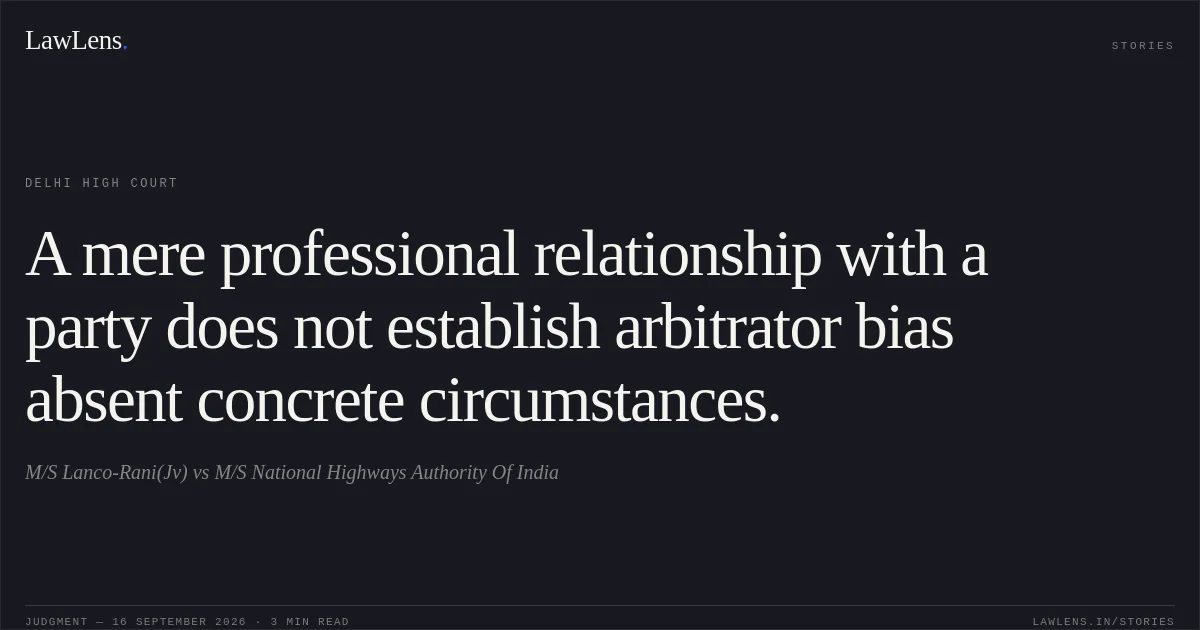
Source reference: paras.11–12Under the pre-amendment law, the mere fact that an arbitrator was an employee or nominee of one party did not, by itself, establish bias; there had to be specific circumstances giving rise to a justifiable apprehension of bias.
Source reference: para.13Relying on Indian Oil Corporation Ltd. v. Raja Transport (P) Ltd., (2009) 8 SCC 520, and Aravali Power Co. Pvt. Ltd. v. Era Infra Engineering Ltd., (2017) 15 SCC 32, the Court held that concrete circumstances—such as the arbitrator’s involvement in the contract, status as the controlling or dealing authority, or direct subordination to the decision-maker—were necessary to establish an apprehension of bias.
Source reference: paras.13–14Non-disclosure did not automatically invalidate an award; the undisclosed circumstance had to independently give rise to justifiable doubts regarding the arbitrator’s independence or impartiality.
Source reference: para.15The Seventh Schedule disqualifications were therefore not applicable to the present proceedings.
Source reference: para.22Reasoning
The Court held that the Petitioner had shown only that Dr. Suryawanshi was associated with CES and that CES had a professional relationship with NHAI in other projects.
Source reference: para.7The Petitioner accepted that CES was not the engineer or consultant for the particular project in dispute.
Source reference: para.7No material demonstrated that Dr. Suryawanshi had any involvement in the contract, acted under the control of the NHAI officers who made the relevant decisions, or possessed a direct disqualifying interest.
Source reference: paras.16–18The Court further found no evidence that the majority members were improperly influenced by NHAI or that the award resulted from any disqualifying interest.
Source reference: para.18The fact that an arbitrator had previously been appointed in another NHAI project, without additional concrete circumstances, could not establish actual or apparent bias.
Source reference: para.19A belated and unsupported suspicion, particularly based merely on dissatisfaction with the award, was insufficient to warrant interference under Section 34.
Source reference: para.20Holding
The Court answered the issues against the Petitioner.
The alleged association of the arbitrator with CES and CES’s relationship with NHAI did not establish actual bias, apparent bias, or a justifiable apprehension of bias, nor did it attract the Seventh Schedule disqualifications.
Source reference: paras.20–22The Petitioner failed to establish any ground under Section 34 of the Arbitration and Conciliation Act, 1996, warranting interference with the majority award dated 7 June 2008.
Source reference: para.23The petition was accordingly dismissed, along with all pending applications.
Source reference: para.23Acts & Sections Cited
6 provisions across 1 statute referred to in this judgment. Each provision opens on LawLens.
Arbitration and Conciliation Act, 19966
Original Court PDF
M/S Lanco-Rani(Jv)vsM/S National Highways Authority Of India
Click to open original judgment
Original judgment, available to read, download and summarize on LawLens.in