Facts
The petitioner challenged a UPSC communication dated 13 August 2020 requiring him to submit an EWS certificate for 2017–2018; after he failed to do so, his candidature was cancelled.
Source reference: p. 2He had earlier challenged the communication in OA 1148/2020, which was dismissed as withdrawn on 7 December 2020, with the Tribunal leaving it open to him to pursue remedies “in accordance with the rules”.
Source reference: p. 2; p. 4In 2025, he filed OA 3698/2025 and sought condonation of a stated delay of 938 days.
Source reference: pp. 2–3He relied on the earlier order and the merits of his claim, while explaining that he had focused on his studies and continued in the IRS.
Source reference: pp. 2–3The Tribunal dismissed the condonation application for want of a satisfactory explanation.
Source reference: p. 1; p. 2The petitioner then challenged that order under Article 226.
Source reference: p. 19Issues
1. Whether the Tribunal erred in refusing to condone the delay in filing OA 3698/2025, given the petitioner’s reliance on the earlier withdrawal order and the asserted merits of his case.
Source reference: pp. 2–52. Whether the Tribunal’s refusal disclosed an error warranting interference by the High Court in its supervisory jurisdiction under Article 226.
Source reference: pp. 16–19Law Applied
In considering condonation, the Court discussed Section 5 of the Limitation Act, 1963, under which a matter may be admitted after the prescribed period if sufficient cause is shown; a liberal, justice-oriented approach does not dispense with the requirement of an adequate explanation for delay (*Collector, Land Acquisition, Anantnag v. Mst. Katiji*).
Source reference: pp. 4–7The Court relied on *State of Odisha v. Managing Committee of Namatara Girls High School* for the principles that condonation is discretionary and that an explanation must be distinguished from a mere excuse.
Source reference: pp. 6–11It also applied the settled doctrine that unexplained delay and laches may defeat discretionary relief under Article 226.
Source reference: pp. 11–16Finally, under *Syed Yakoob v. K.S. Radhakrishnan*, certiorari is supervisory, not appellate; interference is confined to jurisdictional error, breach of natural justice, or an error of law apparent on the face of the record.
Source reference: pp. 17–19Reasoning
The Court found that the petitioner’s explanation did not account for the period between the withdrawal of his first OA in 2020 and his renewed approach to the Tribunal in 2025.
Source reference: p. 4The earlier order merely left him to pursue remedies “in accordance with the rules”; it did not reserve liberty to re-approach the Tribunal.
Source reference: p. 4Nor could the asserted strength of the underlying claim substitute for sufficient cause, because the merits could be considered only after the delay was condoned.
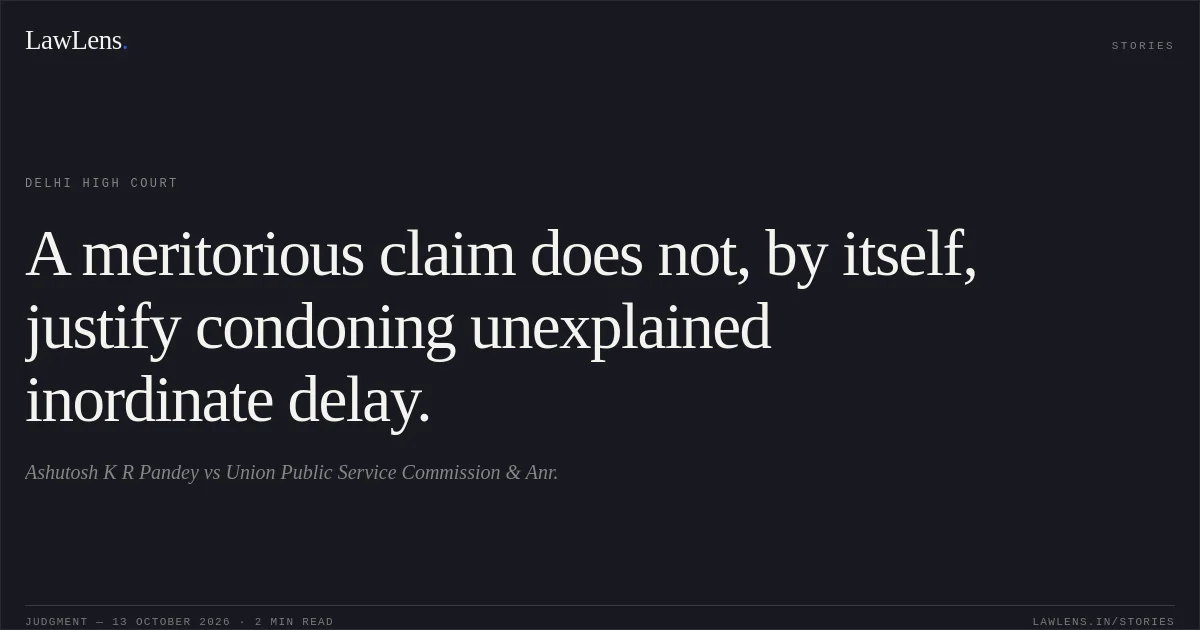
Source reference: pp. 4–5; p. 16Applying the principles on delay and laches, the Court held that the petitioner had not provided a satisfactory explanation and that the Tribunal’s refusal disclosed no ground for supervisory intervention.
Source reference: pp. 11–16; p. 19Holding
The Court answered both issues against the petitioner.
It found no cause to interfere with the Tribunal’s order refusing to condone the delay and dismissed the writ petition, along with the pending applications, in limine.
Source reference: p. 19Acts & Sections Cited
1 provisions across 1 statute referred to in this judgment. Each provision opens on LawLens.
Limitation Act, 19631
Original Court PDF
Ashutosh K R PandeyvsUnion Public Service Commission & Anr.
Click to open original judgment
Original judgment, available to read, download and summarize on LawLens.in


