Facts
T. Savadamuthu sought permanent status under the Tamil Nadu Industrial Establishments (Conferment of Permanent Status to Workmen) Act, 1981, claiming that he had worked as an overhead tank operator and completed 480 working days between 1 September 1996 and 31 August 1998.
Source reference: pp. 2–4, para. 4(i), (iv)–(v)The Inspector of Labour allowed his application, and the Town Panchayat’s writ petition challenging that order was dismissed by a Single Judge.
Source reference: pp. 2–4, para. 4(i), (iv)–(v)The Town Panchayat’s writ appeal was allowed on 26 June 2025 after the matter was heard in the absence of Savadamuthu’s counsel; the Division Bench concluded that the Town Panchayat’s activities and Savadamuthu’s tender-based engagement did not bring him within the Act.
Source reference: pp. 4–5, para. 4(v)Savadamuthu then applied to recall that decision, stating that his counsel had been held up in another court and seeking an opportunity to make submissions on the merits.
Source reference: pp. 1–2, paras. 1–2Issues
Whether the writ appeal judgment should be recalled because Savadamuthu’s counsel was absent when the appeal was heard and decided on its merits.
Source reference: pp. 4–5, para. 5; p. 5, paras. 6–7Whether Savadamuthu could use the recall application to reopen the merits of the writ appeal, or whether he had to pursue a further remedy under law.
Source reference: p. 5, paras. 8–9Law Applied
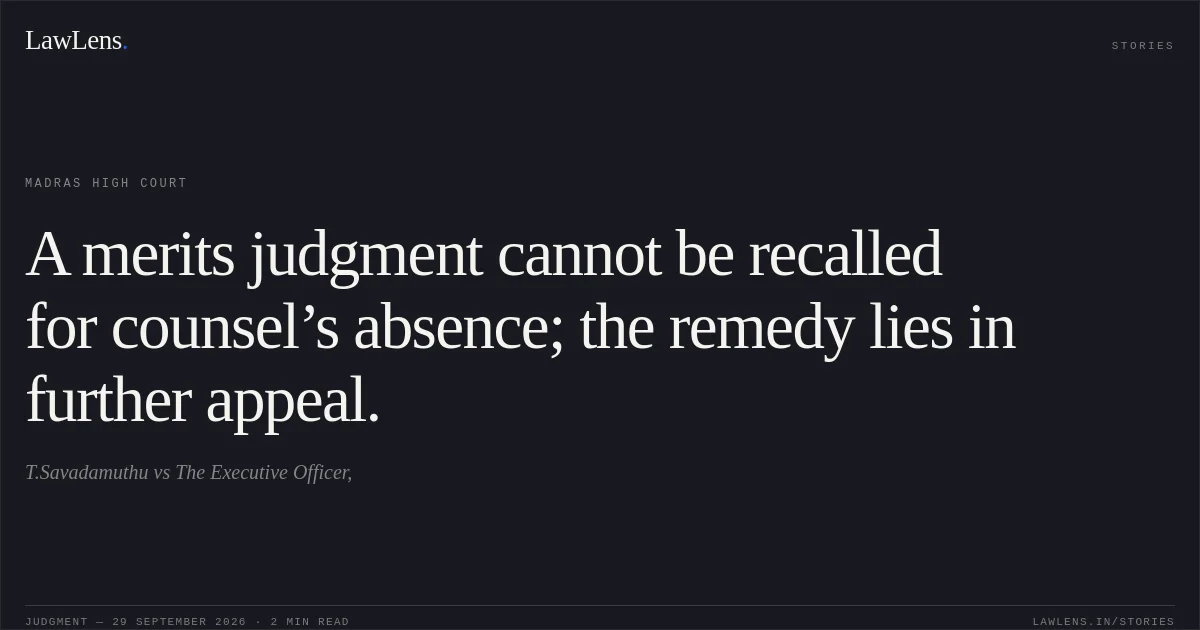
The Court applied the procedural principle that a party’s counsel being absent when a matter is taken up for hearing does not, by itself, require the Court to recall a judgment decided on the merits; the Court may proceed with the hearing and decide the case on the record.
Source reference: p. 5, paras. 6, 8–9It also held that a party aggrieved by a merits decision of a co-ordinate Bench must pursue any further remedy available under law, rather than seek restoration of the appeal to re-argue it.
Source reference: p. 5, paras. 8–9The judgment cites no specific statutory provision or precedent for these propositions.
Source reference: p. 5, paras. 6, 8–9Reasoning
The Court noted that the appeal had been heard on 18 June 2025, reserved, and decided on 26 June 2025.
Source reference: p. 5, paras. 6–7Savadamuthu’s counsel had made no request for the matter to be taken up later or for an opportunity to be heard before judgment was pronounced, and the recall application was filed only on 25 July 2025.
Source reference: p. 5, paras. 6–7The Court treated counsel’s absence as a lapse attributable to Savadamuthu, not a reason to set aside the merits judgment.
Source reference: p. 5, paras. 8–9Because the writ appeal had already been decided on its merits, allowing the application would effectively permit re-argument; the Court considered a further remedy under law to be the appropriate course.
Source reference: p. 5, paras. 8–9Holding
The Court held that the recall application was not maintainable.
It dismissed CMP(MD) No. 14512 of 2025.
Source reference: p. 5, paras. 9–10It declined to reconsider the factual merits of the writ appeal, leaving Savadamuthu to pursue any further remedy available under law.
Source reference: p. 5, paras. 9–10Original Court PDF
T.SavadamuthuvsThe Executive Officer,
Click to open original judgment
Original judgment, available to read, download and summarize on LawLens.in