Facts
The petitioner, a Mandi Inspector, was served with a charge-sheet dated 06.05.2012 alleging that, although he had deployed security guards pursuant to official directions and certified their attendance, he had failed to maintain a shift-wise deployment record.
Source reference: para. 2The petitioner denied having received any instruction to maintain such a record, contending that the deployment record was maintained by the security agency’s Supervisor, that he had only verified the guards’ physical presence, and that no loss had been caused to the Mandi premises.
Source reference: para. 3Without conducting a regular departmental enquiry, the respondents imposed the minor penalty of withholding two annual increments without cumulative effect by order dated 01.08.2012, which was affirmed in appeal on 05.09.2013.
Source reference: paras. 3, 17The petitioner challenged both orders under Article 226 of the Constitution.
Source reference: no citationIssues
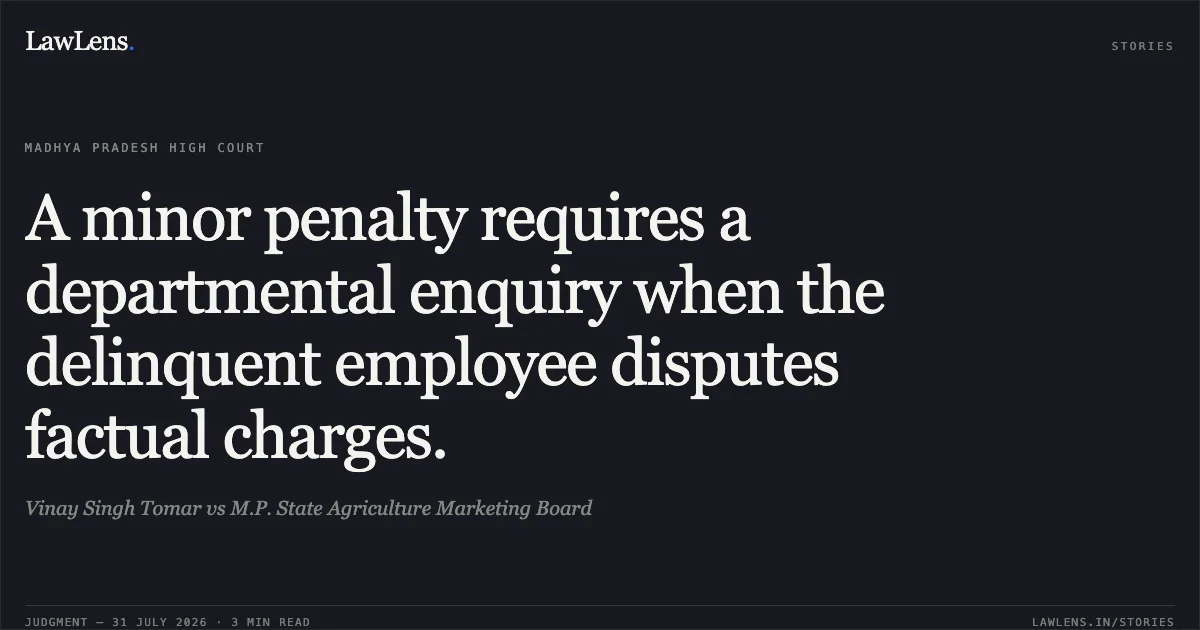
Whether a minor penalty could be imposed without a regular departmental enquiry where the employee specifically disputed the factual basis of the charge.
Source reference: paras. 3, 11, 15Whether the finding that the petitioner was duty-bound to maintain a shift-wise deployment record was sustainable when no relevant instruction or material had been disclosed or confronted to him.
Source reference: paras. 11, 13–14Whether the impugned punishment orders violated the principles of natural justice and warranted interference under Article 226 of the Constitution.
Source reference: paras. 12–14Law Applied
The Court applied Article 226 of the Constitution, under which interference with disciplinary orders is limited but is permissible where the proceedings violate natural justice or the punishment is shockingly disproportionate.
Source reference: paras. 6, 12Regulation 33 of the Raj Mandi Board Seva Viniyam, 1998 governed the disciplinary process for employees of the respondent Board.
Source reference: para. 5Relying principally on O.K. Bhardwaj v. Union of India, (2001) 9 SCC 180, the Court held that even in proceedings involving a minor penalty, the delinquent employee must be given an opportunity to explain the charges; where factual allegations are specifically denied, an enquiry must ordinarily be conducted as a minimum requirement of natural justice.
Source reference: para. 15The Court also recognised the general principle, relied upon by the respondent with reference to CISF v. Santosh Kumar Pandey, that the High Court does not ordinarily re-appreciate departmental evidence in writ jurisdiction.
Source reference: paras. 6–7, 13Reasoning
The petitioner’s reply did not admit that he had been instructed to maintain a shift-wise deployment record; it only acknowledged that such a record had not been maintained and asserted that no such duty had been communicated to him.
Source reference: paras. 9, 11This constituted a specific dispute regarding the factual foundation of the charge.
Source reference: no citationUnder O.K. Bhardwaj, the respondents could not treat the matter as undisputed merely because the proposed punishment was minor; they were required either to establish the alleged duty through the relevant instruction or material and confront it to the petitioner, or to conduct an enquiry under Regulation 33.
Source reference: paras. 11, 15–16Since no such instruction or material was shown to have been supplied or confronted, the authority’s conclusion that maintaining the record was the petitioner’s duty was unsupported and inconsistent with natural justice.
Source reference: paras. 11, 13–14The Court therefore interfered not by re-appreciating evidence, but because the disciplinary determination lacked procedural fairness.
Source reference: para. 13Holding
The Court held that the petitioner’s specific denial of the alleged instruction required an appropriate opportunity of hearing and, if necessary, a departmental enquiry.
The finding of misconduct and the resulting penalty were unsustainable because the relevant instruction or supporting material had not been disclosed or confronted to the petitioner, violating the principles of natural justice.
Source reference: paras. 14, 16–17The writ petition was allowed, and the penalty order dated 01.08.2012 and appellate order dated 05.09.2013 were quashed.
Source reference: para. 17Original Court PDF
Vinay Singh TomarvsM.P. State Agriculture Marketing Board
Click to open original judgment
Original judgment, available to read, download and summarize on LawLens.in