Facts
On 13 July 2003, the appellant, aged approximately 14 years and travelling as a passenger in an S.T. bus, sustained grievous injuries when a truck allegedly driven rashly and negligently collided with the bus.
Source reference: p.2, para. 2(i)–(ii)The appellant claimed compensation for the injuries and permanent disability suffered in the accident.
Source reference: p.2, para. 2(i)–(ii)The Motor Accident Claims Tribunal, Panchmahals at Godhra, partly allowed M.A.C.P. No. 1553 of 2005 by awarding ₹45,500 with interest at 9% per annum from the date of filing of the claim petition.
Source reference: p.1, para. 1The Tribunal assessed the appellant’s disability at 12% of the whole body and his notional income at ₹15,000 per annum.
Source reference: p.4, para. 6Aggrieved by the quantum of compensation, the claimant preferred the present appeal seeking enhancement.
Source reference: p.3, para. 2(v)Issues
Whether the compensation awarded to a minor claimant suffering 12% permanent disability of the whole body was required to be enhanced under the principles laid down in Master Mallikarjun v. Divisional Manager, National Insurance Co. Ltd.?
Source reference: p.3, para. 4; p.4, para. 6Whether the amounts awarded towards medical expenses and special diet, attendant and transportation charges required interference?
Source reference: p.5, para. 8Whether the enhanced compensation should carry interest at 9% per annum from the date of filing of the claim petition until realization?
Source reference: p.6, para. 10Law Applied
The Court applied the principles governing “just compensation” under the Motor Vehicles Act, 1988, and relied principally on the Supreme Court’s judgment in Master Mallikarjun v. Divisional Manager, National Insurance Co. Ltd., (2014) 14 SCC 396.
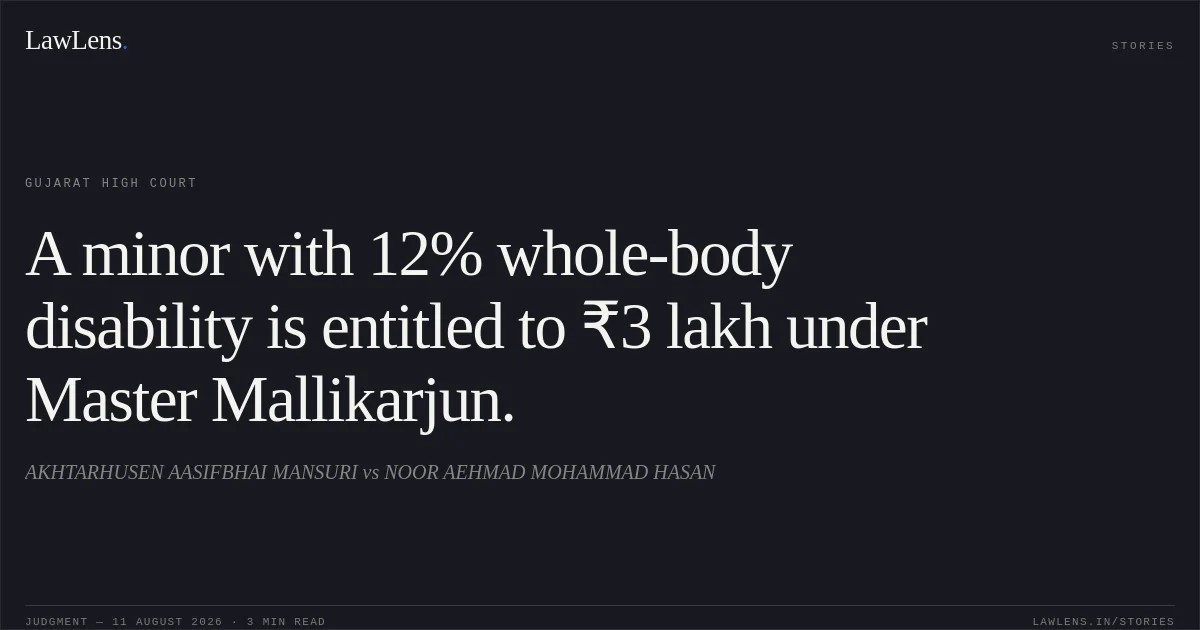
Source reference: p.4, para. 6Under Master Mallikarjun, where a child suffers permanent disability in a motor-vehicle accident, compensation under the heads of pain and suffering, mental and physical shock, hardship, inconvenience, discomfort and loss of amenities should ordinarily be assessed on a lump-sum basis, in addition to actual treatment-related expenses; for permanent disability exceeding 10% and up to 30% of the whole body, the indicated amount is ₹3,00,000.
Source reference: p.4, para. 6The Court also upheld the principle that proved medical, attendant, special diet and transportation expenses are separately recoverable.
Source reference: p.5, para. 8Reasoning
The Court found that the appellant was a 14-year-old student at the time of the accident and that his permanent disability had been assessed at 12% of the whole body.
Source reference: p.4, para. 6These facts brought the case squarely within the 10%–30% disability bracket prescribed in Master Mallikarjun.
Source reference: p.4, para. 6Accordingly, the Court substituted the compensation awarded under the heads of “future economic loss” and “pain, shock and suffering” with a consolidated sum of ₹3,00,000 for pain and suffering, mental and physical shock, hardship, inconvenience, discomfort and loss of amenities arising from permanent disability.
Source reference: p.5, para. 7The amounts of ₹2,000 for medical expenses and ₹4,500 for special diet, attendant and transportation charges were found just and proper and were therefore maintained.
Source reference: p.5, para. 8The resulting total compensation was ₹3,06,500, from which the Tribunal’s award of ₹45,500 was deducted, producing an enhancement of ₹2,61,000.
Source reference: p.5, para. 9The existing rate of interest at 9% per annum was also maintained.
Source reference: p.6, para. 10Holding
The appeal was partly allowed and the Tribunal’s award was modified.
The appellant was held entitled to total compensation of ₹3,06,500, representing an enhancement of ₹2,61,000, with interest at 9% per annum from the date of filing of the claim petition until realization.
Source reference: pp.5–6, paras. 9–11Respondent Nos. 3 and 5 were directed to satisfy the award, including the enhanced amount, in the same ratio determined by the Tribunal within six weeks of receiving the judgment.
Source reference: p.6, para. 12Upon deposit, the Tribunal was directed to disburse the awarded amount to the appellant after due verification and deduction of any deficit court fee.
Source reference: p.6, para. 12Original Court PDF
AKHTARHUSEN AASIFBHAI MANSURIvsNOOR AEHMAD MOHAMMAD HASAN
Click to open original judgment
Original judgment, available to read, download and summarize on LawLens.in