Facts
The appellant-husband challenged the judgment dated 26 December 2022 of the 5th Additional District Judge, Mahesana, dismissing his application under Sections 12 and 15 of the Guardians and Wards Act, 1890 and the Hindu Minority and Guardianship Act, 1956, seeking custody and visitation rights in respect of his minor daughter, Jaina.
Source reference: pp.1–3; para. 2The appellant alleged that his wife had left the matrimonial home in 2012, had prevented him from meeting the child, and that the child was residing in circumstances allegedly adverse to her welfare.
Source reference: pp.2–3; paras. 3.1–3.3The parties were involved in several matrimonial and maintenance proceedings.
Source reference: p.2; para. 3.2The application for custody was filed in 2020, approximately eight years after the parties’ separation.
Source reference: p.10; para. 4.4Before the Court below, the appellant did not enter the witness box and instead filed a pursis requesting disposal of the application on the basis of the documents on record.
Source reference: p.4; para. 4.2The Court below recorded the child’s preference not to reside with or meet the appellant and dismissed both the custody and visitation claims.
Source reference: pp.3–6; paras. 4–4.3Issues
Whether the appellant was entitled to custody of his minor daughter under Sections 12 and 15 of the Guardians and Wards Act, 1890 and the applicable guardianship law, having regard to the paramount consideration of the child’s welfare?
Source reference: p.4; para. 4.1.1Whether the appellant was entitled to visitation rights despite the minor’s expressed unwillingness to meet or reside with him?
Source reference: p.4; para. 4.1.1; p.10; para. 4.5Law Applied
The Court applied Sections 12 and 15 of the Guardians and Wards Act, 1890, together with the principles governing guardianship under the Hindu Minority and Guardianship Act, 1956.
Source reference: p.3; para. 3The controlling principle was that the welfare of the minor is paramount and overrides the statutory or personal claims of either parent.
Source reference: pp.8–9; para. 4.3Relying on Rosy Jacob v. Jacob A. Chakramakkal , as referred to in Rajeswari Chandrasekar Ganesh v. State of Tamil Nadu , the Court emphasized that children are not chattels or objects of parental possession and must be enabled to grow in a balanced and beneficial environment.
Source reference: pp.6–8; para. 4.3The Court also relied on the principle that a child’s wishes, particularly where freely expressed, are relevant to determining custody and access.
Source reference: no citationIt further referred to the Supreme Court’s observations in Contempt Petition No. 251 of 2026 in Criminal Appeal No. 623 of 2025, reported as 2026 INSC 818, that a parent seeking visitation must first build confidence in the child.
Source reference: p.11; para. 4.6The Court invoked the principles against frivolous and abusive litigation stated in Subrata Roy, Sahara v. Union of India , AIR 2014 SC 3241, and Dalip Singh v. State of Uttar Pradesh , AIR 2010 SC (Supp) 116.
Source reference: pp.11–12; paras. 4.7–4.8Reasoning
The High Court held that the child’s welfare, rather than the father’s asserted parental entitlement, governed both custody and visitation.
Source reference: no citationThe child had consistently expressed that she did not wish to reside with or meet the appellant, and the Court found no basis to override that preference.
Source reference: p.9; para. 4.3.1The mother had been caring for the child, arranging her education at St. Joseph School, Vijapur, and was financially capable of meeting her needs through her employment and maintenance received for the child.
Source reference: pp.8–9; para. 4.3The appellant’s failure to give evidence weakened his factual claims, while his delay in seeking custody until 2020, despite separation since 2012, was treated as indicative of an attempt to use the child in the matrimonial dispute.
Source reference: pp.4, 10; paras. 4.2, 4.4The Court also noted that earlier applications for visitation had been dismissed and not challenged.
Source reference: p.5; para. 4.3In those circumstances, compelling custody or contact would be contrary to the child’s expressed wishes and welfare; the Court further characterized the appeal as frivolous and an abuse of process.
Source reference: pp.10–12; paras. 4.5, 4.9Holding
The appeal was dismissed.
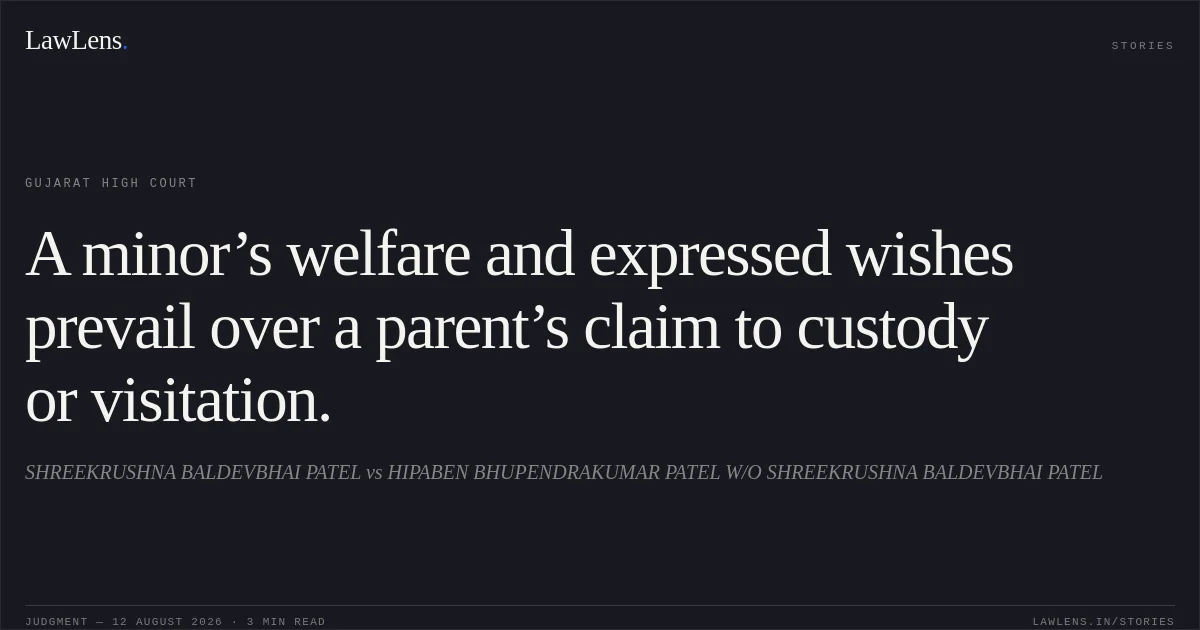
The High Court affirmed the refusal to transfer custody of Jaina to the appellant and rejected his claim for visitation rights, holding that the child’s welfare and expressed unwillingness to meet her father prevailed over his parental claim.
Source reference: pp.9–10; paras. 4.3.1, 4.5The appellant was directed to pay ₹10,000 as costs to the minor child within one month and to produce the receipt before the Registry; failure would permit recovery as arrears of land revenue or through execution of the order.
Source reference: p.12; para. 5The connected civil applications were disposed of as not surviving, and the record and proceedings were directed to be returned to the Court below.
Source reference: p.13; paras. 5.1–5.2Acts & Sections Cited
2 provisions across 1 statute referred to in this judgment. Each provision opens on LawLens.
Guardians and Wards Act, 18902
Original Court PDF
SHREEKRUSHNA BALDEVBHAI PATELvsHIPABEN BHUPENDRAKUMAR PATEL W/O SHREEKRUSHNA BALDEVBHAI PATEL
Click to open original judgment
Original judgment, available to read, download and summarize on LawLens.in