01Facts
The appellants, the deceased Banmali Gope’s dependants, claimed that he was travelling as a bona fide passenger on a valid ticket when he fell from a crowded train near Kendposi railway station on 1 September 2017 and died.
pp. 2–4The Railway Claims Tribunal dismissed their claim under Section 124-A of the Railways Act, 1989, principally because no ticket was recovered from the deceased’s body.
pp. 2–4The appellants appealed under Section 23(1) of the Railway Claims Tribunal Act, 1987.
pp. 2–4The High Court considered the UD case, post-mortem report, Station Manager’s letter and evidence of the deceased’s brother, who testified that he had purchased the ticket and seen the deceased off at the station.
pp. 4–502Issues
i.1. Whether the evidence established that the deceased was a bona fide passenger, despite the absence of a recovered ticket.
pp. 5–8, 14ii.2. Whether the deceased’s fatal fall from the train constituted an untoward incident under Section 123(c) of the Railways Act and entitled his dependants to compensation under Section 124-A.
pp. 8–1403Law Applied
Sections 123(c) and 124-A of the Railways Act, 1989 provide for compensation where a passenger’s death results from an untoward incident, subject to the statutory exceptions in Section 124-A.
Under Union of India v. Rina Devi, (2019) 3 SCC 572, the claimant bears the initial burden of establishing bona fide passenger status, but that burden may be discharged through relevant evidence; absence of a ticket alone does not defeat the claim, and the burden may then shift to the Railways.
pp. 5–8 · Rina Devi, paras 26, 29Rina Devi also holds that negligence, without more, does not establish a statutory exception to no-fault liability.
p. 5 · ¶ 25Under Jameela v. Union of India, (2010) 12 SCC 443, Section 124-A liability is independent of wrongful act, neglect or default by the Railways, subject to the listed exceptions.
p. 9 · ¶ 10The Court also applied the beneficial-construction principle to the expression “accidental falling” in Section 123(c).
pp. 9–13The Court also applied Rule 13 of the Railway Passenger (Manner of Investigation of Untoward Incidents) Rules, 2003, concerning the DRM’s report.
p. 14Compensation was determined under Rule 3 and Schedule II of the Railway Accident and Untoward Incidents (Compensation) Rules, 1990; Rina Devi governed the applicable compensation and interest principles.
pp. 14–16Provisions in the judgment · 6 · Linked ones open on LawLens
Railway Claims Tribunal Act, 1987 Section 23
Railways Act, 1989 Section 2Section 55Section 123Section 137
Motor Vehicles Act, 1988 Section 163
04Reasoning
The UD case, post-mortem report and Station Manager’s letter corroborated that the deceased died in a train-related incident; the brother’s evidence supported the claim that the deceased had boarded the train with a ticket.
pp. 8–14The Court considered that evidence sufficient to establish bona fide passenger status, notwithstanding the missing ticket.
pp. 8–14It found that the fall was accidental and that the Railways had not proved any Section 124-A exception, including suicide, self-inflicted injury or the deceased’s own criminal act.
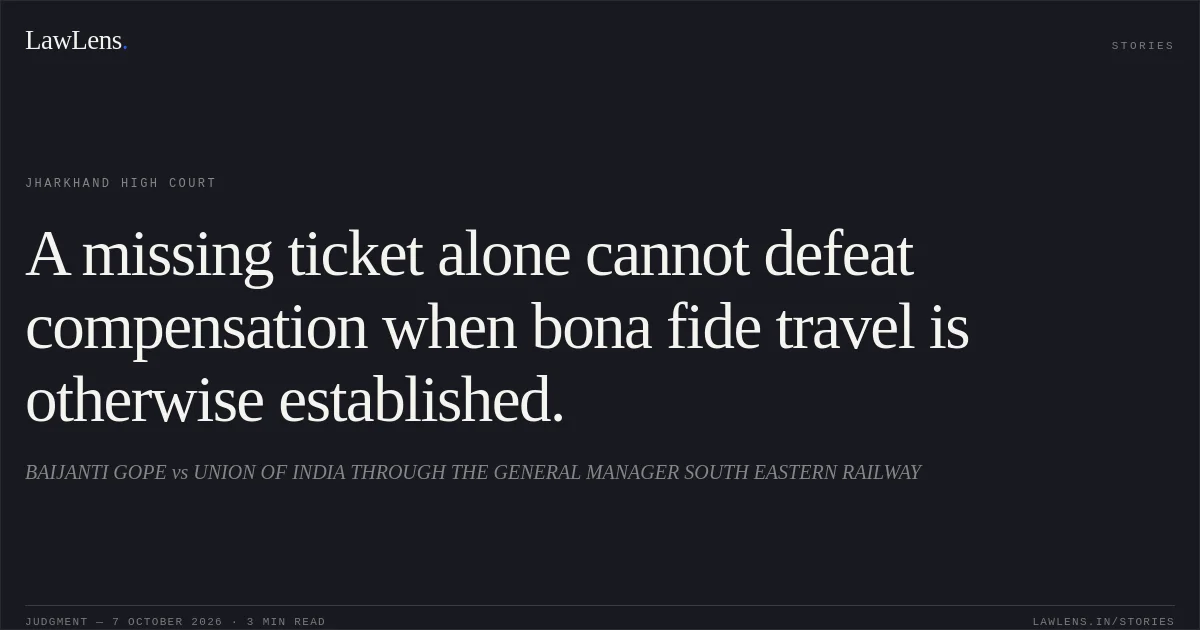
pp. 8–14Treating the Tribunal’s reliance on the missing ticket as hyper-technical, the Court held that the evidence established an untoward incident and entitlement to compensation.
pp. 8–1405Holding
The High Court allowed the appeal and set aside the Tribunal’s judgment dated 12 September 2023.
pp. 14–16It awarded the appellants ₹8,00,000 in compensation, with interest at 6% per annum from the date of the claim application until the award, and directed that the trial court records be returned to the Tribunal.
pp. 14–16Original Court PDF
BAIJANTI GOPEvsUNION OF INDIA THROUGH THE GENERAL MANAGER SOUTH EASTERN RAILWAY
Click to open original judgment
Original judgment, available to read, download and summarize on LawLens.in