Facts
The complainant, who had retired from employment with the company, rejoined on a contractual basis and claimed that the company had agreed to pay him remuneration and incentives.
Source reference: paras. 2–5The company paid part of the claimed incentive but did not pay the balance of Rs. 9,00,000, leading the complainant to file a complaint alleging offences under Sections 420, 406 and 120B IPC against the company and its directors, including the petitioner, an independent non-executive director residing in Chennai.
Source reference: paras. 2–5The Magistrate issued process after examining the complainant and witnesses, without holding an inquiry under Section 202 CrPC, although the petitioner resided outside the Magistrate’s territorial jurisdiction.
Source reference: paras. 6, 13, 15The petitioner sought quashing under Section 482 CrPC, contending that the dispute was contractual, the complaint disclosed no specific role or criminal intent on his part, and the Section 202 inquiry had been omitted.
Source reference: paras. 6–9Issues
1. Whether the complaint and supporting material disclosed the essential ingredients of cheating or criminal breach of trust against the petitioner, or instead concerned a contractual payment dispute
Source reference: paras. 17–202. Whether the Magistrate’s failure to conduct an inquiry under Section 202 CrPC before issuing process against a petitioner residing outside the territorial jurisdiction warranted intervention
Source reference: paras. 15–163. Whether continuation of the criminal proceeding against the petitioner would constitute an abuse of process justifying quashing under Section 482 CrPC
Source reference: paras. 20–22Law Applied
Section 482 CrPC preserves the High Court’s inherent power to prevent abuse of process and secure the ends of justice; that power may be exercised where the complaint, taken at face value, does not disclose an offence.
Source reference: no citationUnder Section 202 CrPC, where an accused resides beyond the Magistrate’s territorial jurisdiction, the Magistrate must postpone process and conduct an inquiry or direct an investigation; an inquiry may include examination of witnesses for deciding whether sufficient grounds exist to proceed (National Bank of Oman v. Barakara Abdul Aziz and Vijay Dhanuka v. Najima Mamtaj).
Source reference: paras. 15–16Cheating under Sections 415/420 IPC requires deception and dishonest or fraudulent intent when the promise or representation is made; subsequent failure to perform a contractual promise, without such initial intent, is insufficient (V.Y. Jose v. State of Gujarat and Lalit Chaturvedi v. State of Uttar Pradesh).
Source reference: paras. 17–18The judgment also relied on Delhi Race Club (1940) Ltd. v. State of Uttar Pradesh and Arshad Neyaz Khan v. State of Jharkhand for the proposition that Sections 406 and 420 IPC cannot coexist on the same factual allegations.
Source reference: paras. 9, 19Reasoning
The Court noted that the complaint concerned non-payment of the remaining incentive under a contractual arrangement, after the company had made a part-payment.
Source reference: paras. 18–20It found no material showing that the petitioner had dishonestly induced the complainant at the outset to deliver property, or that property had been entrusted to the petitioner and misappropriated; nor did the complaint attribute a specific criminal act to him.
Source reference: paras. 18–20The Court therefore treated the allegations as a contractual dispute rather than conduct meeting the ingredients of Sections 420 or 406 IPC.
Source reference: paras. 18–20It also observed that the petitioner resided in Chennai and that no Section 202 inquiry had been held, notwithstanding the mandatory requirement identified in the cited authorities.
Source reference: paras. 15–16On the whole, it concluded that continuing the case against the petitioner would amount to an abuse of process.
Source reference: para. 21Holding
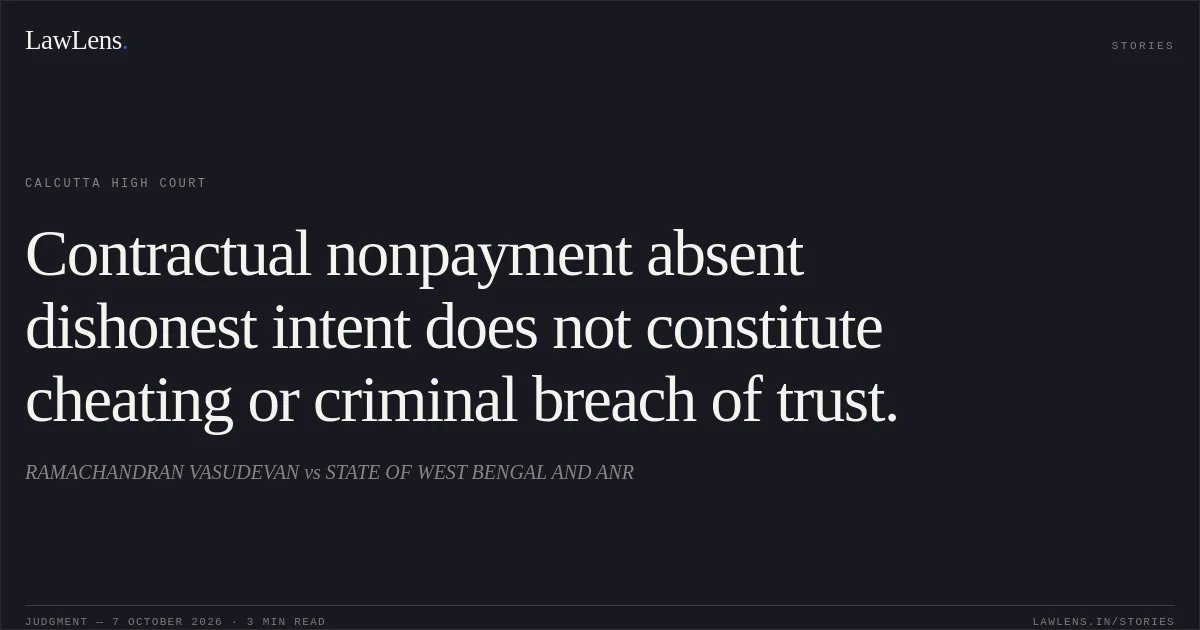
The High Court allowed the revision and quashed complaint case No. C.S. 73527 of 2023 under Sections 420/406/120B IPC qua the petitioner, finding that the allegations did not disclose the requisite criminal offences and that continuation of the proceeding would be an abuse of process.
Connected applications were disposed of.
Source reference: para. 23Acts & Sections Cited
8 provisions across 2 statutes referred to in this judgment. Each provision opens on LawLens.
Code of Criminal Procedure, 19735
Indian Penal Code, 18603
Original Court PDF
RAMACHANDRAN VASUDEVANvsSTATE OF WEST BENGAL AND ANR
Click to open original judgment
Original judgment, available to read, download and summarize on LawLens.in