Facts
The respondent, an HUF operating Hotel Metropole at Lawrance Road, Ambala Cantt., claimed that the open space between the hotel gate and the metalled road was a katcha berm forming part of a public street and pathway.
Source reference: paras. 2–3; p. 2The appellant-Municipal Committee proposed to construct and allot shops on the site, allegedly obstructing the hotel’s frontage and the respondent’s right of access.
Source reference: paras. 2–3; p. 2The respondent instituted a suit for perpetual injunction on 23 March 1982.
Source reference: paras. 2–3; p. 2During the pendency of the suit, the Committee constructed two stalls, and the plaint was amended to seek their demolition by mandatory injunction.
Source reference: paras. 2–3; p. 2The Trial Court decreed the suit, restrained further construction and allotment, and directed demolition of the stalls.
Source reference: para. 8; p. 4The First Appellate Court affirmed the decree.
Source reference: para. 9; p. 4The Municipal Committee thereafter filed the Regular Second Appeal.
Source reference: para. 10; p. 5Issues
Whether the appeal before the First Appellate Court had been instituted by a duly authorised representative of the Municipal Committee, in the absence of a specific resolution authorising the Executive Officer to file it?
Source reference: para. 14; pp. 6–7Whether the disputed open space constituted a katcha berm or part of a public street, and whether the Municipal Committee could construct shops thereon so as to obstruct the respondent’s right of access, ingress and egress?
Source reference: para. 15; pp. 7–8Whether the respondent was entitled to a mandatory injunction directing demolition of the two stalls constructed during the pendency of the suit?
Source reference: para. 16; p. 8Whether the High Court, in Regular Second Appeal, could interfere with the concurrent findings of fact recorded by the Courts below?
Source reference: para. 17; pp. 9–10Law Applied
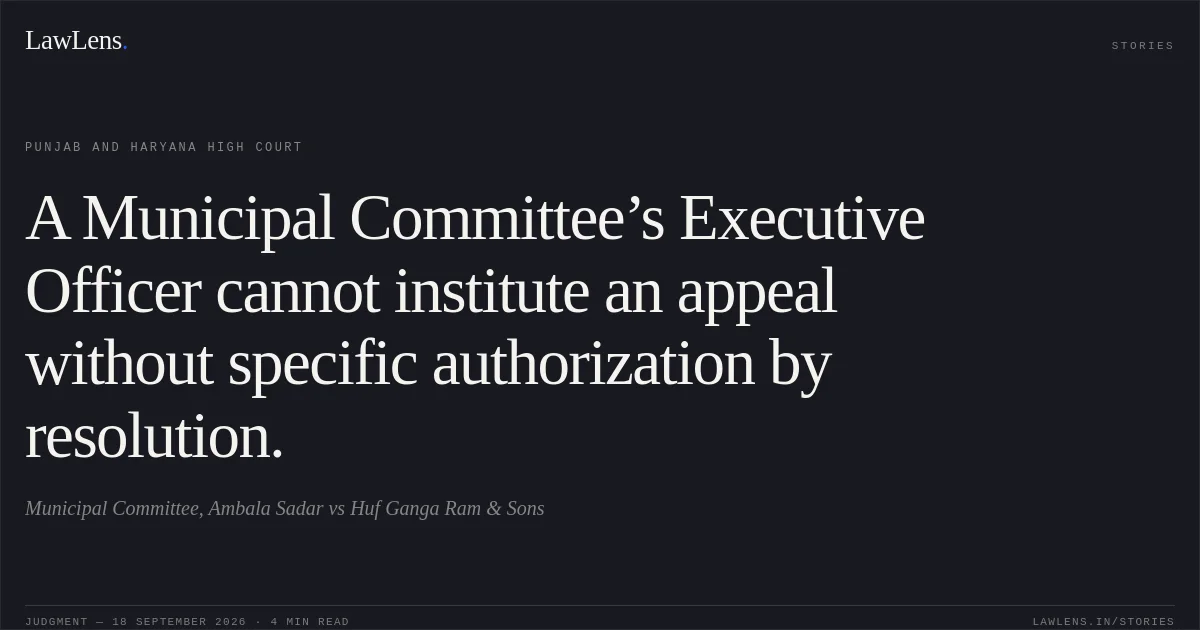
The Court held that an Executive Officer of a Municipal Committee cannot institute an appeal or civil proceeding on behalf of the Committee without an express or specific authorisation; Section 35 of the applicable Municipal Act does not, by itself, confer such authority.
Source reference: para. 14; pp. 6–7relying on Municipal Committee, Ludhiana v. Surinder Kumar, 1971 PLR 390, and Garib Chand v. Municipal Committee, Budhlada, 1979 PLR 565.
Source reference: para. 14; pp. 6–7The Court applied the principle that an owner of property abutting a public street possesses a private right of access, ingress and egress to the street, and that a local authority cannot obstruct that right by raising permanent structures on a katcha berm or public pathway.
Source reference: para. 15; pp. 7–8relying on Municipal Board, Manglaur v. Mahadeoji Maharaj, AIR 1965 SC 1147, and the other authorities cited therein.
Source reference: para. 15; pp. 7–8A mandatory injunction may be granted to remove structures constructed during the pendency of litigation where their construction is found to obstruct the plaintiff’s lawful right.
Source reference: para. 16; p. 8In second appeal, interference with concurrent findings of fact is impermissible merely because the findings may appear erroneous; intervention is justified only for an error of law or procedure or a substantial procedural defect, as explained in M/s. Shivali Enterprises v. Godawari (Deceased), referring to Randhir Kaur v. Prithvi Pal Singh, (2019) 17 SCC 71.
Source reference: para. 17; pp. 9–10Reasoning
The Court found that Resolution No. 759 dated 13 October 1983 authorised the Administrator, Executive Officer, Secretary and Municipal Engineer only to file proceedings under the Haryana Public Premises and Land (Eviction and Rent Recovery) Act, 1972.
Source reference: para. 14; pp. 6–7It did not confer a general power to institute civil appeals, and no separate resolution authorised the present appeal; therefore, the First Appellate Court correctly treated the appeal as having been filed by an unauthorised person.
Source reference: para. 14; pp. 6–7On the merits, the respondent’s hotel abutted the disputed open space, and the Committee’s own witness admitted that katcha berms are intended for public use as pathways.
Source reference: para. 15; pp. 7–8The Court consequently accepted the concurrent finding that the space formed part of the berm of the metalled road and that the proposed shops would interfere with the respondent’s private right of access.
Source reference: para. 15; pp. 7–8The Local Commissioner’s report, prepared shortly after institution of the suit, showed that the stalls were incomplete and under construction, supporting the finding that they had been completed during the litigation.
Source reference: para. 16; p. 8Their subsequent construction justified mandatory demolition, while the gap between the stalls and the road was held immaterial because the obstruction of access remained established.
Source reference: para. 16; p. 8No substantial question of law, legal infirmity, perversity, or procedural error was shown to warrant interference in second appeal.
Source reference: para. 17; pp. 9–10Holding
The High Court dismissed the Regular Second Appeal with costs.
It upheld the concurrent judgments directing the Municipal Committee to remove the two stalls and restraining it from constructing or allotting shops adjacent to the hotel gate.
Source reference: para. 18; p. 10The Court further affirmed that the Executive Officer lacked authority to institute the First Appeal without a specific municipal resolution and that no ground existed for interference with the findings of the Courts below.
Source reference: para. 18; p. 10Pending miscellaneous applications, if any, were also disposed of.
Source reference: para. 19; p. 10Acts & Sections Cited
1 provisions across 1 statute referred to in this judgment. Each provision opens on LawLens.
Code of Civil Procedure, 19081
Original Court PDF
Municipal Committee, Ambala SadarvsHuf Ganga Ram & Sons
Click to open original judgment
Original judgment, available to read, download and summarize on LawLens.in