Facts
The appellants preferred an appeal under Order XLI Rule 11 of the Code of Civil Procedure, 1908 (“CPC”) against an ex parte ad interim injunction granted by the Trial Court in favour of respondent no. 1, who claimed tenancy rights and possession over the suit property.
Source reference: p. 4; para. 14The Trial Court had relied, at the prima facie stage, on photocopies of rent receipts, KMC trade licences, and a complaint addressed to the Officer-in-Charge of Girish Park Police Station, and restrained forcible eviction of respondent no. 1.
Source reference: p. 4; para. 14The appeal was filed with a delay of approximately six days. The appellants explained the delay by referring to the time required for preparing the appeal and their attendance at the police station pursuant to a complaint lodged at the instance of respondent no. 1.
Source reference: p. 1; para. 2The appellants also contended that appellant no. 1 was a director of the company which owned the property, while appellant no. 2 had no connection with it.
Source reference: p. 2; para. 7The appellants filed CAN 2 of 2026 under Order XLI Rule 27 CPC seeking to introduce additional documents.
Source reference: p. 1; para. 3Issues
Whether the delay of approximately six days in filing the appeal ought to be condoned?
Source reference: p. 1; paras. 2–5Whether the appeal had become infructuous because the impugned ex parte ad interim injunction had subsequently been extended?
Source reference: p. 2; para. 6Whether the Trial Court’s grant of an ex parte ad interim injunction disclosed any perversity or error of law or fact warranting appellate interference under Order XLI Rule 11 CPC?
Source reference: pp. 3–5; paras. 13–20Whether the appellants could introduce additional documents under Order XLI Rule 27 CPC at the stage of an appeal against an ex parte ad interim injunction?
Source reference: pp. 4–5; paras. 13, 17–18Law Applied
The Court applied Order XLI Rule 11 CPC, under which an appellate court may dismiss an appeal at the admission stage where no sufficient ground for interference is made out.
Source reference: p. 5; para. 20The Court applied the principle that a subsequent extension of an interlocutory injunction does not render an appeal against the original ex parte ad interim order infructuous, since the appellate decision concerning the principal order would bind the subsequent orders of extension.
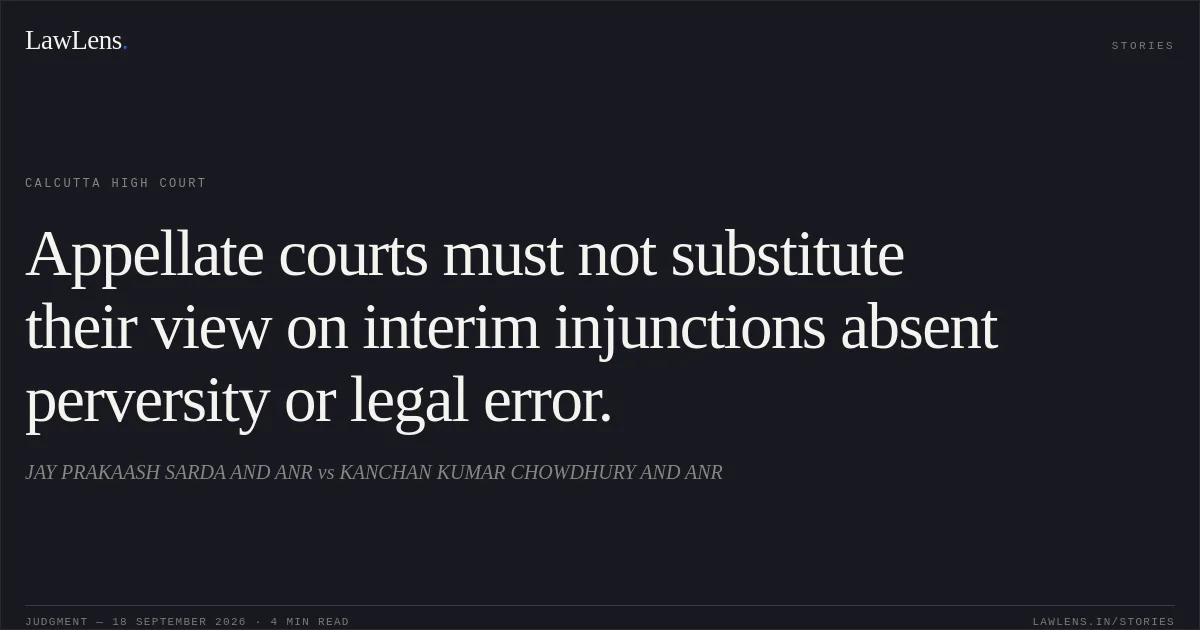
Source reference: p. 2; para. 6The Court further applied the settled appellate restraint applicable to discretionary interlocutory injunction orders: an appellate court should not substitute its own view merely because another view is possible, particularly in the absence of perversity or an error of law or fact.
Source reference: p. 4; para. 15Order XLI Rule 27 CPC was applied restrictively, with the Court holding that additional evidence could not ordinarily be introduced in an appeal against an ex parte ad interim order when the Trial Court itself had not considered those documents at the time of passing the order.
Source reference: p. 5; para. 17Reasoning
The Court found the explanation for the six-day delay plausible, particularly in view of the appellants’ involvement in preparing the appeal and attending the police station, and therefore condoned the delay.
Source reference: p. 1; paras. 2–5It rejected the objection that the appeal was infructuous, holding that the validity of the original ex parte ad interim order remained material notwithstanding its subsequent extensions.
Source reference: p. 2; para. 6On the merits, the Court noted that the Trial Judge had considered the pleadings, temporary injunction application, rent receipts, KMC trade licences, and police complaint, and had formed a prima facie view that respondent no. 1 was in possession and ought not to be forcibly evicted.
Source reference: p. 4; para. 14Although the appellants identified differences in the rent receipts, the Court held that whether those differences invalidated the documents required consideration by the Trial Court at the final hearing of the injunction application, rather than appellate determination at this preliminary stage.
Source reference: p. 4; para. 16Since the Trial Court’s order was reasoned and disclosed no perversity or error of law or fact, appellate substitution of views was unwarranted.
Source reference: p. 4; para. 15The requested additional documents were also excluded because they had not been before the Trial Court when the ex parte order was passed; the appellants remained free to rely on them in their written objection to the injunction application.
Source reference: p. 5; paras. 17–18Holding
The Court allowed CAN 3 of 2026 and condoned the six-day delay in filing the appeal, without costs.
It held that the appeal was not rendered infructuous by subsequent extensions of the injunction.
Source reference: p. 2; para. 6Finding no sufficient error of law or fact in the Trial Court’s order, the Court dismissed FMAT 312 of 2026 under Order XLI Rule 11 CPC.
Source reference: p. 5; para. 20CAN 1 and CAN 2 of 2026 were disposed of consequentially; the application for additional documents was not entertained at that stage.
Source reference: p. 5; para. 23The Court clarified that its observations were tentative and would not prejudice the Trial Court’s independent determination of the temporary injunction application or the suit.
Source reference: p. 5; para. 21The appellants were directed to file their written objection to the injunction application within a fortnight, after which the Trial Court was requested to decide the application expeditiously.
Source reference: pp. 5–6; para. 22There was no order as to costs.
Source reference: p. 6; para. 24Original Court PDF
JAY PRAKAASH SARDA AND ANRvsKANCHAN KUMAR CHOWDHURY AND ANR
Click to open original judgment
Original judgment, available to read, download and summarize on LawLens.in