Facts
The appellants, landless persons, were allotted one hectare of Government land comprised in Khasra No. 5/1, Village Simri, pursuant to Gram Panchayat proceedings and subsequent revenue proceedings.
Source reference: para. 2–3The Naib Tehsildar passed an allotment order dated 14 May 2002 granting the land on lease for agricultural purposes, subject to conditions including restrictions on transfer.
Source reference: para. 2–3Rajendra Singh, who was not a party to the original allotment proceedings, filed a revenue appeal.
Source reference: para. 4The Sub-Divisional Officer, by order dated 11 February 2004, cancelled the appellants’ lease on the ground that the requisite publication had not preceded the grant.
Source reference: para. 4, 15The appellants asserted that they were not effectively informed of that order and continued in possession and cultivation.
Source reference: no citationAfter approximately 21 years, Rajendra Singh sought mutation of his name on the basis of alleged possession.
Source reference: para. 6–9Upon receiving notice of the mutation proceedings in 2025, the appellants challenged the 2004 order before the Commissioner and sought condonation of delay under Section 5 of the Limitation Act.
Source reference: para. 6–9, 16The Commissioner rejected the appeal on 25 June 2026, principally on limitation, and the learned Single Judge dismissed the appellants’ writ petition on 19 August 2026.
Source reference: para. 6–9, 16The present writ appeal challenged both orders.
Source reference: no citationIssues
Whether the appellants’ delayed challenge to the Sub-Divisional Officer’s order dated 11 February 2004 could be entertained by condoning the approximately 21-year delay, particularly when the appellants claimed that they had acquired effective knowledge of the order only in 2025.
Source reference: para. 6–10, 13–14Whether the appellants could challenge the cancellation order merely because mutation proceedings were initiated by Rajendra Singh after a prolonged period.
Source reference: para. 15–17Whether the learned Single Judge erred in declining writ interference with the Commissioner’s order rejecting the delayed appeal.
Source reference: para. 14, 18–19Whether the appellants retained any valid or enforceable leasehold right in the disputed land after cancellation of the 2002 allotment.
Source reference: para. 15–17Law Applied
The Court considered the limitation principles governing a delayed statutory appeal and the requirement that an applicant seeking condonation must establish sufficient cause, including the relevance of actual or effective knowledge of the impugned order.
Source reference: para. 7–8, 13–14Section 5 of the Limitation Act was invoked by the appellants as the statutory basis for condonation of delay.
Source reference: para. 7The Court also considered the appellants’ reliance on Section 44 of the Madhya Pradesh Land Revenue Code, 1959 concerning the maintainability of an appeal by a person who was not a party to the original proceedings.
Source reference: para. 4The governing principle applied by the Court was that writ or appellate interference is not warranted absent illegality, perversity, or jurisdictional error, and that a party cannot claim an enforceable right on the basis of a lease that has already been cancelled.
Source reference: para. 17–19Reasoning
The Court accepted that the appellants had originally received the allotment, but held that the lease had subsequently been cancelled by the SDO in 2004 and that the cancellation order had never been challenged within the prescribed period.
Source reference: para. 15Although the appellants alleged lack of effective notice and contended that their counsel’s participation did not establish knowledge of the final order, the Court upheld the finding that the challenge was brought after an unexplained delay of nearly 21 years.
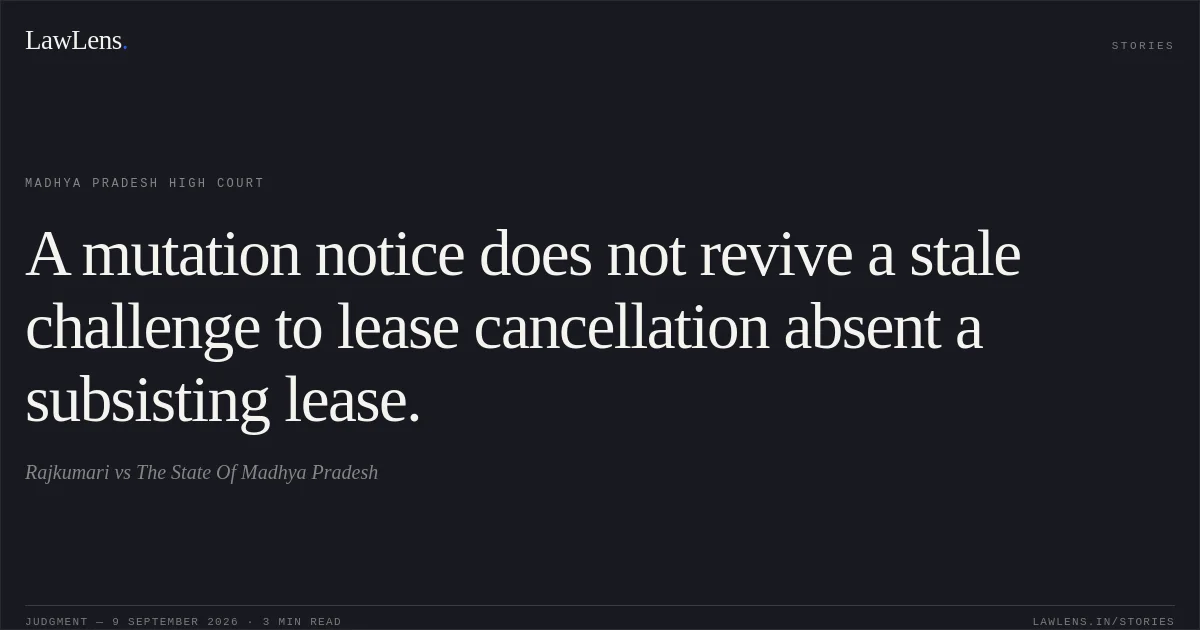
Source reference: para. 8, 13–14The Court further reasoned that Rajendra Singh’s later application for mutation did not revive or create a vested right in the appellants to reopen the stale challenge.
Source reference: para. 16–17Since no valid lease presently existed in favour of either side, the appellants could contest the mutation proceedings and apply for a fresh lease, but they could not use those proceedings as a basis to challenge the 2004 cancellation order as of right.
Source reference: para. 16–17Consequently, the Court found no illegality, perversity, or jurisdictional error in the Single Judge’s refusal to interfere.
Source reference: para. 18–19Holding
The Division Bench held that the appellants had no subsisting or enforceable leasehold right after the cancellation order dated 11 February 2004 and could not challenge that order merely in response to the subsequent mutation proceedings.
The Court found no error in the Commissioner’s rejection of the delayed appeal or in the learned Single Judge’s dismissal of the writ petition.
Source reference: para. 17–19The writ appeal was accordingly dismissed, while the appellants remained free to contest Rajendra Singh’s mutation application and seek grant of a fresh lease in accordance with law.
Source reference: para. 17–19Acts & Sections Cited
2 provisions across 2 statutes referred to in this judgment. Each provision opens on LawLens.
MP Land Revenue Code 19591
Limitation Act, 19631
Original Court PDF
RajkumarivsThe State Of Madhya Pradesh
Click to open original judgment
Original judgment, available to read, download and summarize on LawLens.in