Facts
The appellant, an Assistant Teacher (L.B.), challenged her transfer order dated 31.05.2025, by which she was transferred approximately 65 kilometres from her existing place of posting.
Source reference: no citationIn Writ Petition (S) No. 4948 of 2025, the learned Single Judge initially granted interim protection and, on 27.02.2026, directed the State respondents to file a reply.
Source reference: para. 3; para. 8No written reply was filed by the State.
Source reference: no citationWhen the writ petition was subsequently dismissed on 20.07.2026, the learned Single Judge relied upon the decision in Shashi Shrivastava v. State of Chhattisgarh & Others, W.A. No. 674 of 2025, decided on 18.09.2025.
Source reference: para. 3The appellant preferred the present intra-Court appeal, contending that the writ petition ought not to have been dismissed without a written reply from the State.
Source reference: para. 4Issues
Whether the learned Single Judge erred in dismissing the writ petition without insisting upon a written reply from the State respondents, despite the direction dated 27.02.2026 to file such reply?
Source reference: paras. 4, 8–10Whether the appellant’s transfer order warranted judicial interference in the absence of a plea or proof of mala fides, violation of statutory rules, or lack of competence of the transferring authority?
Source reference: paras. 5–6, 10–11Law Applied
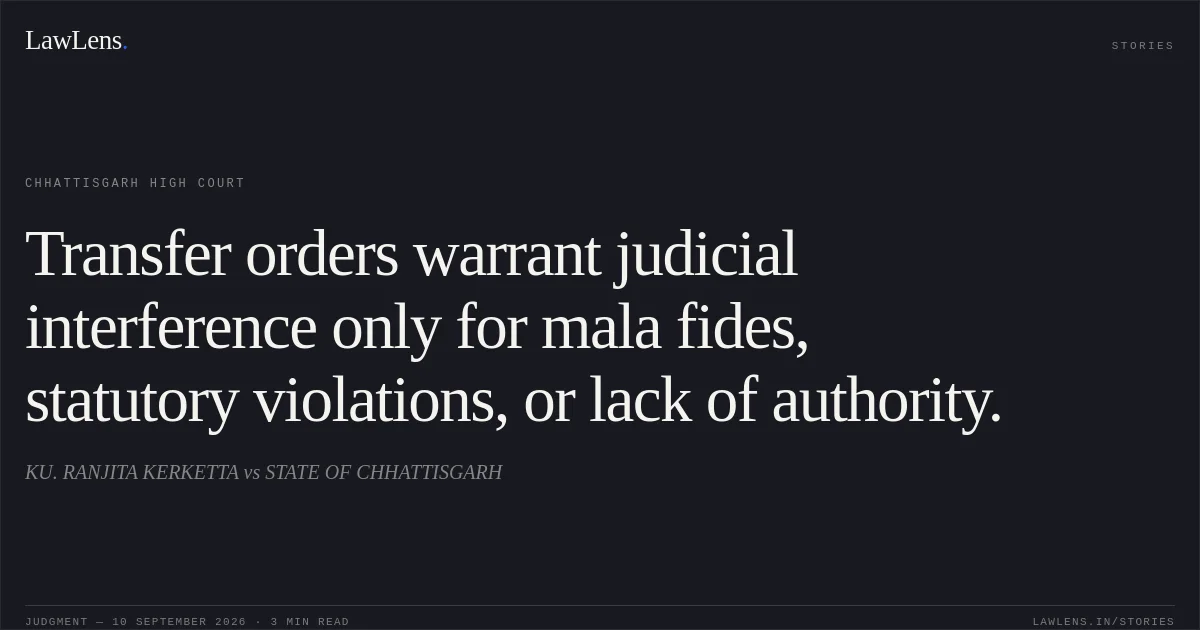
Transfer is ordinarily an incidence of service, and courts should not interfere with a transfer or posting order unless it is vitiated by mala fides, lack of competence, or infringement of statutory rules or regulations.
Source reference: para. 5, quoting Shashi Shrivastava v. State of Chhattisgarh & OthersTeacher Rationalization Instructions are treated as guidelines and do not supplant the employer’s general statutory power to transfer an employee in public interest or administrative exigency.
Source reference: para. 5The Court also applied the principle that a procedural objection regarding non-filing of a written reply will not, by itself, justify appellate interference where the substance of the State’s position was placed before the Court and the appellant cannot demonstrate what material or defence would have emerged from the written reply.
Source reference: paras. 9–10Reasoning
The Division Bench acknowledged that the State had not filed a formal written reply despite the order dated 27.02.2026.
Source reference: paras. 8–9However, the State had relied upon Shashi Shrivastava, and the appellant did not dispute that the factual and legal issues were substantially similar.
Source reference: no citationThe appellant also did not challenge the Single Judge’s findings on mala fides, statutory violation, or the relevant transfer principles, nor could she identify any specific fact or defence that would have emerged from a written reply and altered the result.
Source reference: paras. 6, 9The Court therefore held that the direction to file a reply had been effectively complied with in substance by placing the applicable precedent before the Single Judge.
Source reference: para. 10Since the transfer challenge disclosed no recognised ground for judicial interference and the reasoning in Shashi Shrivastava applied, the impugned dismissal was neither infirm nor perverse.
Source reference: para. 11Holding
The Court answered both issues against the appellant.
It held that the absence of a formal written reply did not invalidate the Single Judge’s decision because the State’s legal position had been presented and the appellant failed to show resulting prejudice.
Source reference: paras. 9–10It further held that the transfer order was not liable to be interfered with in the absence of mala fides, statutory breach, or lack of authority.
Source reference: paras. 5, 10–11Finding no infirmity or perversity in the order dated 20.07.2026, the Division Bench dismissed the writ appeal.
Source reference: para. 11Original Court PDF
KU. RANJITA KERKETTAvsSTATE OF CHHATTISGARH
Click to open original judgment
Original judgment, available to read, download and summarize on LawLens.in