Facts
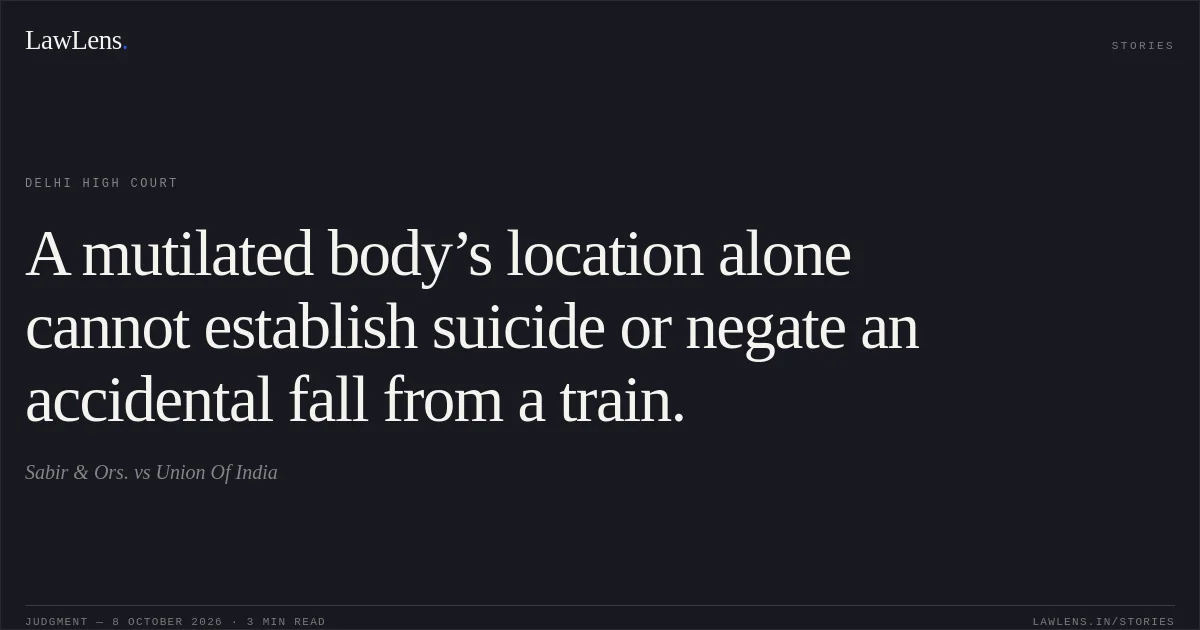
The appellants challenged the Railway Claims Tribunal’s dismissal of their claim for the death of Smt. Sahana.
Source reference: pp. 1–3, 5They alleged that on 9 March 2023 she was travelling from Amroha to Delhi on Train No. 15036 and died after accidentally falling from the moving train.
Source reference: pp. 1–3, 5A ticket for that journey was recovered from her person and verified.
Source reference: pp. 1–3, 5The Tribunal questioned both her status as a bona fide passenger and whether the death resulted from an “untoward incident,” relying in part on the fact that her body was found in two pieces on the Down line, although the ticket indicated travel in the Up direction.
Source reference: pp. 1–3, 5The appeal was brought under Section 23 of the Railway Claims Tribunal Act, 1987.
Source reference: p. 1Issues
1. Whether the recovered and verified railway ticket, together with the other evidence, discharged the appellants’ initial burden to establish that the deceased was a bona fide passenger.
Source reference: pp. 3–4, 72. Whether the circumstances in which the deceased’s body was found established that her death did not result from an accidental fall constituting an “untoward incident”.
Source reference: pp. 4–6Law Applied
Section 23 of the Railway Claims Tribunal Act, 1987 provides for an appeal to the High Court.
Source reference: p. 1Under Section 123(c) of the Railways Act, 1989, an “untoward incident” includes an accidental fall of a passenger from a train; Section 124-A imposes statutory strict liability, subject to the exceptions specified in the Act.
Source reference: pp. 2, 5–6Under Union of India v. Rina Devi, (2019) 3 SCC 572, a claimant’s initial burden to establish bona fide passenger status is not onerous and may be discharged through relevant facts and attending circumstances, after which the burden shifts to the Railways to rebut the claim with cogent evidence.
Source reference: p. 3The Court also relied on Lata v. Union of India, 2026 SCC OnLine SC 1350, and Sukhabhai Nanjibhai Makwana & Anr. v. Union of India, 2026 INSC 1056, concerning discharge and shifting of that burden.
Source reference: pp. 3–4Hoti Lal & Anr. v. Union of India, 2026 SCC OnLine Del 5816, supports the principle that the condition of a body, without evidence establishing the sequence of events, does not by itself prove that the deceased was run over or entered the track.
Source reference: p. 5Reasoning
The recovered and verified ticket, supported by AW-1’s evidence, discharged the appellants’ initial burden of showing that the deceased was a bona fide passenger; the body’s location on the Down line did not negate that evidence.
Source reference: p. 4The body’s condition and position were relevant but did not establish how the deceased reached the track or prove suicide, trespass, or a run-over by another train. Nor did the timing of the train’s passage and the later Station Master Memo fill that evidentiary gap.
Source reference: pp. 5–6The Loco Pilot’s statement that he had not encountered an untoward incident showed only that he had not witnessed one, and was not positive evidence of voluntary track entry or a run-over.
Source reference: p. 6Applying the beneficial, strict-liability scheme of Section 124-A, the Court held that uncertainty about the precise mechanics of the accident could not, by itself, defeat the claim once the evidence supported passenger status and an accidental fall on a preponderance of probabilities.
Source reference: p. 6Holding
The Court set aside the Tribunal’s judgment and allowed the appeal, concluding that the evidence did not justify rejecting the claim on the basis of the body’s condition, location, or the timing circumstances.
It remanded the matter to the Tribunal to assess compensation in accordance with law and directed that the authorities concerned disburse it within two months of receiving the order; the matter was to be listed before the Tribunal on 30 November 2026.
Source reference: p. 7Acts & Sections Cited
2 provisions across 2 statutes referred to in this judgment. Each provision opens on LawLens.
Railway Claims Tribunal Act, 19871
Railways Act, 19891
Original Court PDF
Sabir & Ors.vsUnion Of India
Click to open original judgment
Original judgment, available to read, download and summarize on LawLens.in