Facts
The Punjab Health Systems Corporation invited online bids for the “Selection of Service Provider for Nucleic Acid Amplification (NAT) Test Machine on Reagent Rental Basis” at Guru Gobind Singh Medical College & Hospital, Faridkot. The petitioner and the private respondent qualified technically; upon opening the financial bids, the private respondent emerged as the lowest bidder and was issued the Letter of Intent dated 13 November 2024.
Source reference: p.2, paras. 1–2The petitioner challenged the award under Articles 226 and 227 of the Constitution, contending that the successful bidder’s financial bid was non-responsive because it mentioned GST as “nil”, and that the bidder failed to comply with Rule 144(xi) of the General Financial Rules, 2017 concerning procurement from entities connected with countries sharing a land border with India. The respondents maintained that the quoted amount was inclusive of taxes and that Rule 144(xi) did not apply to the State Corporation or the equipment in question.
Source reference: p.2, paras. 3–4Issues
Whether the successful bidder’s financial bid was invalid or non-responsive merely because GST was stated as “nil”, despite the quoted amount being treated as inclusive of all taxes for determining the lowest bid?
Source reference: p.4, paras. 8–9Whether Rule 144(xi) of the General Financial Rules, 2017 applied to the State procurement in question and rendered the successful bidder ineligible?
Source reference: p.5, para. 10Whether the Court should interfere under Articles 226 and 227 with the tender award on the grounds of arbitrariness, illegality, irrationality or mala fides?
Source reference: p.3, paras. 6–7; p.6, paras. 11–12Law Applied
The Court applied the limited scope of judicial review in tender and commercial matters, relying on BTL EPC Ltd. v. Macawber Beekay Pvt. Ltd., 2023 SCC OnLine SC 1223, for the principle that the tender-inviting authority is ordinarily best placed to interpret its own tender conditions and that judicial review is confined to examining arbitrariness, mala fides, illegality or irrationality, rather than undertaking appellate review of the commercial decision.
Source reference: p.3, para. 6It also relied on M/s Utkarsh Enterprises v. Union of India, for the rule that a challenge to tender conditions must be raised promptly and that delay, substantial progress of the procurement process, third-party interests and public interest may justify refusal of relief.
Source reference: p.3, para. 6; p.6, para. 11Clause 18 of the tender placed responsibility for taxes, duties, fees and levies upon the service provider and provided that GST would be paid in addition as applicable.
Source reference: p.4, para. 8Rule 144(xi) of the GFR, 2017 restricts procurement from bidders or agencies having specified commercial arrangements with entities connected with countries sharing a land border with India; however, the Court held that the GFR, by its terms, applies to the Central Government and its departments or subordinate bodies, not automatically to the State of Punjab or its statutory instrumentalities.
Source reference: p.5, para. 10Reasoning
The Court held that the NAT procurement involved a composite arrangement covering installation of the machine, supply of reagents and consumables, manpower, operation, maintenance and other recurring expenses.
Source reference: p.4, para. 8The successful bidder quoted ₹1,000 per reportable test with GST shown as “nil”, while the petitioner’s effective GST-inclusive quote was ₹1,287 per test; the respondents’ position was that the successful bidder would bear any ultimately leviable GST from the quoted amount, causing no additional burden to the Corporation.
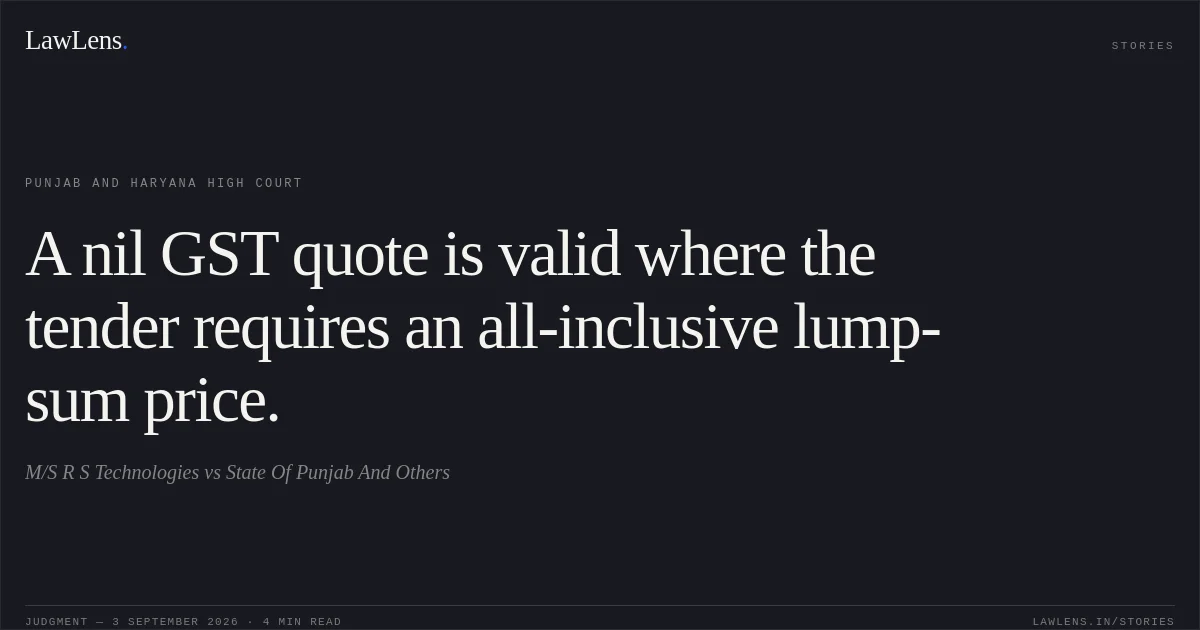
Source reference: p.4, para. 8Since the pre-bid process had clarified that the lump-sum final rate inclusive of all taxes would determine the L1 comparison, the bid was not rendered non-responsive merely by the GST entry.
Source reference: p.4, para. 9The decision in Roche Diagnostics was distinguishable because its prescribed bid format required separate GST disclosures, unlike the present tender.
Source reference: p.4, para. 9On Rule 144(xi), the Court found that both bidders had offered machines manufactured in Switzerland and that the relevant OEMs had no connection with countries sharing a land border with India; accordingly, the rule was factually inapplicable in any event, apart from not extending by its own force to the State Corporation.
Source reference: p.5, para. 10The petitioner had participated in the tender and pre-bid meeting without raising these objections and approached the Court only after the financial bids revealed the private respondent to be L1, attracting the principles of delay and laches.
Source reference: p.6, para. 11Given the specialized nature of the procurement and the public-health implications of disrupting the tender, no ground for judicial interference was established.
Source reference: p.6, para. 12Holding
The Court answered the issues against the petitioner. It held that the successful bidder’s GST entry of “nil” did not invalidate the financial bid, that Rule 144(xi) of the GFR, 2017 did not disqualify the bidder or apply to the State procurement in the circumstances, and that the tender award did not suffer from arbitrariness, illegality, irrationality or mala fides.
The writ petition challenging the Letter of Intent dated 13 November 2024 was dismissed, with no order as to costs; all pending miscellaneous applications were also disposed of.
Source reference: p.7, paras. 13–14Acts & Sections Cited
1 provisions across 1 statute referred to in this judgment. Linked provisions open on LawLens.
Tender Document1
Original Court PDF
M/S R S TechnologiesvsState Of Punjab And Others
Click to open original judgment
Original judgment, available to read, download and summarize on LawLens.in