Facts
The petitioner, Sarpanch of Kharsanmal Gram Panchayat, challenged the notice dated 12 January 2026 convening a meeting to consider a no-confidence motion against her under Section 24 of the Orissa Gram Panchayats Act, 1964.
Source reference: para. 1The motion was initiated on the basis of a resolution dated 17 December 2025 and a requisition dated 5 January 2026 submitted by the Naib-Sarpanch and other Ward Members.
Source reference: paras. 1–2The petitioner alleged procedural irregularities, particularly that the resolution appeared to have been signed by the Naib-Sarpanch on 5 January 2026 despite being dated 17 December 2025.
Source reference: para. 7By an interim order dated 2 February 2026, the High Court permitted the meeting to be held but restrained publication of its result without the Court’s leave.
Source reference: paras. 3–4The Block Development Officer verified the original proceedings and reported that the signatures of the Ward Members and Naib-Sarpanch were genuine and tallied with those on the resolution.
Source reference: paras. 7–8They further contended that, even excluding the Naib-Sarpanch’s signature, nine other Ward Members had signed the requisition, which exceeded the statutory minimum.
Source reference: paras. 8, 8-AThe petitioner filed no reply to these assertions.
Source reference: para. 8-BIssues
Whether the alleged discrepancy between the date of the no-confidence resolution and the date appearing alongside the Naib-Sarpanch’s signature invalidated the resolution and the consequential notice convening the no-confidence meeting.
Source reference: paras. 2, 7–10Whether the requisition and proposed resolution complied with the procedural requirements under Section 24(2) of the Orissa Gram Panchayats Act, 1964.
Source reference: paras. 1–2, 8, 8-AWhether the High Court should interfere under Articles 226 and 227 of the Constitution with the proposed no-confidence proceedings.
Source reference: para. 10Law Applied
The Court applied Section 24 of the Orissa Gram Panchayats Act, 1964, which governs no-confidence motions against a Sarpanch or Naib-Sarpanch.
Source reference: pp. 2–4Under Section 24(2)(a), a meeting may be convened only upon a requisition signed by at least one-third of the total membership of the Gram Panchayat and accompanied by a copy of the proposed resolution.
Source reference: pp. 2–4The Court also relied on the Full Bench decision in Nabanita Kapat Patra v. Collector, Kandhamal, 2025 SCC OnLine Ori 4218, which settled the legal position concerning the manner of initiating and conducting a no-confidence motion.
Source reference: pp. 11–12; para. 9The Court further proceeded on the principle that writ interference was unwarranted where no substantive statutory infirmity was established.
Source reference: para. 10Reasoning
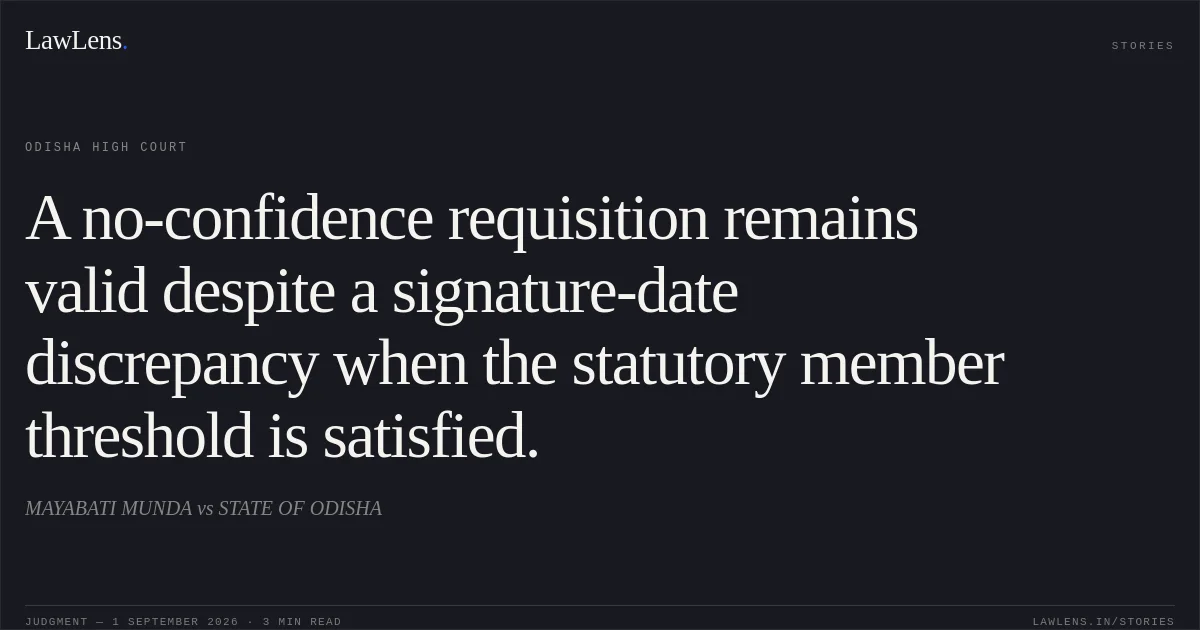
The Court rejected the petitioner’s challenge based principally on the explanations in the counter-affidavits that the date appearing beside the Naib-Sarpanch’s signature represented the date of submission of the resolution and requisition, not necessarily the date on which the resolution was passed.
Source reference: paras. 8, 8-AThis explanation was supported by the BDO’s verification report, which found the signatures in the original proceedings register to be genuine and consistent with those on the submitted resolution.
Source reference: paras. 7–8In any event, the Court noted that nine other Ward Members had signed the requisition, and their signatures were undisputed; therefore, even excluding the Naib-Sarpanch, the statutory threshold under Section 24(2)(a) was satisfied.
Source reference: paras. 8, 8-AThe petitioner did not controvert these factual assertions.
Source reference: para. 8-BApplying the principles in Nabanita Kapat Patra, the Court held that no legally material defect in the initiation or convening of the no-confidence proceedings had been demonstrated so as to justify interference in writ jurisdiction.
Source reference: para. 10Holding
The High Court held that the no-confidence proceedings against the petitioner were not shown to suffer from any statutory or procedural infirmity.
The writ petition was dismissed as devoid of merit.
Source reference: para. 10The interim order restraining publication of the result was vacated.
Source reference: para. 11The Court permitted the result of the no-confidence motion, if the meeting had been held, to be declared and consequential steps to be taken in accordance with the Orissa Gram Panchayats Act, 1964.
Source reference: para. 12The petition was accordingly disposed of without costs.
Source reference: para. 13Acts & Sections Cited
2 provisions across 1 statute referred to in this judgment. Linked provisions open on LawLens.
Orissa Grama Panchayats Act, 19642
Original Court PDF
MAYABATI MUNDAvsSTATE OF ODISHA
Click to open original judgment
Original judgment, available to read, download and summarize on LawLens.in