Facts
Rohit Kumar Yadav, aged 31 years, serving as a Corporal in the Indian Air Force, died in a motor-vehicle accident on 10 July 2000 due to the rash and negligent driving of Bus No. RJ-18-P-611 by respondent No. 2, owned by respondent No. 1 and insured with respondent No. 3.
Source reference: no citationHis widow and minor son filed a claim petition under the Motor Vehicles Act.
Source reference: no citationThe Motor Accident Claims Tribunal, Gurgaon, awarded ₹9,45,000 with interest at 9% per annum from the date of filing of the claim petition until realization.
Source reference: para. 3The Tribunal’s finding on negligence was not challenged by the respondents and therefore was not interfered with in appeal.
Source reference: para. 8The record of the appeal and Tribunal had been destroyed in a fire, and the High Court decided the appeal on the basis of the facts and evidence recorded in the impugned award.
Source reference: para. 1The claimants appealed seeking enhancement, contending that the deceased’s income had been assessed incorrectly, future prospects had not been added, and appropriate amounts had not been awarded under the conventional heads.
Source reference: para. 9Issues
Whether the deceased’s monthly income had been correctly assessed by the Tribunal, including the allowances forming part of his salary and the permissible deductions?
Source reference: paras. 12–13Whether future prospects, income-tax deduction, personal-expense deduction, and the appropriate multiplier had been correctly applied in calculating the loss of dependency?
Source reference: paras. 14–16Whether the claimants were entitled to enhanced compensation under the heads of spousal consortium, parental consortium, loss of estate, and funeral expenses?
Source reference: para. 17What enhanced compensation and consequential directions should be granted to the appellants?
Source reference: para. 19Law Applied
The Court applied the principle of “just compensation” under the Motor Vehicles Act, holding that compensation must be based on objective data and settled principles and must neither be arbitrary nor become a source of profit or windfall, as explained in Syed Basheer Ahamed v. Mohd. Jameel.
Source reference: para. 11Under Sarla Verma v. Delhi Transport Corporation, the appropriate multiplier and deduction for personal expenses are determined with reference to the deceased’s age and number of dependants; accordingly, a multiplier of 16 and a one-third deduction were applicable.
Source reference: para. 16Under National Insurance Co. Ltd. v. Pranay Sethi, a salaried deceased below 40 years of age was entitled to 50% addition for future prospects, together with compensation under conventional heads such as consortium, loss of estate, and funeral expenses.
Source reference: paras. 14, 17Magma General Insurance Co. Ltd. v. Nanu Ram and United India Insurance Co. Ltd. v. Satinder Kaur supported an award for parental consortium in favour of the deceased’s son.
Source reference: para. 17Reasoning
The Court accepted the service and salary records showing a monthly salary of ₹7,705.
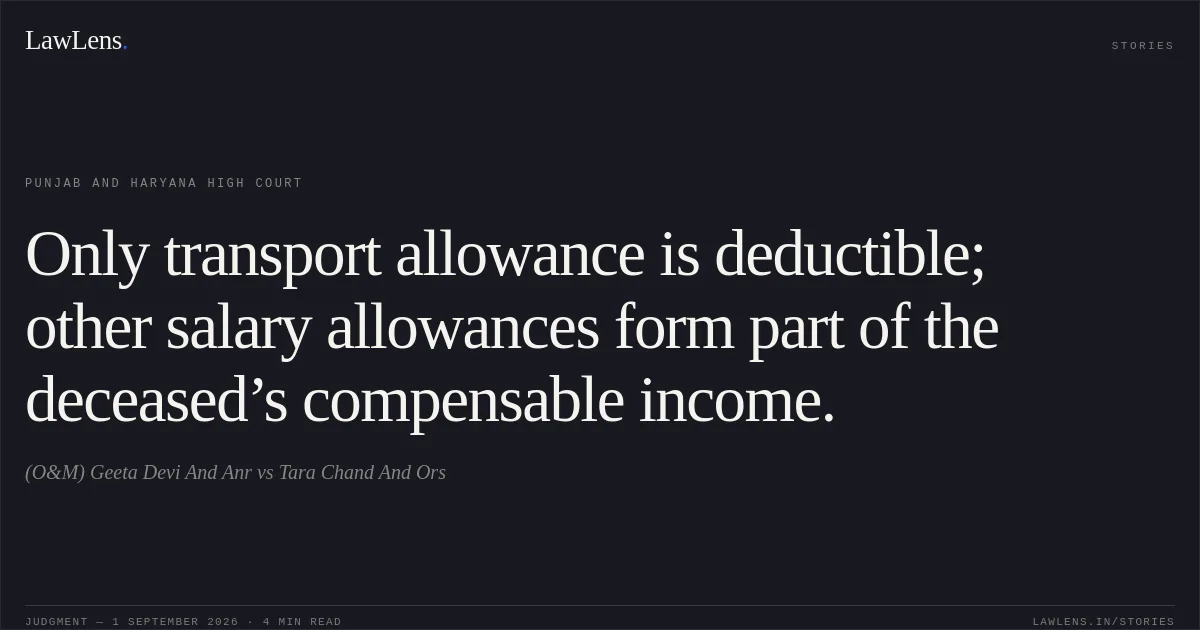
Source reference: no citationIt held that only the transport allowance of ₹75 was liable to be deducted; the maintenance, leave-ration, and other allowances formed part of the deceased’s income.
Source reference: para. 13The monthly income was therefore fixed at ₹7,630.
Source reference: para. 13Since the deceased was 31 years old and in permanent service, 50% was added towards future prospects, resulting in a monthly income of ₹11,445.
Source reference: para. 14After deducting ₹300 towards income tax, the net income was ₹11,145.
Source reference: para. 14As the deceased left behind two dependants, one-third was deducted towards personal expenses, producing a monthly loss of dependency of ₹7,430 and an annual loss of ₹89,160.
Source reference: para. 15Applying the multiplier of 16, the loss of dependency came to ₹14,26,560.
Source reference: paras. 15–16The Court further awarded ₹70,000 to the widow under the conventional heads—₹40,000 for loss of consortium, ₹15,000 for loss of estate, and ₹15,000 for funeral expenses—and ₹40,000 to the son for loss of parental consortium.
Source reference: para. 17The total compensation was consequently recalculated at ₹15,36,560, rounded off to ₹15,36,500.
Source reference: para. 18Holding
The appeal was partly allowed with costs.
The total compensation was enhanced from ₹9,45,000 to ₹15,36,500, resulting in enhanced compensation of ₹5,91,500, with interest at 9% per annum from 9 August 2000, the date of filing of the claim petition, until realization.
Source reference: para. 19Respondents No. 1 to 3 were held jointly and severally liable, with the primary responsibility placed on the Insurance Company to satisfy the award.
Source reference: para. 19Out of the enhanced amount, ₹1,50,000 with proportionate interest was directed to be paid to claimant No. 2, the deceased’s son, and the balance to claimant No. 1, the widow, with proportionate interest.
Source reference: para. 19The Registry was also directed to email the authenticated judgment to the Insurance Company in accordance with the directions in Bajaj Allianz General Insurance Co. v. Union of India.
Source reference: para. 20Original Court PDF
(O&M) Geeta Devi And AnrvsTara Chand And Ors
Click to open original judgment
Original judgment, available to read, download and summarize on LawLens.in