Facts
M/s. Neesa Leisure Limited had obtained financial assistance from the Industrial Finance Corporation of India (IFCI), under an arrangement permitting IFCI to appoint a nominee director on the company’s board.
Source reference: paras. 3–3.1; pp. 2–3The applicant, an IFCI officer, was appointed as such nominee director on 3 December 2010 and claimed to have ceased holding that office on 30 January 2014.
Source reference: paras. 3–3.1; pp. 2–3The Company Law Board (CLB), by order dated 29 March 2014, directed the company to repay deposits and interest to depositors within 30 days and warned that penal provisions under Section 58A(10) of the Companies Act, 1956 would be enforced against the Managing Director or concerned officers in case of default.
Source reference: para. 5.1; pp. 5–6The Registrar of Companies filed Criminal Case No. 7263 of 2014 against the company and its directors, including the applicant, alleging violation of the CLB’s order under Sections 58A(9) and 58A(10) of the Companies Act, 1956.
Source reference: paras. 1–2.1; pp. 1–2The applicant invoked Section 482 Cr.P.C. seeking quashing of the complaint, the order issuing process dated 4 August 2014, and all consequential proceedings.
Source reference: paras. 3.1–3.3; pp. 2–3Issues
Whether a nominee director appointed by IFCI, who was not involved in the company’s day-to-day affairs or deposit-related transactions, could be prosecuted for breach of the CLB’s repayment order under Sections 58A(9) and 58A(10) of the Companies Act, 1956.
Source reference: paras. 5.1–5.3; pp. 5–7Whether the criminal complaint and consequential proceedings disclosed the applicant’s criminal liability notwithstanding his asserted cessation from office before the CLB’s order.
Source reference: paras. 3.1, 4.1, 5.1–5.3; pp. 2–4, 5–7Whether the High Court should exercise its inherent jurisdiction under Section 482 Cr.P.C. to quash the proceedings against the applicant.
Source reference: para. 1; p. 1Law Applied
The Court applied Section 482 Cr.P.C., which empowers the High Court to quash criminal proceedings where continuation would be unjustified or where the allegations do not disclose the requisite criminal liability.
Source reference: para. 1; p. 1It considered Sections 58A(9) and 58A(10) of the Companies Act, 1956, under which defaults concerning company deposits and non-compliance with directions relating to repayment may attract penal consequences against the company’s Managing Director or concerned responsible officers.
Source reference: paras. 2.1, 5.1; pp. 2, 5–6The Court also applied Section 25(2) and (3) of the Industrial Finance Corporation Act, 1948: a nominee director appointed pursuant to an IFCI financing arrangement is validly appointed notwithstanding contrary provisions, and such director does not incur liability merely by reason of being a director or for acts or omissions done in good faith in discharge of directorial duties.
Source reference: para. 5.1; pp. 5–6Section 25(3)(a) further recognises that such a nominee director holds office during the pleasure of the Corporation.
Source reference: para. 5.1; p. 5The Court also referred to Section 26 of the IFCI Act concerning restrictions on acceptance of deposits.
Source reference: para. 5.2; p. 6Reasoning
The Court found that the applicant’s appointment was made by IFCI pursuant to a financing arrangement and that the materials described him as a nominee, independent and non-executive director.
Source reference: paras. 5.1–5.2; pp. 5–6Under Section 25(3) of the IFCI Act, mere status as an IFCI nominee director did not impose criminal liability, particularly where the alleged default concerned the company’s failure to repay deposits pursuant to the CLB’s order.
Source reference: paras. 5.1–5.2; pp. 5–6The complaint did not attribute to the applicant any role in inviting deposits, receiving or retaining depositors’ money, failing to repay the amounts, or managing the company’s day-to-day affairs.
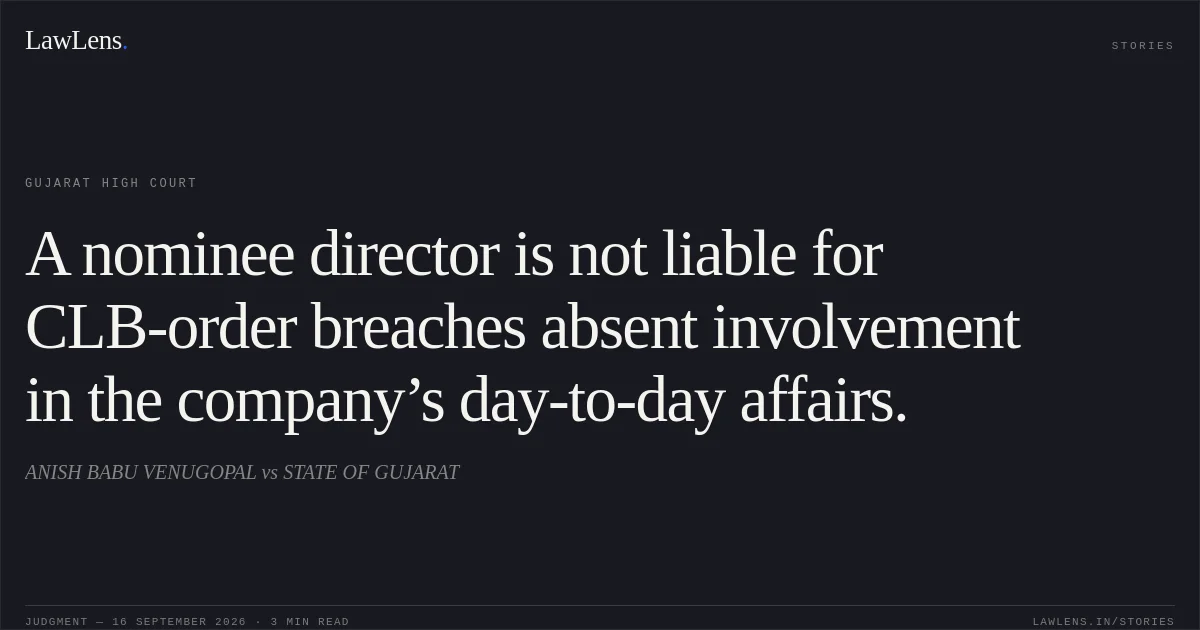
Source reference: para. 5.3; p. 7The Court therefore held that all directors could not automatically be made liable for the company’s breach, and that the applicant’s nominee-director status, coupled with the absence of specific allegations or an overt act, was insufficient to sustain the prosecution.
Source reference: paras. 5.2–5.3; pp. 6–7The Court consequently considered continuation of the proceedings against him unwarranted and exercised its inherent jurisdiction under Section 482 Cr.P.C.
Source reference: para. 5.3; p. 7Holding
The Court answered the issues in favour of the applicant.
It held that the applicant, being an IFCI nominee/non-executive director with no alleged involvement in the company’s deposit activities or day-to-day management, could not be held criminally liable merely because he had been shown as a director or had been associated with the company.
Source reference: paras. 5.2–5.3; pp. 6–7Criminal Case No. 7263 of 2014, the order dated 4 August 2014 passed below Exh. 1, and all prior and subsequent proceedings were quashed and set aside insofar as they concerned the applicant.
Source reference: para. 6; p. 7The application was allowed to that extent and the Rule was made absolute.
Source reference: para. 7; p. 7Acts & Sections Cited
1 provisions across 1 statute referred to in this judgment. Each provision opens on LawLens.
Code of Criminal Procedure, 19731
Original Court PDF
ANISH BABU VENUGOPALvsSTATE OF GUJARAT
Click to open original judgment
Original judgment, available to read, download and summarize on LawLens.in