01Facts
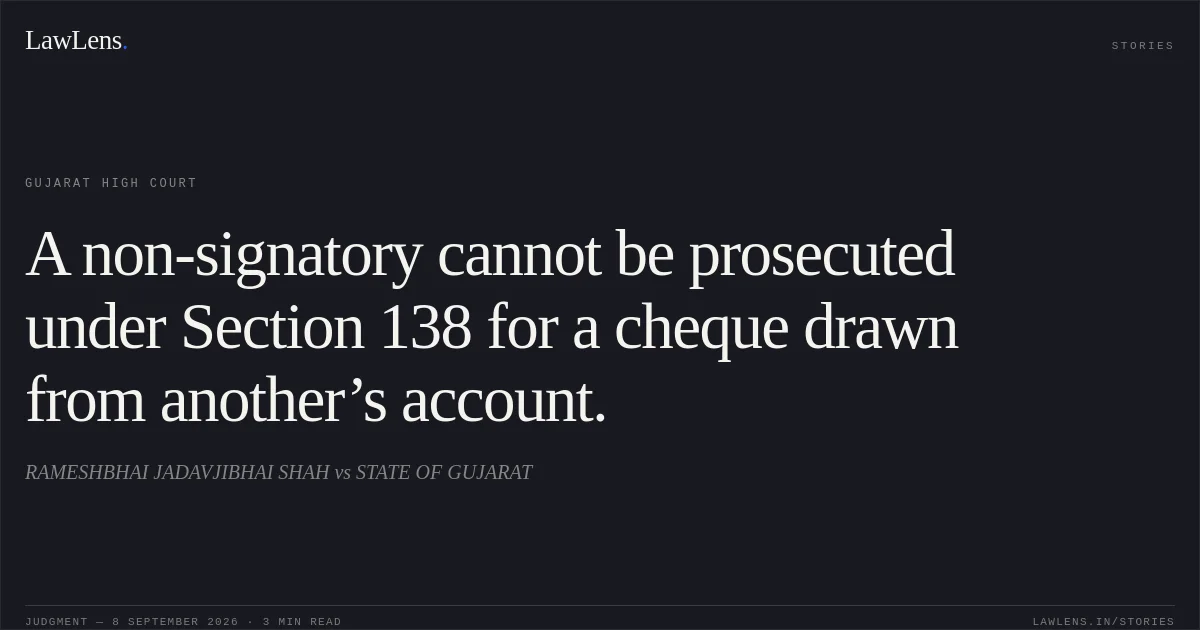
The applicant and his son, Devangbhai Rameshbhai Shah, allegedly obtained a loan of ₹25,00,000 from the complainant. In relation to the alleged loan, Devangbhai issued cheque No. 21285 dated 17 October 2018, drawn on his personal Axis Bank account. The cheque was dishonoured for insufficiency of funds, and the complainant thereafter issued a statutory demand notice.
¶ 3.1The applicant replied that he had not entered into any transaction with the complainant, that the cheque had been issued by his son from the son’s personal account, and that he had no knowledge of it. He also stated that his son had been missing since 1 October 2018 and that a missing-person complaint had been lodged with the police on 6 October 2018. Despite this, the complainant filed Criminal Case No. 3404 of 2018 under Section 138 of the Negotiable Instruments Act, 1881, arraigning the applicant as a co-accused. The applicant invoked Section 482 of the Code of Criminal Procedure, 1973, seeking quashing of the complaint and consequential proceedings.
¶ 3.2 · ¶ 202Issues
i.Whether proceedings under Section 138 of the Negotiable Instruments Act could be maintained against the applicant when he was neither the signatory to the dishonoured cheque nor the holder of the bank account on which it was drawn.
¶ 4, 6ii.Whether the complaint and subsequent proceedings against the applicant warranted quashing under Section 482 of the Code of Criminal Procedure, 1973.
¶ 2, 703Law Applied
Section 138 of the Negotiable Instruments Act, 1881, requires, inter alia, that the dishonoured cheque be drawn by a person on an account maintained by that person; criminal liability under the provision cannot ordinarily be imposed on a non-signatory merely because of his relationship with or alleged joint involvement with the drawer.
¶ 6The High Court may exercise its inherent jurisdiction under Section 482 of the Code of Criminal Procedure, 1973, to prevent abuse of process where the foundational ingredients of the alleged offence are absent. The Court relied on Jugesh Sehgal v. Shamsher Singh Gogi, (2009) 14 SCC 683, for the principle that Section 138 is not attracted where the cheque was neither drawn by the accused nor issued from an account maintained by the accused.
¶ 2 · ¶ 4.1Provisions in the judgment · 2 · Linked ones open on LawLens
Code of Criminal Procedure, 1973 Section 482
Negotiable Instruments Act, 1881 Section 138
04Reasoning
The documentary material showed that the cheque was issued and signed by Devangbhai from his personal Axis Bank account, not by the applicant. Accordingly, the essential statutory requirement that the cheque must be drawn by the accused on an account maintained by him was not satisfied in relation to the applicant.
¶ 6The Court held that the applicant’s alleged status as the drawer’s father, or the prosecution’s assertion that the loan had been jointly obtained, could not substitute for the statutory requirement of being the drawer or account holder under Section 138. Since the basic ingredients of the offence were absent against the applicant, continuation of the prosecution would not be justified.
¶ 5–605Holding
The Court answered the issues in favour of the applicant. It held that the Section 138 proceedings could not continue against a person who was neither the signatory to the cheque nor the holder of the relevant bank account.
¶ 6Exercising jurisdiction under Section 482 of the Code of Criminal Procedure, the Court allowed the application and quashed Criminal Case No. 3404 of 2018, pending before the Additional Chief Judicial Magistrate, Patan, under Section 138 of the Negotiable Instruments Act, together with all consequential proceedings, insofar as they related to the applicant. Rule was made absolute to that extent.
¶ 7–8Original Court PDF
RAMESHBHAI JADAVJIBHAI SHAHvsSTATE OF GUJARAT
Click to open original judgment
Original judgment, available to read, download and summarize on LawLens.in