01Facts
The petitioners sought release and restoration of approximately 2.98 acres comprised in Plot Nos. 2055, 2124, 2068, 2281 and 2882, situated at Village Nagri, District Ranchi, which formed part of Land Acquisition Case No. 21 of 1957–58.
pp. 2–4The land measuring approximately 202.07 acres had been acquired for Birsa Agriculture College, Kanke, after initiation of proceedings under the Land Acquisition Act, 1894.
pp. 2–4The petitioners claimed that the land was recorded in the names of their ancestors, that they remained in possession, and that revenue rent receipts continued to be issued in their favour.
pp. 2–4The writ petition was filed in 2014, approximately 66 years after the acquisition proceedings commenced.
p. 4, 11The Court also noted that the petitioners had not established their relationship with the original awardees or furnished a genealogy.
p. 9, 1402Issues
i.Whether the petitioners were entitled to a direction under Article 226 of the Constitution for release and restoration of the acquired land on the ground that it had not been used for the original purpose for which it was acquired?
pp. 2–4, 10–14ii.Whether the acquired land could be returned after completion of acquisition, payment of compensation, and vesting of the land in the State?
pp. 5–8, 11–13iii.Whether the writ petition was liable to be dismissed on account of gross delay, disputed questions of title and succession, and failure to establish that the petitioners were the legal heirs of the original awardees?
pp. 4–5, 9, 1403Law Applied
The Court applied Sections 4, 5-A, 16, 17, 34 and 48 of the Land Acquisition Act, 1894.
pp. 5–8, 11–13Under Section 16, once possession is taken after an award, the land vests absolutely in the Government free from all encumbrances; under Section 48, withdrawal from acquisition is permissible only where possession has not been taken.
pp. 5–8, 11–13Relying on Government of A.P. v. Syed Akbar, 2005 (1) SCC 558, and State of Kerala v. M. Bhaskaran Pillai, (1997) 5 SCC 432, the Court held that acquired land cannot ordinarily be reconveyed to the erstwhile owners merely because it remains unused for the original public purpose; it may instead be used for another public purpose or dealt with through public auction.
pp. 5–8, 11–13Relying on Satendra Prasad Jain v. State of U.P., (1993) 4 SCC 369, the Court reiterated that possession and vesting prevent withdrawal from acquisition.
pp. 5–8, 11–13The Court also relied on Indore Development Authority v. Manoharlal, (2020) 8 SCC 129, particularly the principles that taking possession and payment of compensation prevent lapse or divesting of acquired land.
pp. 5–8, 11–13A writ court under Article 226 will not ordinarily adjudicate disputed questions of title, succession or genealogy, particularly where the claim is brought after substantial delay.
pp. 4–5, 9, 14Provisions in the judgment · 2 · Linked ones open on LawLens
Right to Fair Compensation and Transparency in Land Acquisition, Rehabilitation and Resettlement Act, 2013 Section 24
General Clauses Act, 1897 Section 21
04Reasoning
The Court found that acquisition of the plots in question under Land Acquisition Case No. 21 of 1957–58 was not disputed and was supported by the State’s records and the Circle Officer’s report.
p. 10The Court accepted the respondents’ case that an award had been passed and compensation had been paid to the original awardees.
pp. 10–13Consequently, the land had vested in the State and could not be restored merely because Birsa Agriculture University did not ultimately use it for the precise purpose stated in the acquisition proceedings.
pp. 7–8, 13–14Its subsequent use for the National University of Study and Research in Law and the Ring Road constituted use for public purposes, consistent with the principles in Bhaskaran Pillai.
pp. 7–8, 13–14The Court further held that the petitioners had approached the Court after an unexplained delay of approximately 66 years and had failed to demonstrate that they were the legal heirs or successors of the original awardees.
p. 9, 14The absence of a genealogy and the existence of disputed questions concerning title and succession made the claim unsuitable for adjudication in a writ proceeding.
p. 9, 14The Commissioner’s recommendation for release of the land did not override the completed acquisition or confer any enforceable right of re-conveyance.
p. 4, 1005Holding
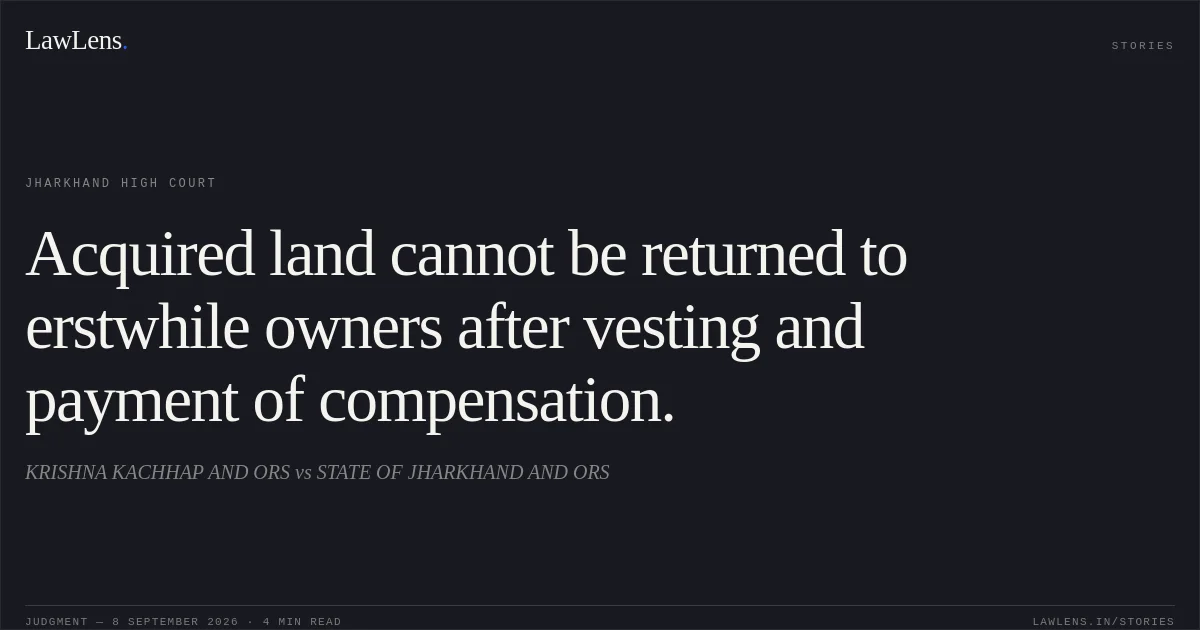
The Court held that the petitioners were not entitled to release or restoration of the land.
¶ 14–16 · p. 14Since the acquisition had been completed, compensation had been paid, and the land had vested in the State, it could not be returned merely because it was not used by the original requisitioning authority.
¶ 14–16 · p. 14The petitioners’ unexplained delay and failure to establish their succession to the original awardees independently disentitled them to relief under Article 226.
¶ 14–16 · p. 14Accordingly, W.P.(C) No. 4590 of 2014 was dismissed, and any pending interlocutory application was also disposed of.
¶ 14–16 · p. 14Original Court PDF
KRISHNA KACHHAP AND ORSvsSTATE OF JHARKHAND AND ORS
Click to open original judgment
Original judgment, available to read, download and summarize on LawLens.in