Facts
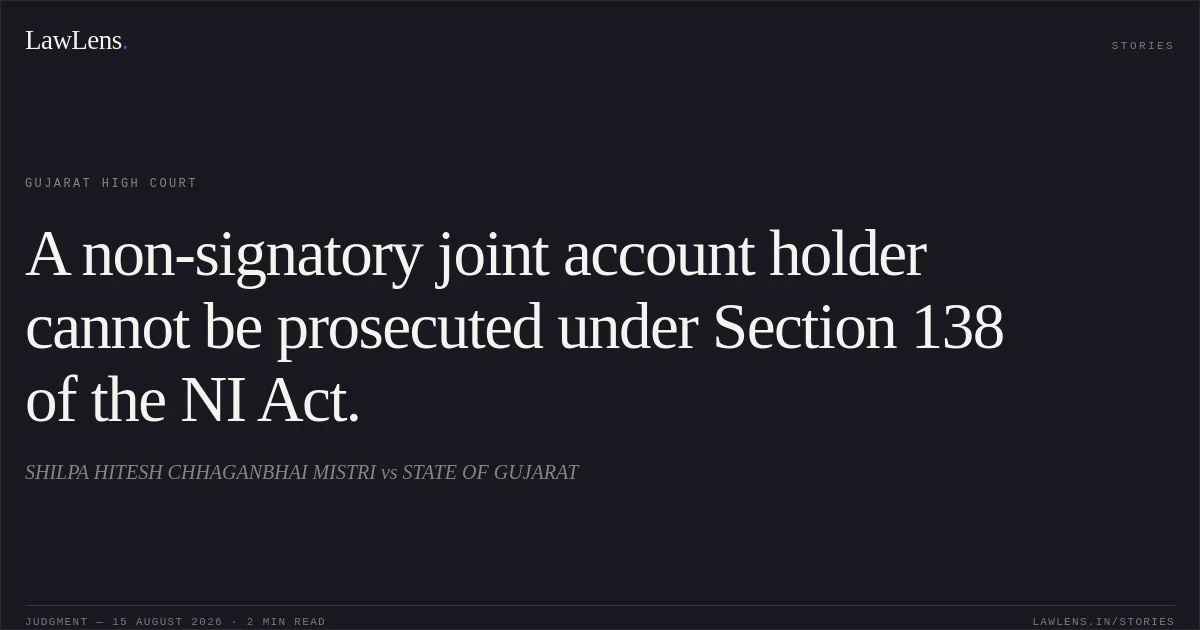
The applicant sought quashing of proceedings arising from a complaint under Section 138 of the Negotiable Instruments Act, 1881, in which she was arraigned as a co-accused.
Source reference: p.2She contended that she was only a joint account-holder with her husband, that the dishonoured cheque was signed solely by her husband, and that the complaint contained no allegation against her apart from describing her as his wife.
Source reference: p.2On examining the complaint and the cheque, the Court found that the applicant had not signed the cheque and that her husband alone was its signatory.
Source reference: pp.3–6Issues
1. Whether a joint account-holder who has not signed the dishonoured cheque can be prosecuted under Section 138 of the Negotiable Instruments Act, 1881.
Source reference: pp.3–62. Whether the proceedings against the applicant, based only on her being the wife and joint account-holder of the cheque’s signatory, amounted to an abuse of the process of law.
Source reference: pp.2, 5–6Law Applied
The Court applied Section 138 of the Negotiable Instruments Act, 1881, under which liability for dishonour is primarily attributable to the drawer of the cheque.
Source reference: no citationRelying on Aparna A. Shah v. Sheth Developers Pvt. Ltd., (2013) 8 SCC 71, the Court held that only the person who has drawn and signed the cheque can ordinarily be prosecuted under Section 138; a joint account-holder who has not signed the cheque cannot be prosecuted merely because the cheque was issued from a joint account.
Source reference: pp.3–5The Supreme Court further held that, in the case of a joint account, a joint holder cannot be prosecuted unless the cheque has been signed by each joint account-holder; Section 141 of the NI Act does not extend such liability in an individual joint-account situation.
Source reference: pp.3–5Reasoning
The complaint contained no specific allegation attributing the issuance or signing of the cheque to the applicant; it relied only on her relationship with accused No.1 and her status as a joint account-holder.
Source reference: pp.2–4The cheque itself showed that the applicant had not signed it and that her husband was the sole signatory.
Source reference: pp.4–5Applying the rule in Aparna A. Shah, the Court concluded that the statutory culpability under Section 138 could not be extended to the applicant merely because the cheque was drawn on a joint account.
Source reference: pp.5–6Her non-signatory status therefore removed the essential basis for prosecution under Section 138, making continuation of the proceedings against her an abuse of process.
Source reference: pp.5–6Holding
The Court answered the issues in favour of the applicant.
It held that a non-signing joint account-holder cannot be prosecuted under Section 138 of the NI Act solely on the basis of joint account ownership or marital relationship with the drawer.
Source reference: pp.6–7The application was allowed, the rule was made absolute, and the proceedings under Section 138 against the applicant were quashed.
Source reference: pp.6–7Acts & Sections Cited
4 provisions across 3 statutes referred to in this judgment. Each provision opens on LawLens.
Negotiable Instruments Act, 18812
Code of Criminal Procedure, 19731
Indian Penal Code, 18601
Original Court PDF
SHILPA HITESH CHHAGANBHAI MISTRIvsSTATE OF GUJARAT
Click to open original judgment
Original judgment, available to read, download and summarize on LawLens.in